




Japan’s seafood exports to China plummeted in 2023, dislocating the country’s ambitious plans for export growth. In response, the Japanese government and seafood industry have scrambled to quickly find new markets and processing channels.
China imposed a total ban on seafood imports from Japan in August 2023 following Japan’s discharge into the ocean of treated radioactive water from the Fukushima Daiichi nuclear plant; limited exports to Hong Kong have continued.
As a result, in fiscal year 2023, Japanese seafood exports to China plummeted 57 percent from the previous year – from JPY 74.6 billion (USD 474.8 million, EUR 437.5 million) to JPY 32 billion (USD 203.7 million, EUR 187.6 million). Japan's overall exports in the seafood category, which includes not only fish and shellfish but also pearls, coral, and ornamental fish, fell 17 percent from FY 2022 to JPY 218.5 billion (USD 1.39 billion, EUR 1.28 billion) in FY 2023. The U.S. also overtook China as Japan’s biggest seafood customer in the period.
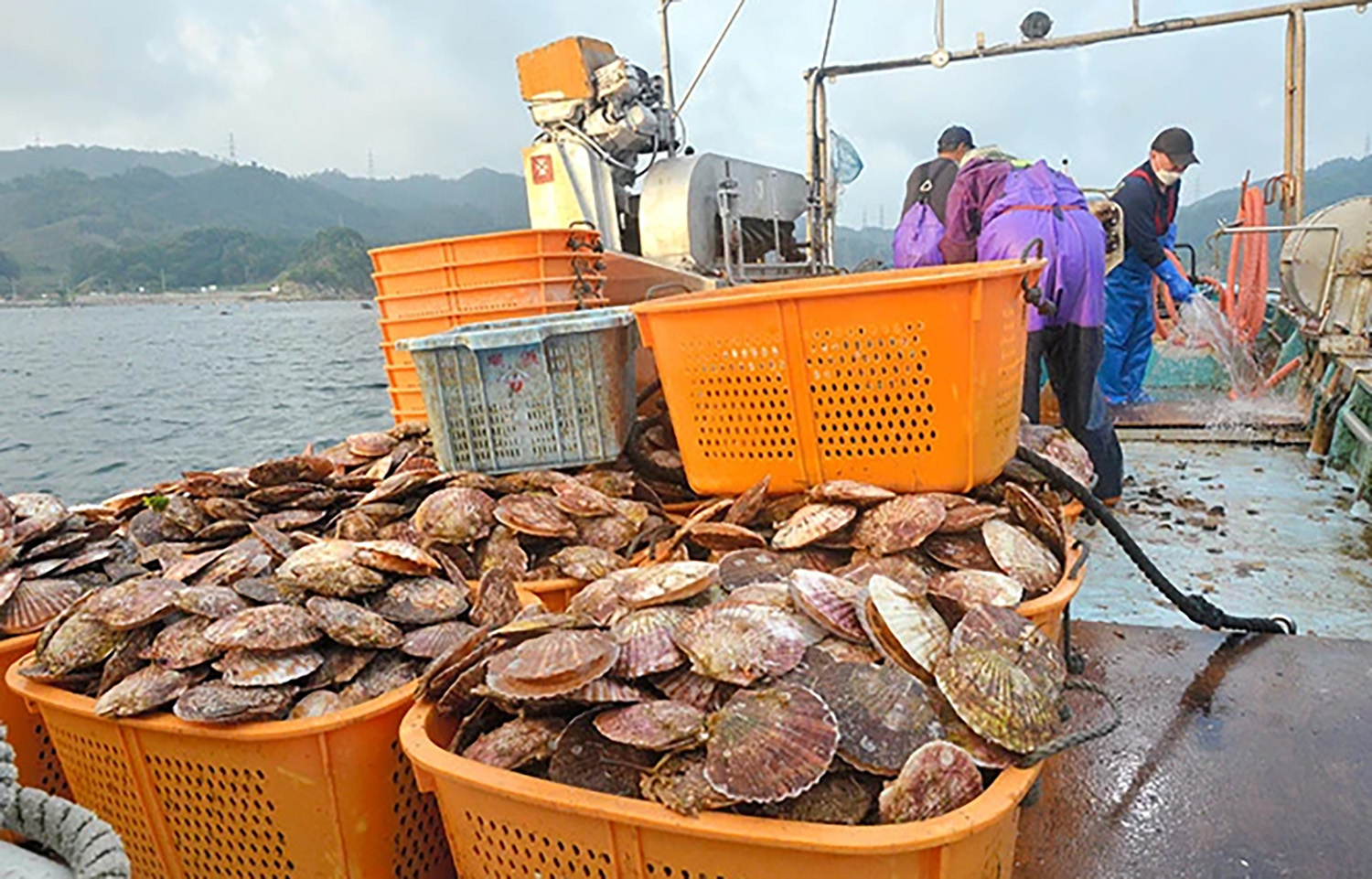
The loss of the Chinese market has created two huge problems for Japanese scallop suppliers in particular: replacing its largest market and finding new locations to process scallops for export, as Chinese processors were, prior to the ban, handling about USD 100 million worth (EUR 93.3 million) of scallops destined for export to the U.S. market annually due to a lack of labor in Japan, among other reasons.
To combat the first issue, various organizations have been aggressively promoting Japanese scallops around the globe. For example, JFOODO, an affiliate of the Japan External Trade Organization (JETRO), ran a campaign in America on CNN that promoted scallops and other fishery products from Japan. And in January 2024, Japan’s Ministry of Agriculture, Forestry, and Fisheries (MAFF) held a tasting event in Sao Paulo, Brazil, for around 100 people in the restaurant, food distribution, and related industries to promote scallops and other fishery products, with the event marking the first time Brazil has imported scallops directly from Japan.
Additionally, the Japan Scallop Export Promotion Association (J-Hotate) has promoted scallops at trade shows since the import ban, including at Seafood Expo Asia in Singapore in September 2023 and at Seafood Expo Global in Barcelona, Spain, in April 2024.
To overcome the processing issue, producers needed to find facilities that have obtained HACCP certification and ones that are registered with the U.S. Food and Drug Administration in order to maintain sales with the U.S. U.S. officials have helped Japan to identify approved facilities in Taiwan, Thailand, and Vietnam, and thanks to these efforts, in February 2024, the amount of in-shell frozen scallops exported for reprocessing rose by 31 percent year over year from the same month in 2023 to 2,033 MT, primarily going to Vietnam and Thailand.
JETRO, meanwhile, has been developing a new processing hub in Ensenada, Mexico. In March, representatives of 14 Japanese companies visited three plants in Ensenada to observe trial processing: Baja Marine Foods, Atenea en el Mar, and Productos Marinos ABC, all of which align with the FDA’s Interstate Certified Shellfish Shippers List. Though the three plants had not previously processed scallops, Jetro said “the workers who tried to peel the shells seemed to be able to cope with it without difficulty," according to the Japan Times.
Showcasing the progress made in Mexico, JETRO also organized a meeting with U.S. distributors in Los Angeles, California, U.S.A., around 200 miles from Ensenada, bringing along scallops that had been processed just 24 hours earlier.
“We received market information that some high-end restaurants and supermarkets in the U.S. may not use or sell hydrogenated scallops,” Daisuke Shiga, the commercial promotion director for JETRO’s Mexico office, said. “Therefore, we thought that we should first take advantage of Mexico's proximity to the U.S. market and aim to develop refrigerated scallops that can be consumed raw by limiting the number of freezing times to once in Hokkaido. If scallops manufactured in Mexico can be made into dry scallops that can be eaten raw while retaining their umami and approaching new high-end American buyers, we see the possibility that Japanese scallops will lead to new sales channels.”
JETRO recently issued a report regarding the development of the new supply chain on 12 April, highlighting that Mexico’s tariff rate on scallops from Japan is being gradually reduced under the Comprehensive and Progressive Agreement for Trans-Pacific Partnership (CPTPP) to 6 percent in 2024, 4 percent in 2025, 2 percent in 2026, and 0 percent after 2027. Due to a bilateral economic partnership agreement between Japan and Vietnam, the latter’s tariff was already eliminated, providing additional promise for the scallop supply chain in multiple markets.
