




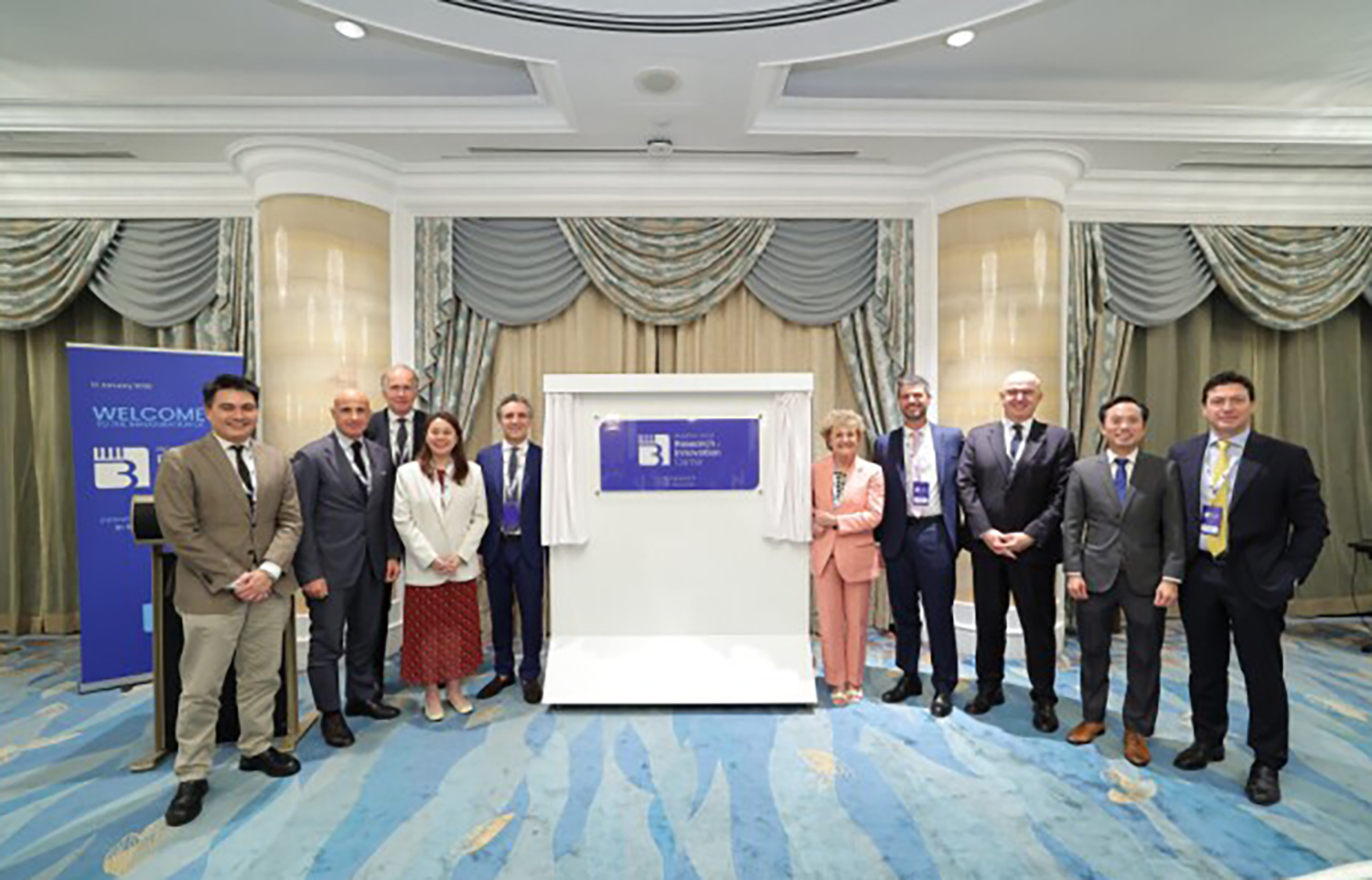
Milan, Italy-based consumer food product manufacturer Bolton Food has launched its first dedicated research and innovation (R&I) center in Singapore, calling it a strategic step to accelerate science-driven sustainability and innovation across its global seafood operations.
Inaugurated on 14 January , the Bolton Food R&I Center is a permanent, nonprofit platform focused on translating scientific research into practical solutions for the seafood industry. According to Bolton, the move reflects its ambition to move beyond partnership-led innovation alone and build in-house scientific capability to address resource efficiency, human health, and environmental challenges at scale.
Bolton Food Chief Sustainability Officer Luciano Pirovano said the new center fills a critical gap between research and real-world application. He told SeafoodSource that this will allow Bolton to “accelerate the innovation journey” through an allocation of resources dedicated to scaling solutions from laboratory research to industry application.
“At the same time, it will strengthen our ability to generate and develop our own scientific understanding and evidence on the role of seafood in sustainable nutrition and human health, creating value across the entire value chain,” he said.
The center, Pirovano explained, has been deliberately designed as an “agile, asset-light entity” to deliver quick results while avoiding unnecessary fixed investments. This will complement – rather than replace – Bolton’s existing partnerships with NGOs, research institutions, and industry bodies, thereby “providing a focused platform to translate research into impact,” he said.
One of the center’s core research pillars is adding value on fish products and identifying solutions that enable the extraction of high-value active ingredients present in byproducts. This is an area Pirovano said he believes holds significant untapped potential across the seafood sector.
The approach moves beyond the most common effort of “downcycling” side streams into low-value, commodity-driven products like fishmeal powder or fish crude oil, which aren’t maximizing the financial potential of byproducts, some of which lies even outside of the food sector.
“While some of the active ingredients are suitable for food application, others have strong potential in sectors such as cosmetics or pharmaceuticals,” Pirovano said.
The center’s other initial research areas include advancing scientific understanding of seafood’s role in human health and sustainable nutrition and developing solutions to reduce plastic use and marine plastic pollution.
As a vertically integrated player operating from “catch to can,” Bolton will aim to ensure that scientific outputs from the R&I Center translate into tangible operational change across fleets, processing plants, and branded products.
Research priorities have been defined in close collaboration with Bolton’s senior management, with the R&I team working cross-functionally with supply chain, operations, and commercial teams to ensure feasibility and scalability. Once solutions reach maturity, marketing and commercial teams will be brought in to bridge the gap between scientific innovation and branded, market-ready product launches.
Discoveries made through the center are expected to deliver both competitive advantages for Bolton and broader industry benefits. While some knowledge gained through the center will be protected, the facility is largely positioned as an open-innovation platform, with research results from collaborative projects intended for publication and wider knowledge-sharing.
“As one of the industry’s leaders, Bolton sees a natural responsibility to help guide best practices that can raise standards across the sector,” Pirovano said. “At the same time, openness will be promoted through the publication of research results generated in collaboration with partners, contributing to shared scientific knowledge and collective progress.”
Regarding the center’s location, Singapore was strategically selected due to its position as a leading global innovation hub in Southeast Asia, Pirovano explained, adding that it has strong R&D infrastructure, a skilled talent pool, and supportive innovation ecosystem, as evidenced by the backing provided by agencies such as Enterprise Singapore and the Singapore Economic Development Board (EDB).
Bolton also expects to have close collaborative relationships with local universities, research institutes, and agrifood tech startups to accelerate early outputs, particularly in high-value byproduct applications.
“This symbiotic relationship also helps to de-risk innovation and translates cutting-edge scientific evidence into operational reality efficiency,” Pirovano said.
Looking ahead, Bolton does not plan to measure the center’s success through a single metric. Instead, impact will be assessed through a balanced scorecard covering environmental, social, and economic outcomes.
“For every R&I solution implemented, the center will need to demonstrate tangible outputs, ensuring that scientific endeavors lead to holistic, long-term impact across the seafood value chain,” Pirovano said.
