




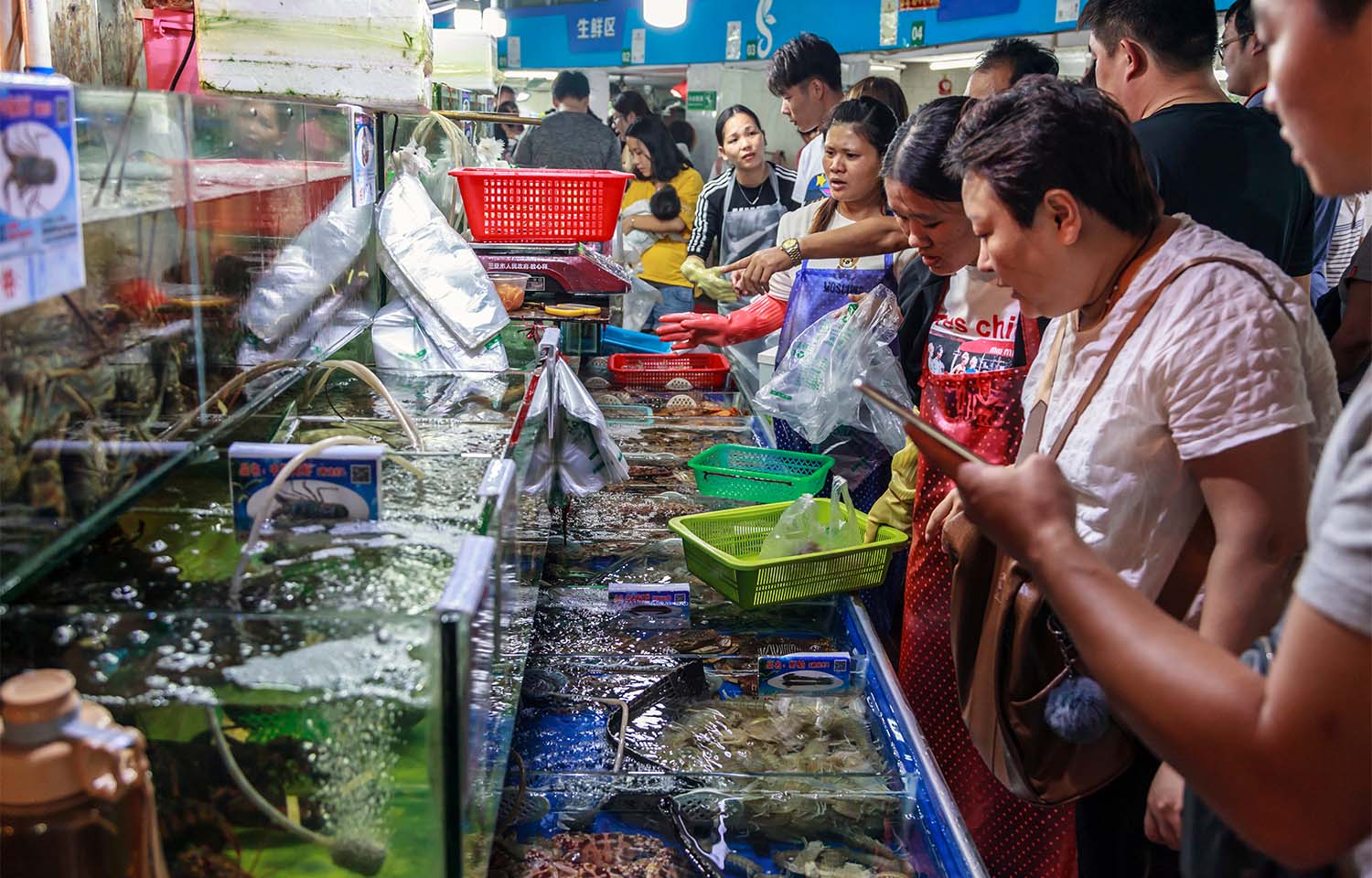
Softer prices for key imported seafood commodities like salmon and prawns prompted an uptick in consumption in China in the run up to Chinese New Year, but the longer-term outlook for the market is showing signs of weaker consumer sentiment and a contraction of high-end purchases.
Tony Fan is the representative for China at Australia-based Stehr Group – which sells farmed bluefin tuna to Chinese sushi restaurants. Fan also distributes salmon in China and told SeafoodSource sales of most species have largely been influenced by prices.
“The Chinese seafood market is not really strong; the only reason people buy is because the prices are cheaper,” he said. “Salmon sales are up 20 percent on last year, and the prices are a little better but not by much.”
Other premium species are also seeing an uptick in demand due to lower pricing, he said.
“King crab has been popular; they are much cheaper than two years ago,” Fan said.
Bluefin tuna has also seen some demand, and a ban on Japanese fish in mainland China has created demand for Mediterranean tuna.
“Malta, Croatia, and Turkey have all gotten access to the Chinese market to ship Mediterranean tuna,” Fan said.
Demand for Mediterranean bluefin tuna is coming from high-end Japanese-style restaurants in China, where tuna is fetching CNY 280 (USD 40.52, EUR 34.39) to CNY 300 (USD 43.41, EUR 36.84) per kilogram. By contrast, Australian tuna importers are aiming at the mid-range market, supplying mid-priced sushi chains.
Fan said he predicts 2026 will be worse than last year for consumer sentiment in China. Weaker consumer sentiment has already wreaked havoc on the high-end dining sector in cities like Beijing and Shanghai, he said.
“VIP fine dining demand is down a lot,” he said. “A lot of restaurants have closed; a lot of the high-end restaurants in particular.”
Demand for salmon is now coming more from retail, Fan said.
“More and more supermarkets are using salmon as a regular sashimi product,” he said.
Even as retailers focus on sales of high-end species like salmon, China remains a tough market for some exporters of packaged seafood products for the country’s supermarkets due to weak consumer sentiment.
“The past year has been quite tough for us,” said Suppachok Meesubwattana, sales director at Phillips Foods Asia, a subsidiary of the Maryland firm known for its packaged crab and lobster offerings.
She told SeafoodSource that volumes shipped by the company to Sam’s Club in China have been dropping in recent months, prompting the company to introduce new products in 2026. Last year, the company made a breakthrough when it started to supply Costco China; however, finding other buyers in China has been difficult.
“We’ve done a trial shipment and will continue to push more for this year. But as regards another customer, we have had no luck yet,” Suppachok said.
Weaker consumer sentiment has upended the dining and processing sectors, too, Fan added.
“China’s young consumers are looking for value for money. VIP restaurants have closed but mass-market players like Hama Sushi have opened a large number of restaurants across China,” he said.
Weaker consumer demand is also driving a new trend: Rather than buying live seafood for in-store cooking, Chinese restaurants are increasingly buying ready to cook seafood in order to cut costs and menu prices.
“Restaurants are buying pre-cut and pre-cooked seafood, such as frozen cooked prawns. This means the restaurant needs less skilled kitchen staff and makes a larger profit,” he said.
The upending of the Chinese seafood market is creating opportunities and new business for Chinese seafood processors, Fan added.
“If you look at the big picture, there’s been investment in processing plants in China as processors install machines to slice salmon for supermarkets,” he said. “A lot of export-oriented factories have transitioned to the domestic market to protect themselves from tariffs and currency fluctuations.”
For others, China remains a solid long-term market. With nearly two decades of sales into China, Irish oyster exporter Des Moore said he’s been “busy enough” with orders for Chinese New Year. CEO of Belles Isle Oysters, Moore said demand from China has stayed solid “with quantity up a little but prices for the lesser brand down due to an overproduction of big oysters this last two years in France and Ireland.”
Moore said he’s “very grateful” to have the Chinese market as the volume purchased by clients there provides “stability” for his company in an otherwise volatile international export market.
Irish shellfish exports to China doubled in 2025 while exports to the E.U. dropped by 4 percent.
