






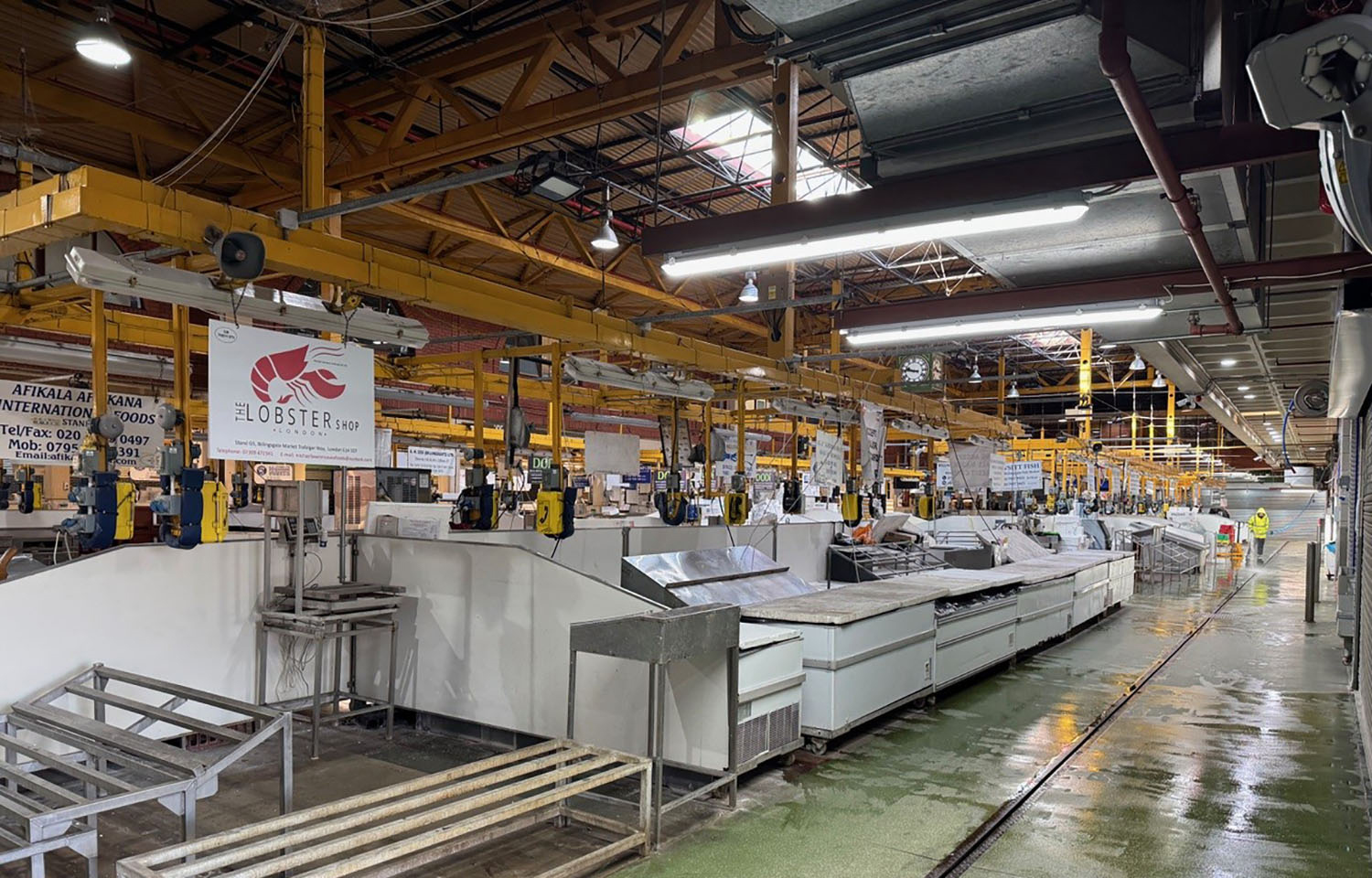
Billingsgate fish market – which is the oldest fish market in the U.K. capital of London and what was once the world’s largest fish market – is set to close in 2028 after the City of London Corporation recently decided to withdraw its support.
However, thanks to “a historic agreement” reached to relocate the operations, the 25,000 metric tons (MT) of fish and shellfish that are still sold annually from the iconic market’s current location should be minimally affected.
Initially, the City of London Corporation planned to move the markets of both Billingsgate and the nearby Smithfield meat market to a GBP 1 billion (USD 1.3 billion, EUR 1.2 billion) purpose-built site in Dagenham on the outskirts of London.
This plan was dropped in November 2024 over cost concerns, so instead, the corporation reached an agreement that will support the market’s traders in finding new sites for their wholesale activities within the M25 motorway that encircles most of Greater London, City of London Corporation Policy Chairman Chris Hayward told SeafoodSource.
Hayward said the agreement is the outcome of a long process of consultation with the traders and other key stakeholders and that it reflects the strong desire among traders to relocate to modern, fit-for-purpose facilities that enable them to scale their businesses.
“The traders are proactively shaping the future of their businesses, receiving support to move to more suitable and sustainable facilities that address current challenges while unlocking growth opportunities,” he said, adding that by relocating to upgraded premises, the traders will “better position themselves in an increasingly competitive and regulated food supply environment.”
A February 2025 study commissioned by the City of London Corporation found the move will have a minimal impact on food supply in London and Southeast England and that relocating could, in the long term, result in improved delivery times, access for suppliers, and lower costs.
The study also ascertained that 80 percent to 85 percent of the markets’ transactions are already conducted off-site, via phone and digital platforms, meaning customers’ reliance on the physical locations has significantly diminished.
As such, Hayward is confident there will be “minimal impact” on the pricing and availability of seafood for London’s restaurants, retailers, and consumers.
“Fundamentally – and this has been clear for a long time – the existing market sites are no longer fit for purpose,” Hayward said. “Limited trading hours, inefficient logistics, and outdated infrastructure mean the demands of a modern wholesale food market serving a global city are no longer being met. Importantly, these factors also constrain the ability of the traders to grow their businesses. For many reasons, it therefore makes sense for the traders to relocate to new locations within the M25.”
So far, 90 percent of Billingsgate traders have said they intend to use the financial compensation involved in the plan to relocate to new premises, which they propose to call “New Billingsgate.” The corporation added that while 10 percent of traders are undecided, should they retire, they will likely transfer their business connections and supply to traders who do plan to relocate.
“Both Billingsgate and Smithfield traders manage successful and profitable businesses and are, therefore, keen to relocate elsewhere,” Hayward said.
He also highlighted that alongside financial aid, the relocation plan includes practical support, such as brokering discussions with landowners and developers, to ensure a smooth transition.
“We are committed to supporting the traders to find new locations, and we anticipate those sites being identified and progressed well before 2028, which, subject to parliamentary approval, is the earliest point at which the current markets will close,” Hayward said. “There will be a transition from the current market locations to new locations, and we will be working with the traders to ensure that the process is as smooth and seamless as possible.”
In addition to relocating traders, the corporation plans to redevelop the Smithfield and Billingsgate sites.
At the Billingsgate site, the London Borough of Tower Hamlets aims to champion the construction of 4,000 new homes and new commercial space, a project that is estimated to directly create 14,500 jobs.
It’s also projected that the redevelopment of both markets would generate GBP 9.1 billion (USD 11.8 billion, EUR 10.8 billion) in cumulative gross value added revenue by 2049, attract 1.4 million visitors annually, and create 600 direct jobs, supporting the corporation’s “Destination City” mission to create jobs, attract visitors, improve sustainability, and support economic growth.
