


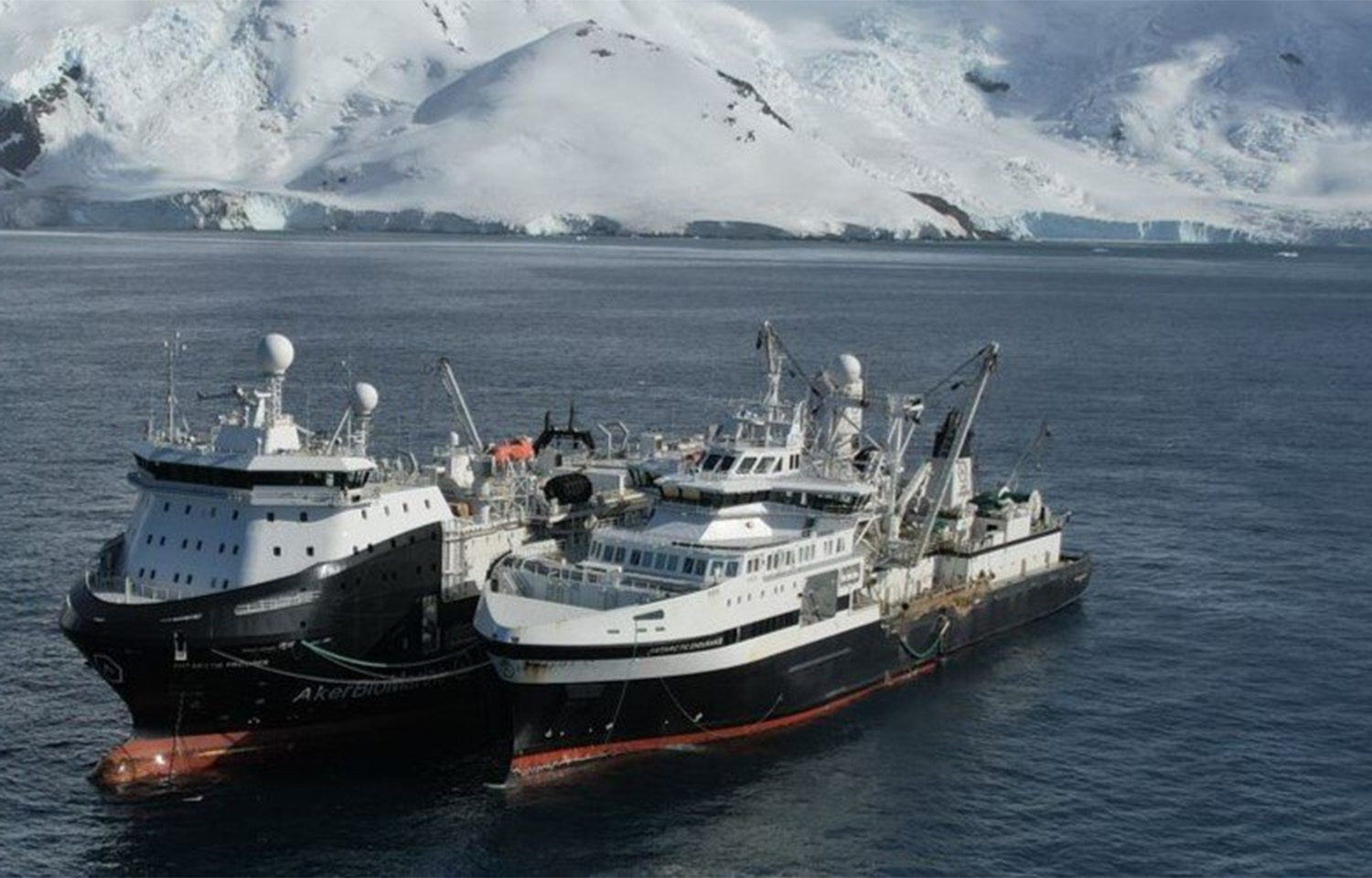
Aker QRILL announced it is ceasing its krill fishing in the Antarctic for the season as the fishery has hit its precautionary harvest limit for the second time in history.
NGOs rose the alarm earlier in the week that the krill fishery in the Antarctic, which is managed by the Commission for the Conservation of Antarctic Marine Living Resources (CCAMLR), was approaching the precautionary catch limit of 620,000 metric tons (MT). That precautionary limit was reached for the first time in 2025 and is in excess of a cap that CCAMLR had worked on but failed to implement due to member opposition.
Aker QRILL confirmed the fishery will close the week of 12 August, just days after the NGOs put out alerts. How the NGOs acquired the information ahead of the public release is unknown, and a spokesperson for CCAMLR told SeafoodSource that fishery notices are only shared confidentially with its members and authorized vessels within the convention area.
“We do indicate a projected closure date once a high proportion of the trigger limit has been reached, but that’s not publicly available information and is only shared on an indicative basis,” the spokesperson said.
NGOs have been criticizing the krill fishery, claiming that the current fishing effort targets a narrow area and could directly impact species in the region like penguins and blue whales, who feed on the krill. They’ve also decried a lack of action by CCAMLR, citing the lapse of controls that previously required the krill catch in “Area 48” to be distributed across multiple subareas.
“The two consecutive years of record catches are inextricably linked to a controversial decision made in 2024 by the CCAMLR, the intergovernmental body responsible for managing the fishery, to allow restrictions that for the previous 16 years had required the krill catch to be spread across larger areas to prevent fishing pressure from becoming too concentrated,” conservation organization Sea Shepherd said in a release.
Despite the lapse, Aker QRILL said fishing was spread across 1,000 kilometers, and the majority of the fishing season occurred after 1 April – outside the penguin breeding season – and that it has continued to maintain buffer zones around penguin colonies.
"Where fishing takes place is an important part of how the krill fishery should be managed," Aker QRILL CEO Webjørn Barstad said in a release. "This season provides another useful real-world evidence that the fishery can operate across a wide geographical area, and the closing proves that the system works. We will use that experience as CCAMLR develops the next generation of krill management."
Aker said the closure is in the wake of an FAO report that named the fishery a “global benchmark” for fisheries that use ecosystem-based management.
“The Antarctic krill fishery remains one of the most tightly regulated fisheries in the world. Around 11 krill vessels operated during the 2026 season across CCAMLR's Area 48, a management area covering approximately 3.5 million square kilometers,” Aker said. “The current 620,000-ton trigger level represents around 11 percent of CCAMLR's precautionary catch limit of 5.61 million MT for Area 48 and less than 1 percent of the approximately 63 million MT of krill biomass estimated by the 2019 CCAMLR synoptic survey.”
A spokesperson for CCAMLR also said that multiple other conservation measures on the fishery remain active, including the agreed trigger level, measures to prevent incidental mortality of seabirds and marine mammals, and a catch and effort reporting system, along with other data requirements to keep close tabs on the state of the fishery.
Aker said it also supports the establishment of a protected area around the Antarctic Peninsula and more measures to modernize fishery management that builds in more distributed fishing effort, rather than allowing it to take place in a limited geographic area.
The company said the last two seasons have shown why both of those efforts matter, as fishery management builds in the practices the companies have taken to alleviate pressure a single area. It pointed out that fishing effort in 2025 increased in Subarea 48.1, and in 2026, the fishery expanded its effort across areas north, central, and south of Bransfield Strait, as well as north of the Gerlach Strait.
"The responsible solution moving forward should now be to build that distribution into the management system rather than relying on annual variations in krill abundance and fleet behavior." Barstad said. "That means protecting large and important areas while establishing a science-based management system for the areas where fishing can be further developed. These elements need to be considered together if the 27 members of CCAMLR are going to reach consensus.”
