





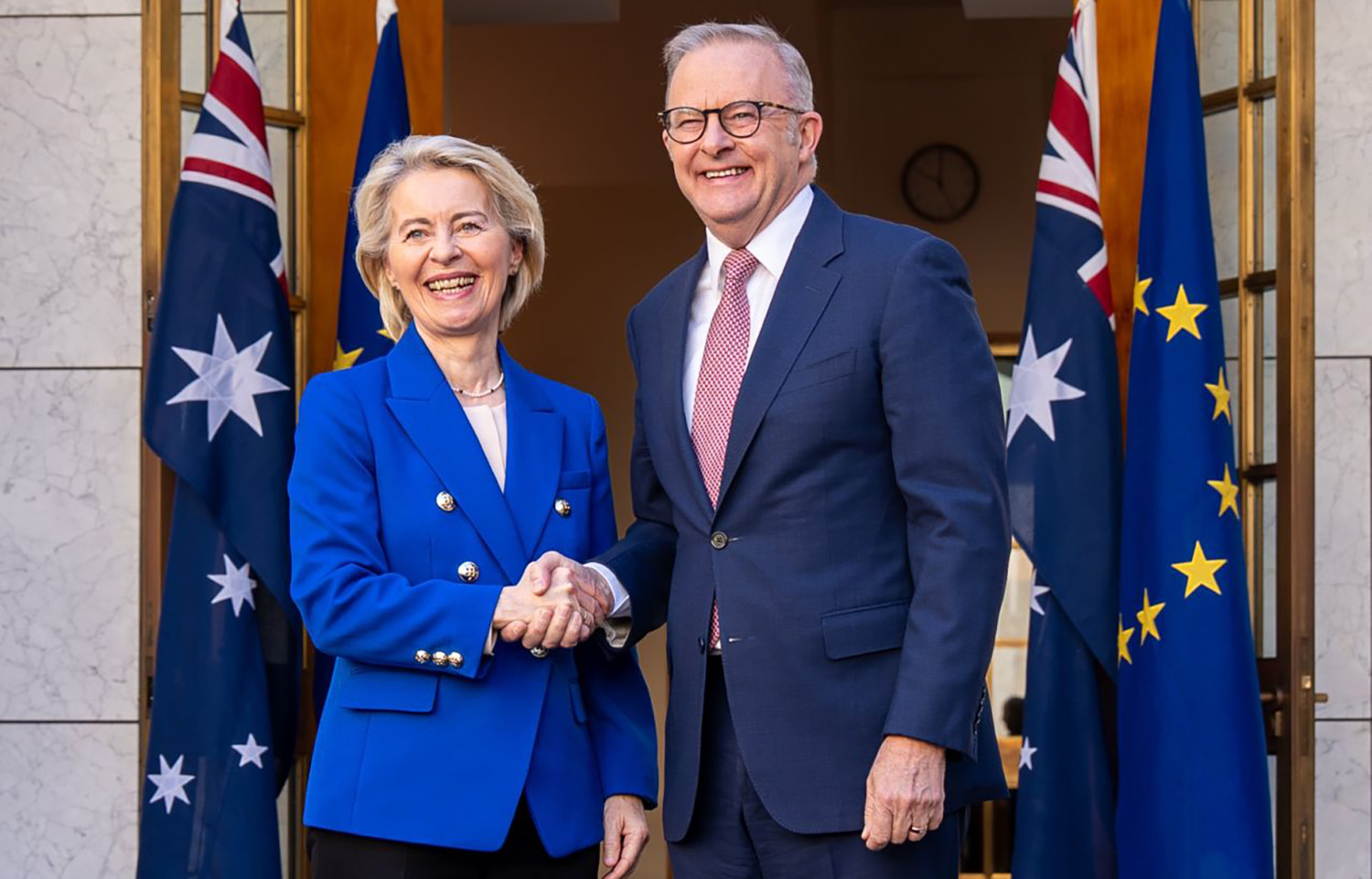
The E.U. and Australia have concluded negotiations on a free trade agreement (FTA), eliminating or reducing virtually all existing tariffs on goods flowing in both directions.
The European Commission said the deal is set to cut around EUR 1 billion (USD 1.2 billion) in annual duties for European companies of all sizes, while the Australian government said Australian farmers and producers, including seafood firms, will benefit from the elimination of almost all E.U. tariffs on agricultural products.
“The E.U. and Australia may be geographically far apart, but we couldn't be closer in terms of how we see the world. With these dynamic new partnerships … we are moving even closer together,” European Commission President Ursula Von der Leyen said in a release. “These agreements put in place lasting, trust-based structures to support peace and security through strength, driving prosperity through rules-based trade, and working together to uphold global institutions. We are committed to building a cleaner, more digital future for our citizens, workers, and businesses, and we are sending a strong signal to the rest of the world that friendship and cooperation is what matters most in times of turbulence.”
“After almost eight years of negotiations, my good friend President von der Leyen and I agreed to the landmark Australia-European Union FTA. I am proud that we have been able to secure this deal, which will deliver benefits for both Australia and the European Union for generations to come,” Australia Prime Minister Anthony Albanese added. “This deal creates major new opportunities for Australian exporters in the European Union’s massive AUD 30 trillion [USD 20.9 billion, EUR 18 billion] economy, and will reduce costs for Australian consumers.”
Australia Minister for Trade and Tourism Don Farrell said the deal comes at an important time, when disrupted global trade patterns make it especially important to diversify.
“This hard-fought deal delivers real commercial gains for Australian exporters, farmers, and producers into a market that has been difficult to enter or effectively closed for decades. The removal of E.U. tariffs on most of Australia’s exports gives Australian exporters the opportunity to diversify trade with 27 European countries and 450 million consumers,” he said. “This is a strategically important and economically valuable agreement at a time when Australian exporters are navigating choppy trade waters. More trade with more trading partners means more supply chain security, more well-paying jobs, cheaper prices, and more national income.”
Seafood Industry Australia, which represents the wild catch, aquaculture, and seafood processing sectors in the country, welcomed the FTA, saying that it will immediately remove E.U. tariffs of up to 15 percent on kingfish, 12 percent on prawns, and 11 percent on abalone, quickly presenting exporters with advantageous opportunities.
“This E.U. FTA should facilitate important long-term market development opportunities for many seafood exporters. This will become increasingly important as global market conditions remain uncertain and the need to diversify export destinations continues to grow,” the organization said.
Business development managers representing European markets within Australia’s trade promotion agency Austrade similarly said that Australian seafood is set to be more competitive in the E.U. bloc.
“Spaniards appreciate high-quality seafood. Australian seafood is premium by nature, and our clams, scallops, tuna, and barramundi are gaining a reputation in Spanish seafood markets. Europeans appreciate responsible fishing practices and pristine waters. This means Australian seafood ticks all the boxes for Spanish importers,” Austrade Business Development Manager for Spain Manuel Barbera said of the deal.
“Germany is one of Europe's largest seafood importers, driven by high demand especially for Alaska pollock, tuna, herring and shrimp. The market provides interesting opportunities for suitable products from Australia,” Austrade Senior Business Development Manager for Germany Sandra Willer said.
The deal follows close on the heels of the E.U. signing an FTA with India in January that eliminates or reduces tariffs on 96.6 percent of E.U. goods by value exported to India. The bloc is also actively negotiating with Thailand on a similar trade deal, but European seafood representatives have urged the bloc to leave tuna out of any eventual deal with the Southeast Asian nation.
As for Australia, the deal comes nearly three years after the nation signed an FTA with the U.K. that brought an immediate end to tariffs on many Australian seafood exports.
