






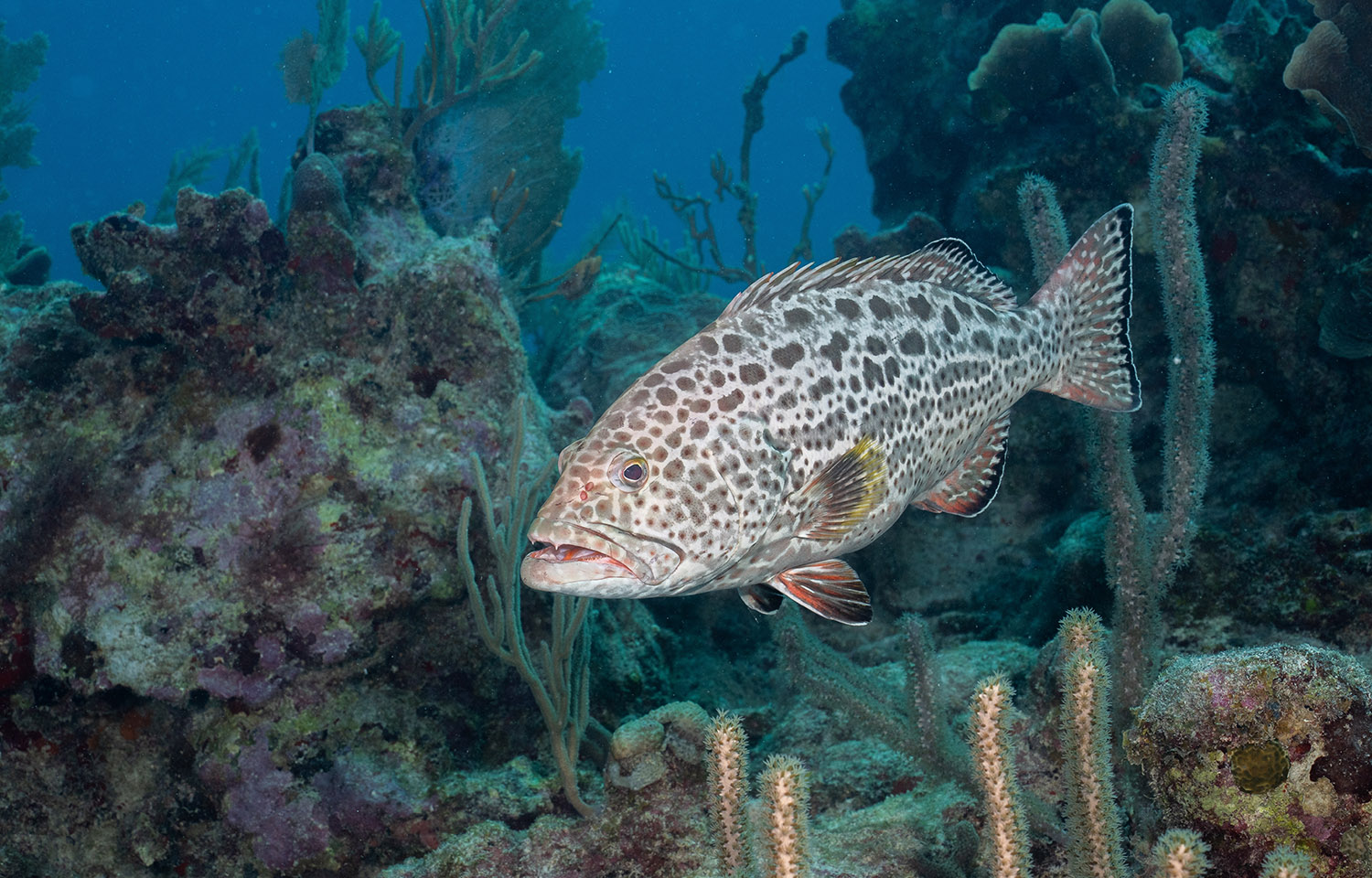
The Gulf Council has recommended roughly halving the total allowable catch of deep-water grouper species in the Gulf of Mexico, currently referred to as the Gulf of America by the U.S. federal government, with most of the catch allocated to the commercial sector.
The deep-water category covers four grouper species – warsaw grouper, snowy grouper, yellowedge grouper, and speckled hind – with a single annual catch limit. For more than a decade, the complex has operated under a commercial quota of 1,024,000 gutted weight (GW) pounds.
Regulators declared the yellowedge grouper stock was experiencing overfishing in 2021, but according to the Gulf Council, NOAA Fisheries lacks the data to determine whether the deep-water grouper complex is overfished or not.
Still, the overfished determination required the council to take action to remedy the situation.
“The yellowedge grouper assessment indicated that fewer young fish are surviving to adulthood (indicating low recruitment) and that recreational harvest has been increasing,” the Gulf Council said in its release. “While yellowedge grouper is the most commonly landed species in the deep-water grouper complex, it is frequently caught with the other deep-water grouper species, so [NOAA's scientific support coordinator] recommended updated catch limits for the other deep-water grouper species based on average historical landings.”
Grouper landings in the Gulf have dropped off in recent years. While landing between 831,911 and 1,081,145 GW pounds annually from 2012 through 2021, commercial fishers landed just 580,524 GW pounds in 2022 – the lowest commercial catch in more than 20 years of data. The following year, commercial fishers landed 625,777 GW pounds from the deep-water grouper complex – a slight improvement but still noticeably down from the 10-year average and far off from the allowable catch.
In response to the overfishing determination, the Gulf Council voted at its recent August meeting to recommend reducing the commercial quota by more than 50 percent. The council’s recommendation sets an acceptable biological catch of 555,026 lb GW, with approximately 10 percent of the catch set aside for the recreational sector.
The council has recommended a commercial quota of 478,424 GW pounds. That figure is lower than the total commercial landings for any year since 2000, according to data provided by the Gulf Council.
The council also recommended an accountability measure for the recreational sector which would reduce the season if the three-year average of recreational landings exceeded the annual catch limit of 56,668 GW pounds.
With the council having taken final action, Reef Fish Amendment 58B will now go to the U.S. Department of Commerce for approval and implementation.
