



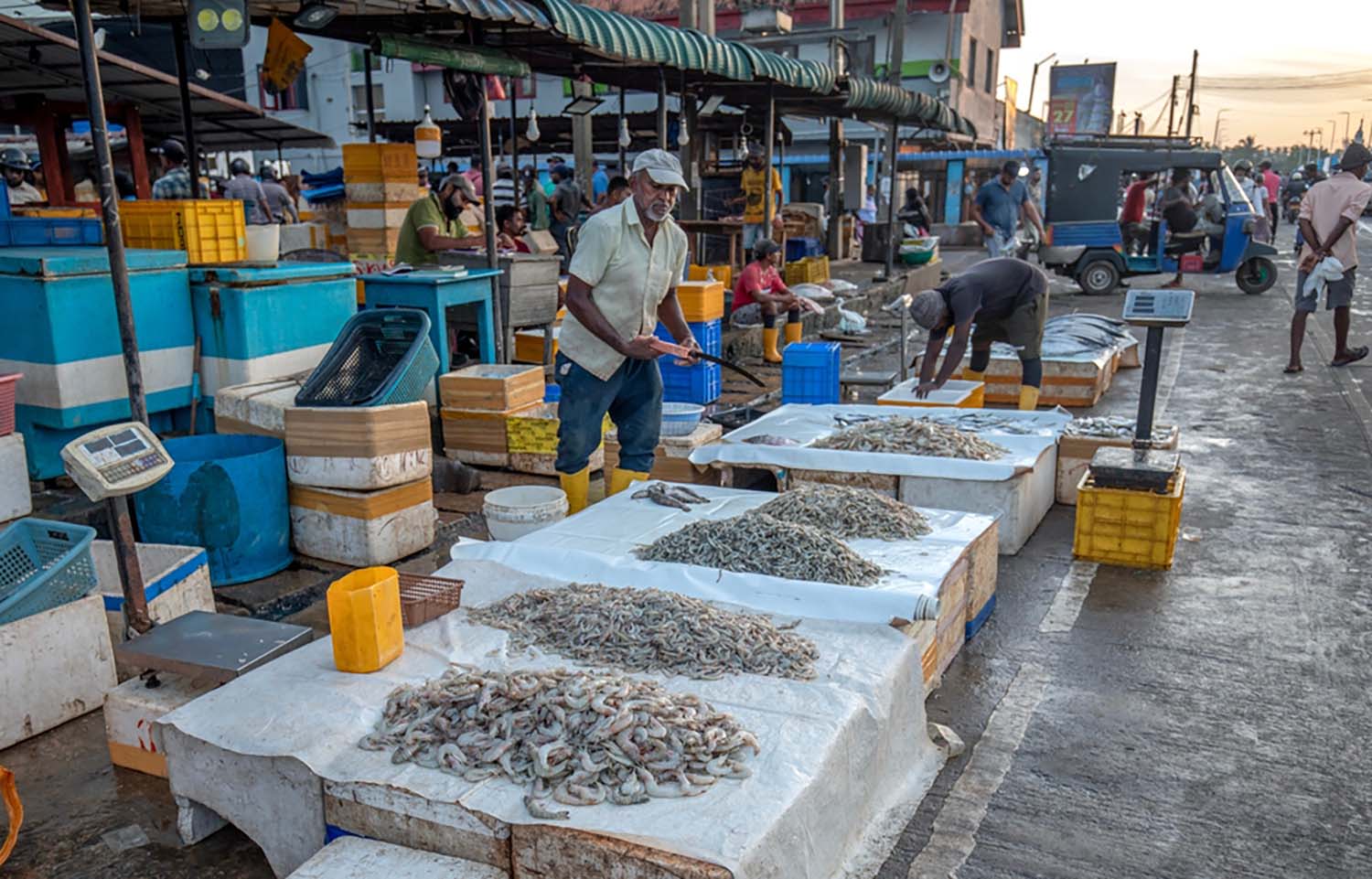
Sri Lanka has introduced a new set of rules to regulate the re-export of shrimp, aiming to address concerns from local farmers and maintain the country’s competitiveness in global seafood markets.
In recent years, the Sri Lankan government has allowed increasing imports of foreign shrimp for value addition and re-export purposes, aiming to meet international demand for seafood and accommodate rising domestic consumption, according to Sri Lanka’s Ministry of Fisheries, Aquatic, and Ocean Resources.
However, the practice has drawn concerns from local shrimp farmers in the country, who fear that foreign shrimp entering the domestic market could undermine demand for products of local origin and increase the risk of disease transmission, potentially leading to trade restrictions in some export destinations. Farmers also raised objections to marketing imported shrimp as Sri Lankan products.
In response, the ministry has established a special committee comprising representatives from relevant government agencies, along with stakeholders from the aquaculture sector and the export industry, to set up a new standard operating procedure (SOP) to address these issues.
The SOP, issued by the fisheries ministry, sets strict conditions for importing foreign shrimp.
Under the new guidelines, only frozen, headless shrimp may be imported, and imports from countries facing trade restrictions will be banned. Health and antibiotic-free certification from the exporting country will also be mandatory.
On the processing side, factories will be required to keep foreign and domestic shrimp strictly separate during handling and cannot operate the facilities processing foreign shrimp near local shrimp farms in order to prevent cross-contamination.
In a bid to avoid misleading consumers and protect the country's reputation in foreign markets, all re-exported shrimp must be clearly labeled as “Other Origin Shrimp, Processed in Sri Lanka.” Waste disposal and wastewater treatment must also comply with environmental standards set by local environmental authorities.
Further, to address concerns about undermining domestic demand for local products, the new rules mandate that 75 percent of all imported shrimp be re-exported, and companies failing to meet this threshold will not be eligible for future import permits. Import permissions will also be granted only after authorities assess local production forecasts for the following three months to ensure domestic supply is not adversely affected.
The SOP comes as Sri Lanka’s shrimp industry grapples with mounting challenges.
In January, the fisheries ministry convened a meeting with stakeholders to explore ways to revitalize the country’s shrimp industry. Discussions focused on collaborative measures to increase domestic production, promote sustainable farming practices, and improve the availability of locally sourced larvae and post-larvae to reduce dependence on imports, the ministry said in a statement.
Before that meeting, The Sunday Times reported in April 2024 that the cost of shrimp production in Sri Lanka doubled in the two years leading up to 2024, driven by rising electricity prices and export taxes on post-larvae shrimp.
Once home to more than 900 shrimp farms, the country has seen a sharp decline in operations due to disease outbreaks and escalating costs.
D.S.P. Farms Owner M. Naurooz said, per The Sunday Times, that white spot and yellow spot viruses had forced many farms to shut down, while larger operators have turned to importing shrimp from India for value addition and re-export.
Though the sector has faced challenges, some are still bullish on its potential. In 2022, Taprobane Seafood Group (TSG) Managing Director and Owner Tim O’Reilly said that Sri Lanka had the potential to produce 100,000 metric tons (MT) of shrimp by 2027.
TSG has become the largest shrimp producer and processor in Sri Lanka through its introduction and proliferation of farming vannamei in 2019. Since then, old shrimp ponds across the country have been revived and new farms opened as a result of the switch to vannamei production.
Still, in 2023, Sri Lanka exported approximately just 3,631 MT of frozen shrimp and prawns, generating USD 30.45 million (EUR 26 million) in export revenue.
The top destinations included Japan, which imported 1,127 MT worth USD 10.49 million (EUR 8.94 million); the U.S., which bought 535 MT worth USD 5.10 million (EUR 4.35 million); the Netherlands, which purchased 393 MT of Sri Lankan shrimp worth USD 2.71 million (EUR 2.31 million); the U.K., which bought 333 MT worth USD 2.22 million (EUR 1.9 million); and other Asian nations, which bought 178 MT worth USD 1.86 million (EUR 1.58 million), according to World Bank‑run World Integrated Trade Solution.
