



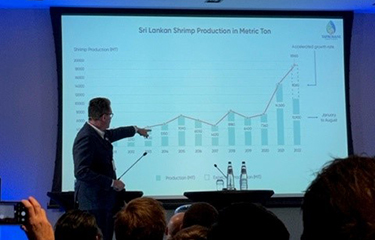
Speaking at the Global Shrimp forum on 7 September in Utrecht, The Netherlands, Tim O’Reilly, managing director and owner of Taprobane Seafood Group in Sri Lanka, said the country is on its way to hitting its goal of producing 100,000 MT of shrimp annually.
Taprobane has become the largest shrimp producer and processor in Sri Lanka through its introduction and proliferation of the farming of whiteleg shrimp (L. vannamei) shrimp to the island country’s shrimp sector, which had traditionally grown black tiger shrimp (P. monodon).
“It took us more than four years to get the go-ahead to introduce and grow a new species, with conservative monodon farmers trying to block every move,” O’Reilly said. "Once approved, we brought in the first broodstock from aquaculture breeding company Kona Bay in Hawaii.”
Taprobane Seafood operates 15 processing facilities in Sri Lanka’s north, which was the epicenter of Sri Lanka’s long and bloody civil war, which ran from 1983 to 2009. It now employs more than 2,000 women processing vannamei shrimp and blue swimming crab.
O’Reilly said he intentionally set out to work closely with communities in Sri Lanka that were previously engaged in black tiger shrimp farming, demonstrating the benefits of growing white shrimp. Many had lost their homes and livelihoods through failure of monodon crops in the years after the war, during which thousands of women lost their husbands and were displaced from their homes.
O’Reilly said the work has paid off and skeptics are now believers as old shrimp ponds have been revived and new farms opened as a result of the switch to vannamei production. As a result, he said, the country saw a doubling of output between 2020 and 2021, and O’Reilly said he’s confident Sri Lanka is just at the start start of a huge growth trajectory for its shrimp aquaculture sector.
“Sri Lanka has the potential to produce 50,000 metric tons by 2025 and to double output to 100,000 [MT] by 2027,” O’Reilly said.
O’Reilly said Tabrobane has benefited from an investment from Colombo, Sri Lanka-based private equity and investment firm Atman Group in November 2021 and a joint venture with Seafood Group AS. But he said he wants the company’s success to be shared with other shrimp-sector firms in Sri Lanka. In December 2021, Taprobane announced the creation of Taprobane Aqua Services to provide aquaculture products and services to Sri Lankan shrimp farmers. The company is hoping to lead the sustainable growth of shrimp aquaculture in Sri Lanka by offering the country’s farmers postlarvae shrimp, equipment, training on farming methods, access to high-quality feed via a collaboration with Skretting, and a 100 percent buyback guarantee to its contracted farmers, according to O’Reilly.
“We are bringing the small- to medium-sized companies along with us,” he said.
Vannamei production is one of five growth sectors identified by the Sri Lankan government for development, and the authorities have set the bar very high on regulation and best practice to ensure a good reputation for the country’s shrimp, O’Reilly said. For example, a 2021 law states that only certified specific pathogen-free (SPF) shrimp broodstock can be farmed in Sri Lanka.
Between January and August 2022, Sri Lanka’s shrimp production rose to 10,900 MT, despite recent political turmoil resulting in civil unrest and ongoing effects from the pandemic. O’Reilly said the should reach almost 19,000 MT by the end of 2022.
O’Reilly acknowledged there are many challenges lying in the way of achieving the country’s production goal, but he said there is a collective will across Sri Lanka for vannamei production to succeed.
However, he said climate change, which Sri Lanka cannot tackle alone, now presents the biggest threat to the future success of the industry.
“Rising sea levels will affect many coastal shrimp production areas,” he said.
Photo courtesy of Nicki Holmyard/SeafoodSource
