






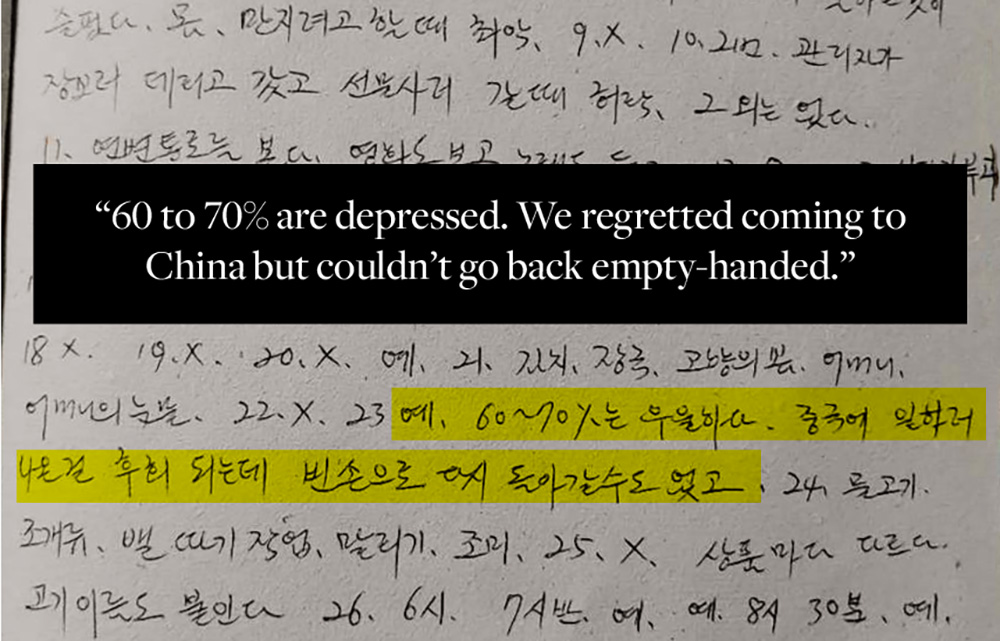
Trident Seafoods, High Liner Foods, and Sysco are among the U.S. seafood firms that have suspended relationships with Chinese processors named in the latest Outlaw Ocean Project report, which revealed their use of North Korean labor, in violation of U.N. sanctions and U.S. law.
The use of North Korean laborers was prohibited in 2017 by the United Nations Security Council in response to the country testing a series of nuclear and ballistic weapons, and the U.S. has also passed a law categorizing the use of North Korean labor as forced labor unless credibly proven otherwise. Despite that, Outlaw Ocean estimates more than 120,000 metric tons (MT) of seafood have been shipped from companies using North Korean laborers to American importers since 2017.
In response to the report, Trident, High Liner, and Sysco have cut ties with Chinese processors that allegedly used North Korean labor. Other companies, including Pacific Seafood and Young’s Seafood, have launched investigations into the allegations of North Korean labor in their supply chains.
Sysco, one of the largest broadline food distributors in the world, was linked to Dalian Haiqing Food, which Outlaw Ocean found employed between 50 and 70 North Korean employees. After Outlaw Ocean contacted the company to ask for its response, the distributor stopped working with the company on 25 January.
“Sysco instructed suppliers to suspend production of our products at all facilities associated with Dalian Haiqing Food as we investigate these allegations,” a Sysco spokesperson told Outlaw Ocean. “Sysco has already established it does not have any production at the company’s Dadong facilities.”
High Liner has also been previously associated with Dalian Haiqing and said it has suspended business dealings with the company following notification from Outlaw Ocean. According to High Liner’s communications with Outlaw Ocean – posted on the organization’s “investigations” page, which details its correspondence with hundreds of companies – it is also investigating its business dealings with Dalian Haiqing.
“The use of any forced, bonded, indentured, slave, and illegal prison or convict labor is a critical violation of High Liner Foods' Supplier Code of Conduct,” High Linger Vice President of Communications Jennifer Bell said in an email to Outlaw Ocean.
High Liner confirmed it has not done any business with seafood processors located in Dandong, but based on Outlaw Ocean's reporting, the locations in question were in Zhuanghe City in the Liaoning Province – located to the west of Dandong, which is near the border between China and North Korea.
High Liner said third-party audits had confirmed no forced labor was used in the facility, but the Outlaw Ocean Project has shown the audits have been unreliable in identifying forced labor in China, including with High Liner suppliers.
“High Liner Foods only imports from plants that are approved and audited, and High Liner has never set up or approved any plants in the Dandong region,” Bell wrote.
Pacific Seafood also allegedly sourced from Dalian Haiqing’s Zhuanghe City facility, according to the report. In its communications with the Outlaw Ocean Project, Pacific Seafood said it has launched an investigation into the allegations, and that it had no association with companies operating in Dandong.
“According to our information, Dalian Haiqing Food does not have any facilities in Dandong City,” Pacific Seafood told Outlaw Ocean.
When Outlaw Ocean clarified the facilities in question are in Zhuanghe City and not Dandong, Pacific Seafood said it will now be able to investigate “more thoroughly.”
“This is a top priority and will take some time on our end, but we will provide you with updates as soon as we can,” Pacific said.
Trident Seafoods was also linked to Dalian Haiqing’s operations and conducted the most extensive communications with Outlaw Ocean of any of the companies the organization had contacted as of 26 February. The company said it suspended its relationship with Dalian Haiqing. Trident said ts extensive corporate social responsibility (CSR) program as well as third-party social audits did not identify any evidence of forced labor used by its Chinese suppliers.
“All Trident seafood suppliers in China have current third-party SMETA audits. Trident requires the 4-Pillar SMETA versus the narrower scope [of the] 2-Pillar SMETA option. Strategically, we use two independent audit firms for social audits in China to invite new perspectives and opportunities for improvement through the audit process," the company said. "As stated previously, Trident does not rely solely on third-party audits for its CSR risk assessments."
The company said its independent CSR program takes into account factors including segregated living, eating, and working areas, discriminatory wage practices, locked doors, refusal to provide access to certain areas, and the presence of guards, and abusive management styles in its review of suppliers.
Trident said its CSR program, third-party audits, and its own China-based employee-run investigations did not find evidence of forced labor at the factories of its Chinese suppliers. The company requested more detailed information from the Outlaw Ocean Project about its findings, but were rebuffed, with the project citing confidentiality it granted to its sources to protect them from retaliation.
“You specifically requested that Trident not engage our China teams; however, the information is proliferating and making it difficult to ensure the integrity of our investigative approach,” a Trident spokesperson wrote in an email to the Outlaw Ocean Project.
On 23 February, Trident said it was continuing to investigate the labor accusations but still had not found any evidence of wrongdoing.
“There is no clear gap in our CSR program to explain how we could have failed to detect a large number of North Korean workers at the Haiqing campus,” the company said. “Regardless of our inability to independently substantiate the OOP allegations, we are proceeding on the assumption that they could be true, and we’re taking action accordingly. We have not resumed trading with Haiqing.”
Trident’s response reveals the complications seafood companies face in attempting to keep forced labor out of their supply chains.
The larger Outlaw Ocean Project investigation into forced labor in China's seafood industry has resulted in U.S. lawmakers calling for sanctions and NGOs pushing U.S. Customs and Border Patrol to take action. Some U.S. lawmakers have called for an investigation into the seafood sector’s “complicity” in the use of forced labor and drafted letters calling for the U.S. Department of Homeland Security to initiate a comprehensive investigation.
