

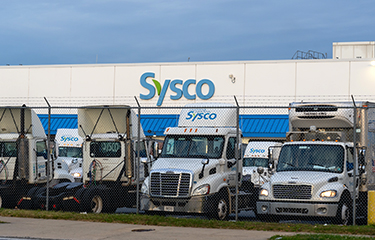
Sysco is facing questions over whether its auditing system forits seafood supply chain is capable of detecting labor abuses, including the use of Uyghur labor at its contracted facilities in China – a practice that is illegal under U.S. law.
In a 14 December letter to Sysco Corporation President and CEO Kevin Hourican, U.S. Representative Jared Huffman (D-California) critiqued the thoroughness and reliability of audits that Sysco relies on to claim it does not sell seafood produced by forced labor supported by human trafficking. Specifically, Huffman expressed concern that Uyghur and North Korean workers had been employed by processing companies Sysco contracted with in China.
“The import of products from any facilities tied to Uyghur workers from the Xinjiang Uyghur Autonomous Region is a clear violation of the Uyghur Forced Labor Protection Act (UFLPA)," Huffman wrote. "The import of products from any facilities tied to North Korean workers is a clear violation of the Countering America's Adversaries Through Sanctions Act (CAATSA)."
Huffman noted in his letter that after an “initial delay in action,” Sysco had terminated its contract with Shandong Haidu on 14 December but that it has not dropped ties with Rongcheng Haibo – both subsidiaries of the Chishan Group, which has been tied to the use of forced labor by the Outlaw Ocean Project.
However, he expressed concern about apparent weaknesses in Sysco’s auditing process for its seafood supply chain. He said Sysco’s third-party independent auditor, Underwriter Laboratories (UL), had engaged in “multiple delay tactics” after being requested to perform an unannounced visit to Chishan Group factories to investigate allegations of human rights violations there.
“UL ultimately said they were unwilling to audit because of what they are seeing with their 'auditors getting intense scrutiny,' implying that it was the Chinese government who had been applying the pressure,” Huffman wrote. “Based on this, it appears to us that UL and other auditors are likely not checking for the presence of forced labor from regions like Xinjiang or North Korea.”
Additionally, Huffman said in a meeting with his staff that there were “highlighted inherent flaws in the auditing processes as it relates to the influence of the Chinese government in the alleged ‘independent’ process. Huffman pointed to Outlaw Ocean Project reporting quoting Sedex – the creator of the social audit used to inspect all the Chinese plants tied to Uyghur labor – saying it was “difficult and risky for auditors themselves to explicitly recognize state-imposed forced labor” that “may have been covered up.”
“This is a cause for concern, one, as it relates to auditors asking specific questions to identify forced labor in processing plants in China, and two, as it relates to the ability of auditors to successfully conduct unannounced visits in China,” Huffman wrote.
Huffman requested Sysco provide him with documentation for all of the audits performed by UL tied to Shandong Haidu over the last four years and asked Sysco to provide evidence its other Chinese suppliers are not employing workers from Xinjiang or North Korea. Additionally, Huffman requested a list of processing facilities from which Sysco sources seafood and their recent audit reports.
UL’s inability to conduct spot audits is a concern in that it could prevent UL from identifying labor issues in Sysco’s supply chain, according to Huffman.
“This … misses the mark in what is expected of corporations the government conducts business with – as it has been clearly documented that human rights abuses occur at multiple levels of the seafood supply chain both on land and at sea. Therefore, surface-level audits are insufficient,” Huffman wrote. “Has Sysco asked UL how they intend to fix that oversight? Does Sysco have reason to believe that this blind spot in UL’s audit methodology might indicate that Sysco has lapses in other plants that have been audited by UL?”
Huffman asked Hourican what Sysco's plan is to ensure audits are properly conducted to “verify that the seafood you are distributing is not tied to workers from Xinjiang or North Korea in processing plants or trafficked and otherwise abused workers at sea."
“What are Sysco’s plans to solve the bigger core problem of auditors they are contracting who are not thoroughly investigating the presence of forced labor and
Huffman also asked about Sysco’s process for verifying that at-sea human rights abuses are not taking place aboard the ships from which its seafood originates and that the vessels are not engaging in illegal, unreported, and unregulated (IUU) fishing.
“Clearly, the core problems in the way that Sysco’s audits have been conducted speak to wider concerns. In light of the huge presence Sysco plays in the food supply writ large, even beyond seafood for the federal government, we’d like to get to the bottom of your supply chain vetting and receive some clear answers to these questions,” Huffman wrote.
In a response to SeafoodSource’s request for comment on Huffman’s letter, Sysco said it “has demonstrated a longstanding commitment to improving safety and human rights practices throughout the food supply chain to reduce the risk of human rights violations.”
“For more than 10 years, Sysco has implemented an industry-leading program for identifying potential risks related to child and forced labor, wages, working hours, discrimination, worker safety, and living conditions," the company stated. "This program is followed for all Sysco-branded suppliers operating in high-risk countries, including China, and includes requiring suppliers in high-risk countries to undergo a third-party social responsibility audit conducted by an auditing firm that specializes in such audits, [as well as] employing dedicated Sysco sourcing and quality assurance resources to administer the program and dedicated staff in overseas offices to conduct facility inspections on a routine or unannounced basis.”
Sysco tightened its seafood sustainability policy in 2021, but the updated policy did not mention labor issues. In a response to the Outlaw Ocean Project, Sysco Senior Director of External Communications Shannon Mutschler said in August 2023 the company would provide a summary of its program with Sysco brand suppliers designed to mitigate risk of human rights abuses in its supply chain but had not provided the documentation as of December 2023. In its statement to SeafoodSource, Sysco said it does have a process in place to take action on human rights abuses uncovered by audits in its supply chain.
“Suppliers can face serious consequences if an audit finds critical issues including suspension/canceling the right to pack Sysco-branded products,” the company stated. “In high-risk areas around the world, such routine audits, combined with a dedicated team responsible for ensuring implementation of corrective actions, has minimized human rights risks and improved working conditions in facilities that act as Sysco brand suppliers.”
Sysco recorded USD 76.3 billion (EUR 69.1 billion) in sales in its most recent fiscal year, ending in July 2023, and its gross profit increased to US 14 billion (EUR 12.7 billion).
Photo courtesy of JHVEPhoto/Shutterstock
