




The administration of U.S. President Donald Trump has asked the New England Fishery Management Council (NEFMC) to abandon a rule forcing commercial herring fishers to pay for at-sea monitors out of pocket.
“After careful consideration, we have determined that an action removing Atlantic herring monitoring requirements […] may be warranted to remove unused provisions that are not achieving their intended goals and, thereby, reduce regulatory burdens on Atlantic herring fishery participants,” NOAA Fisheries Assistant Administrator Eugenio Piñeiro Soler said in a 1 May letter to the council. “Because the herring [industry-funded monitor] program imposes costs on [NOAA Fisheries] as well as the herring industry itself in order to be effectively implemented, in the face of declining resources and the need to prioritize our activities to support the Administration’s goals and objectives of Executive Order 14276, it is unlikely that [NOAA Fisheries] will have the resources necessary to support this program.”
If the council declines to act, the U.S. secretary of commerce is prepared to issue an amendment to rescind the rule, Piñeiro Soler warned.
The rule in question was at the heart of a recent U.S. Supreme Court case that upended longstanding precedent on the regulatory authority of agencies like NOAA Fisheries, but the rule itself remains in place and is still being challenged in the lower courts.
In 2020, NEFMC adopted the rule requiring some commercial fisheries to pay for at-sea monitors on their vessels, enabling the government to collect data on their activities and ensuring compliance with federal regulations. The rule outraged many in the commercial fishing sector, who claimed that the cost of a monitor could be as much as USD 700 (EUR 640) per day.
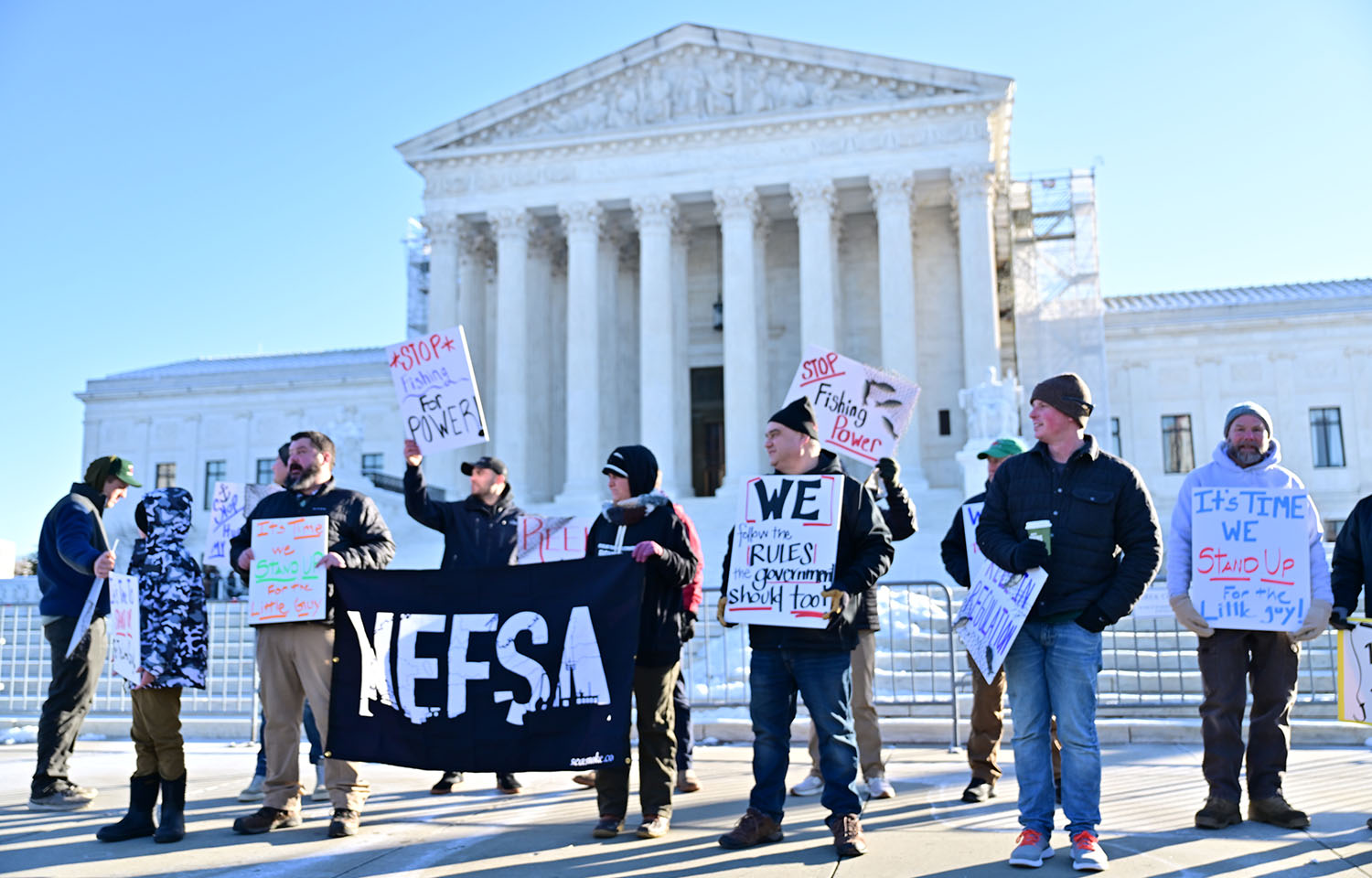
Two lawsuits were filed challenging the rule: Relentless, Inc. v. the U.S. Department of Commerce and Loper Bright Enterprises v. Raimondo. Neither case had success in the lower courts, but in 2024, the U.S. Supreme Court took up the cases as a challenge to the Chevron deference, a longstanding court precedent that saw judges deferring to regulatory agencies in interpreting vague statutes.
The Supreme Court ultimately ruled in favor of the commercial fishers, overturning the Chevron deference.
The Supreme Court, however, did not vacate the at-sea monitor rule. After ruling solely on constitutional grounds, the Supreme Court remanded Loper Bright back to the D.C. Circuit Court of Appeals for reconsideration under the new limits on regulatory agencies interpreting statutes. That case is currently on hold as the plaintiffs negotiate with the government on a solution.
The Loper Bright plaintiffs were quick to welcome Piñeiro Soler’s letter and the request to kill off the rule.
“We are grateful for the Trump administration’s decision to correct course on industry-funded monitoring. We’ve carried monitors on our boats for decades. No one has more at stake than fishermen in the long-term environmental health of our fisheries. But, this regulation was never financially feasible, and it was never fair. Finally, the government agrees,” Lund’s Fisheries President Wayne Reichle said in a release.
In his letter, Piñeiro Soler noted that killing the industry-funded monitor (IFM) rule would be critical for ending those lawsuits.
“As you are aware, the Atlantic herring IFM regulations are the subject of litigation in Loper Bright Enterprises, pending in the D.C. Circuit Court of Appeals, and Relentless, pending in the 1st Circuit Court of Appeals. An action removing the Atlantic herring IFM requirements […] is an important step toward resolving both of these cases and bringing an end to the litigation over the herring IFM program,” Piñeiro Soler said.
The head of NOAA Fisheries also noted that the rule has never been fully implemented, making it difficult to evaluate.
“To date, due to a number of unexpected complications, there has been insufficient IFM coverage to support a meaningful evaluation or to show that the program is achieving its stated goals. In particular, we announced in November 2022 that we were suspending the herring IFM program for the foreseeable future due to a lack of resources to effectively implement the program,” Piñeiro Soler said.
Piñeiro Soler went on to demand that NEFMC act on his request “as soon as possible.”
