






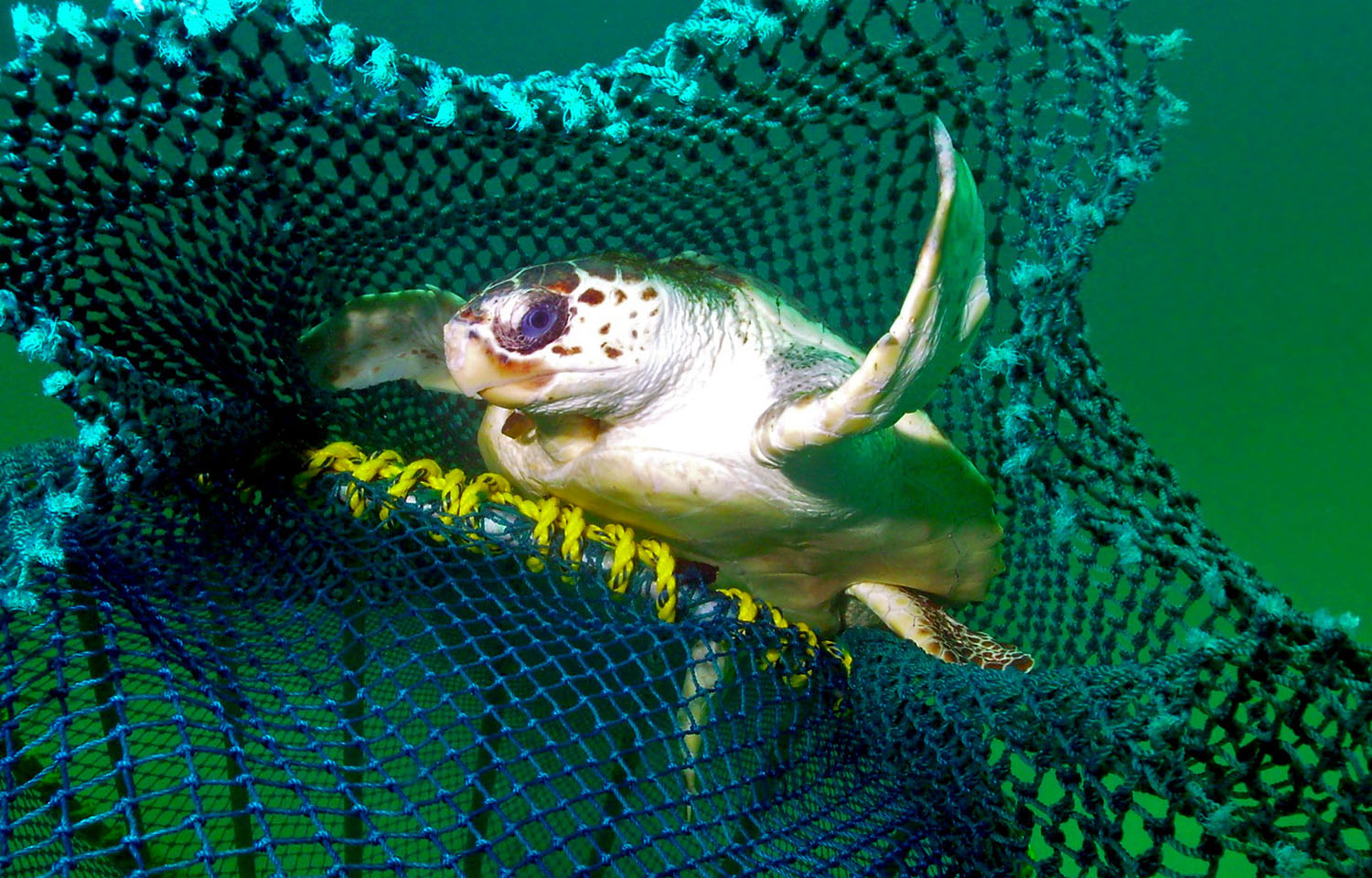
Two trade groups representing U.S. shrimpers have requested the U.S. State Department more evenly enforce a rule prohibiting imports from countries that have not received certification they have required their wild-catch shrimp sectors to use of turtle-excluder devices.
The Southern Shrimp Alliance (SSA) and the Port Arthur Area Shrimpers’ Association (PAASA) said the federal government’s Section 609 program, made law in 1989, requires the U.S. State Department and NOAA Fisheries to certify foreign countries or fisheries as being in compliance with domestic requirements on the usage of turtle-excluder devices (TEDs), which allow turtles to escape from shrimp-trawler nets. The certification makes them eligible to export wild-caught shrimp to the U.S. market.
However, enforcement of Section 609 has been uneven and is often lax, according to Southern Shrimp Alliance Executive Director John Williams.
“The Section 609 program proves that access to our market can be used to improve the production practices of our foreign trading partners. The end result of enforcement improves things for everyone involved at minimal cost,” Williams said. “And yet, too often, federal agencies have refused to use this essential tool for spurious reasons.”
Specifically, the groups called for a suspension of the Section 609 certifications of Peru and Guatemala, which they said lack justification.
“Public information makes clear that the Peruvian commercial shrimping industry has incidental takings of endangered sea turtles yet has adopted no measures to limit the harm caused by these takings. Further, public information indicates that Guatemala records and maintains no data regarding the incidental takings of endangered sea turtles of its shrimp trawl fleet and there appears to be no at-sea enforcement checks for compliance with TED requirements,” they said. “Based on this information, PAASA and the Southern Shrimp Alliance have requested that the certifications awarded to Peru and Guatemala be suspended in the annual certification determination to be made by the State Department in 2025.”
The groups said large volumes of wild-caught shrimp from nations without Section 609 certifications still reaches the United States. In 2021, the U.S. government split its Harmonized Tariff Scheduled codes to delineate between farm-raised and wild-caught shrimp to help it identify the countries responsible for the greatest volumes of exports and whether they were certified, at the behest of the SSA.
The U.S. government has performed selective enforcement of Section 609 adherence, including NOAA Fisheries’ Operation Shrimp Cocktail, which targeted China, India, and Vietnam, resulting in a significant decline in U.S. imports wild-caught shrimp from those countries. The Philippines has also been investigated for its adherence to Section 609, and significant efforts are underway in India and the Philippines to ensure TEDs are being properly installed and used in both countries, according to SSA.
“Should India and the Philippines meaningfully adopt measures to address the incidental taking of endangered sea turtles, the Section 609 program will once again prove that access to the U.S. market can be effectively used as leverage to substantially improve commercial fishing practices overseas,” SSA said.
TED adoption in foreign shrimp-fishing fleets has been tied directly to the Section 609 program. Panama mandated adoption of TEDs across its fleet in July 2021, and since then, USD 27.4 million (USD 24.7 million) of Panamanian wild-caught shrimp have entered the U.S. Similarly, Guyana has exported USD 16.7 million (EUR 15.1 million) worth of shrimp to the U.S. since it received Section 609 certification in July 2021.
“We are thrilled to see the Section 609 program’s positive impact on global fisheries and hope that other federal officials are paying attention,” Williams said.
On the other hand, China lost its certification in 2020, resulting in a crash in its exports of wild-caught shrimp to the U.S. after numerous shipments were rejected by U.S. import authorities, according to SSA. However, Burma, Indonesia, Malaysia, Thailand, and Venezuela continue to ship millions of dollars worth of wild-caught shrimp to the U.S., despite not having Section 609 certifications, it said. Venezuela had its certification rejected in 2020, and the other four countries have never received Section 609 certifications.
SSA and PAASA said they backing an effort by U.S. Senator Cindy Hyde-Smith (R-Mississippi) to secure dedicated funds to support NOAA’s Section 609 enforcement efforts as part of Senate Bill 2025, the Senate’s Departments of Commerce and Justice, Science, and Related Agencies Appropriations Bill. The bill also requires NOAA to report on the implementation and enforcement of the Section 609 program in its Biennial Report to Congress.
PAASA President Kyle Kimball said better efforts need to be made to ensure that shrimp harvested in a manner that harms endangered sea turtles is not imported into the United States. That will also ensure a level playing field for U.S. shrimpers, he said.
“For decades now, American shrimpers have had to work with turtle-excluder devices,” Kimball said. “The Section 609 program puts foreign fishermen who want to sell into this market on equal footing with us. This is a simple issue of fairness and we are grateful to the State Department and NOAA Fisheries for improving enforcement over the last few years.”
Not mentioned by either the SSA or PAASA is the fact that the Louisiana Shrimp Association sued NOAA in January 2024 over a federal rule forcing U.S. shrimp trawlers to use TEDs.
