






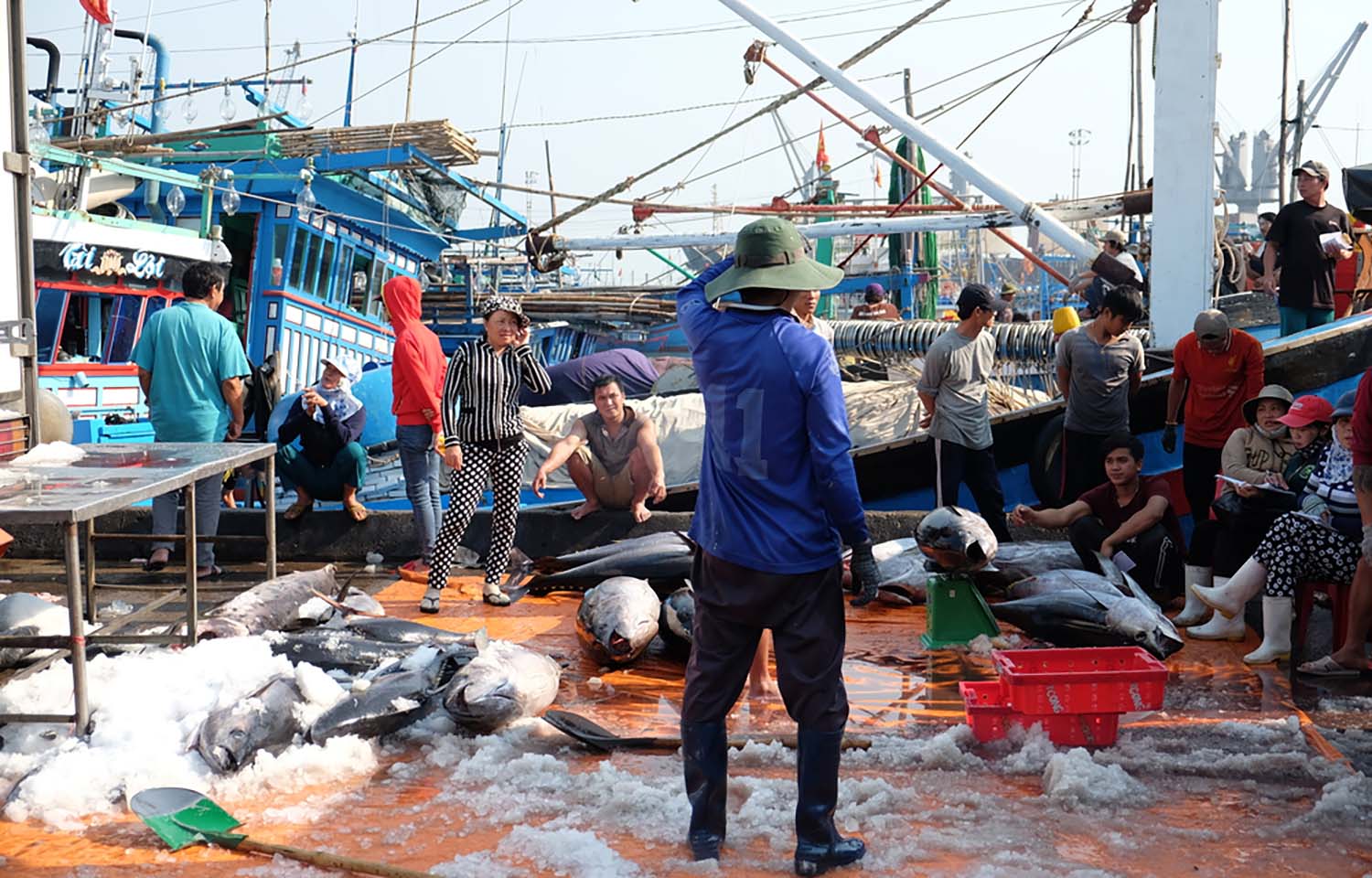
Vietnam’s tuna export industry is under pressure as domestic raw material shortages and stricter compliance rules have eroded its competitiveness in key markets.
The pressures on the industry have intensified recently amid tightening rules on traceability and fishing practices, particularly under a governmental decree introduced last year that restricts the purchase and processing of undersized skipjack tuna. The decree, effective from May 2024, stipulates that fishers may only catch skipjack tuna measuring 500 millimeters or more and businesses are prohibited from purchasing smaller fish for processing and exports.
Citing the adverse impacts the decree has placed on the tuna industry, the Vietnam Association of Seafood Exporters and Producers (VASEP) has repeatedly urged local authorities to reconsider the regulations.
However, despite earlier pledges from top government officials to amend the decree, the revision process remains stalled, forcing businesses to rely on imported tuna in the meantime, which has raised costs and eroded tariff advantages under free trade agreements (FTAs) like the one Vietnam enjoys with the E.U., for example.
“Currently, the amendment is proceeding too slowly and taking too long,” VASEP said. “Despite a directive from Deputy Prime Minister [Tran Hong Ha] to expedite the revision process, the draft has yet to be issued, causing businesses to miss the tuna fishing season and continue to face legal and procedural risks.”
VASEP said delays in revising the decree – initially issued to address E.U. concerns over illegal, unreported, and unregulated (IUU) fishing – have caused domestic fishing ports in Vietnam to stop certifying most skipjack tuna, as the majority of local catch fails to meet the 500-millimeter threshold. As a result, tuna processors have been forced to cancel domestic purchases, and fishing boats across coastal provinces have scaled back operations.
Further, a lack of port-issued origin confirmation has left large volumes of skipjack and yellowfin tuna caught by Vietnamese fishermen ineligible for export to key FTA markets like the E.U., Japan, and South Korea. Without it, businesses cannot secure preferential certificates of origin, putting Vietnam at a disadvantage to competitors like Ecuador and the Philippines that are fully utilizing their FTA benefits and preferential tariff schemes, VASEP said in May 2025.
To maintain business, Vietnamese tuna processors have ramped up imports from E.U. countries like Spain and France, with imports from Spain surging 820 percent and from France 981 percent year over year in the first quarter of this year. Instead of using domestic products, the adapted approach has brought about higher costs, extended shipping routes, and difficulties in obtaining health certificates due to transshipment and container handling complications.
“Unless the challenges stemming from the [governmental decree] are addressed, the shrinking share of eligible Vietnamese-origin tuna could not only reduce income for fishers and processors but also jeopardize Vietnam’s ability to secure a renewed E.U. quota after 2027,” VASEP said.
As a result of the mounting issues, Vietnam’s tuna exports fell sharply in June 2025 to USD 67 million (EUR 58 million), which was down 21 percent from the same month a year earlier.
Tuna exports to the E.U. declined 17 percent year over year in June to USD 16 million (EUR 13.9 million), with sales to key E.U. countries such as the Netherlands and Italy falling by 30 percent and 32 percent, respectively.
Meanwhile, tuna exporters from Vietnam are also facing headwinds in the U.S. – their largest market – with sales dropping 41 percent year over year in June to USD 18 million (EUR 15.6 million). The issue is unlikely to go away soon; although tariffs on tuna imports from Indonesia and the Philippines are just 1 percentage point lower at 19 percent than those from Vietnam at 20 percent, the difference could still be enough to divert long-term contracts, VASEP warned on 24 July.
Shipments to Israel and Russia also declined sharply in June, while ongoing Middle East tensions have continued to disrupt trade flows to the region, VASEP said.
Despite the broader challenges, some market segments continue to show growth.
Exports of frozen tuna loins rose 10 percent year over year in the first half of 2025, supported by higher demand from food processors and supermarkets in Asia and Europe, VASEP said.
Markets under the Comprehensive and Progressive Agreement for Trans-Pacific Partnership (CPTPP), in which Vietnam is a member, have also provided some relief, with total tuna exports reaching USD 62 million (EUR 53.8 million) in the first six months of 2025, marking an 11 percent increase year over year. Exports to Japan and Canada surged 24 percent and 15 percent, respectively.
Additionally, Thailand emerged as a notable bright spot, with imports from Vietnam soaring 137 percent year over year to USD 20 million (EUR 17.3 million) in June, as Thai processors ramped up purchases for re-export, VASEP said.
Overall export value for Vietnamese tuna saw a modest 0.2 percent increase over the first six months of 2025, rising slightly to USD 473 million (EUR 410.4 million).
