




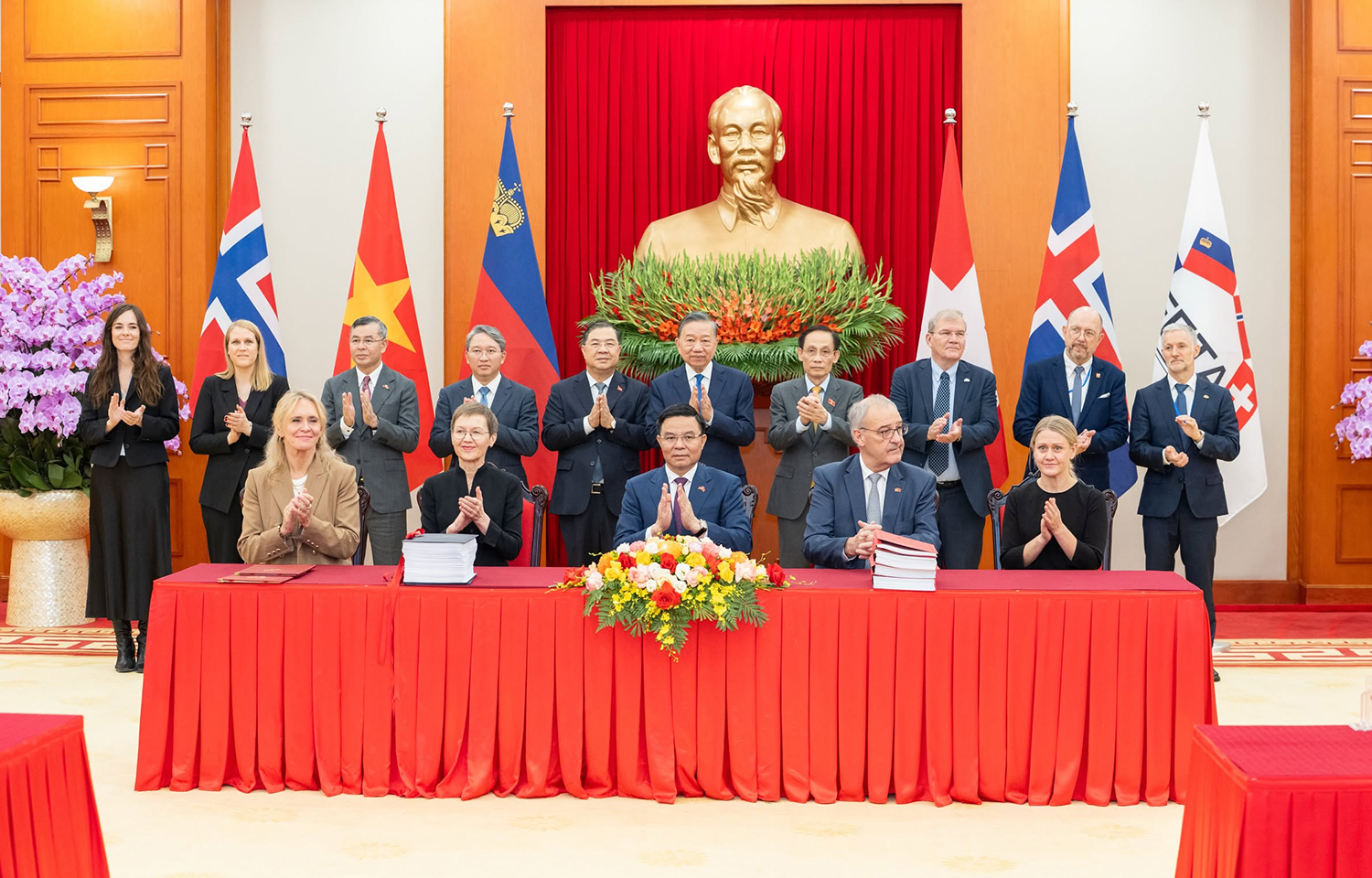
After agreeing on terms earlier this year, Vietnam and the four members of the European Free Trade Association (EFTA) – Iceland, Liechtenstein, Norway, and Switzerland – officially signed a free trade agreement (FTA) on 18 October, paving the way for increased trade between the two parties, with Norwegian salmon and mackerel particularly set to benefit from tariff reductions.
The agreement was signed in Hanoi, Vietnam, in the presence of Vietnam State President To Lam, Switzerland President Guy Parmelin, and Liechtenstein Prime Minister Brigitte Haas.
The FTA covers trade in goods and services, investment, intellectual property, dispute settlement, and sustainable development, among other areas, Vietnam’s Ministry of Industry and Trade explained.
Around half of Norway’s exports to Vietnam will become tariff-free upon implementation, with that total exceeding 98 percent within seven years, Norway’s Ministry of Foreign Affairs said in a statement.
Vietnam currently imposes import tariffs of up to 15 percent on Norwegian salmon and mackerel, but under the agreement, salmon will receive duty-free access as soon as the FTA enters into force, while tariffs on mackerel will be eliminated over three years.
Norwegian Minister of Fisheries and Ocean Policy Marianne Sivertsen Næss said the pact would put Norwegian seafood exporters on a more equal competitive footing with competitors and support further export growth.
The Norwegian Seafood Council (NSC) also welcomed the agreement, highlighting the benefits of tariff-free salmon exports, streamlined customs procedures, and stronger cooperation between the two countries' authorities.
In 2025, Norway’s total export value to Vietnam reached NOK 6.2 billion (USD 660.2 million, EUR 588.8 million), with seafood accounting for more than half of that value at 66,000 metric tons (MT) worth NOK 3.2 billion (USD 340.7 million, EUR 303.9 million). Salmon led the trade flow at 21,300 MT, fueled by a 40 percent year-over-year rise in fresh salmon shipments at 7,900 MT, NSC said.
Regarding trade in the opposite direction, during the first nine months of 2026, seafood exports from Vietnam to Switzerland declined 12.8 percent to USD 24.3 million (EUR 21.7 million), and exports to Norway fell 4.7 percent to USD 11.62 million (EUR 10.4 million), the latest data from Vietnam Customs showed.
VASEP said the FTA could boost those numbers and help Vietnamese exporters develop higher-value markets, particularly for processed shrimp, pangasius, tuna, and other seafood products. However, it warned exporters would need to meet stringent food safety, traceability, and sustainability requirements, as well as product-specific rules of origin to qualify for tariff preferences.
The association also warned that improved market access for Norwegian and Icelandic seafood could intensify competition in Vietnam’s premium seafood, restaurant, hotel, and modern retail segments.
Vietnam Minister of Industry and Trade Le Manh Hung said the government would move forward with ratification and implementation procedures while urging EFTA members to complete their own approval processes, with the aim of bringing the agreement into force in early 2027.
