




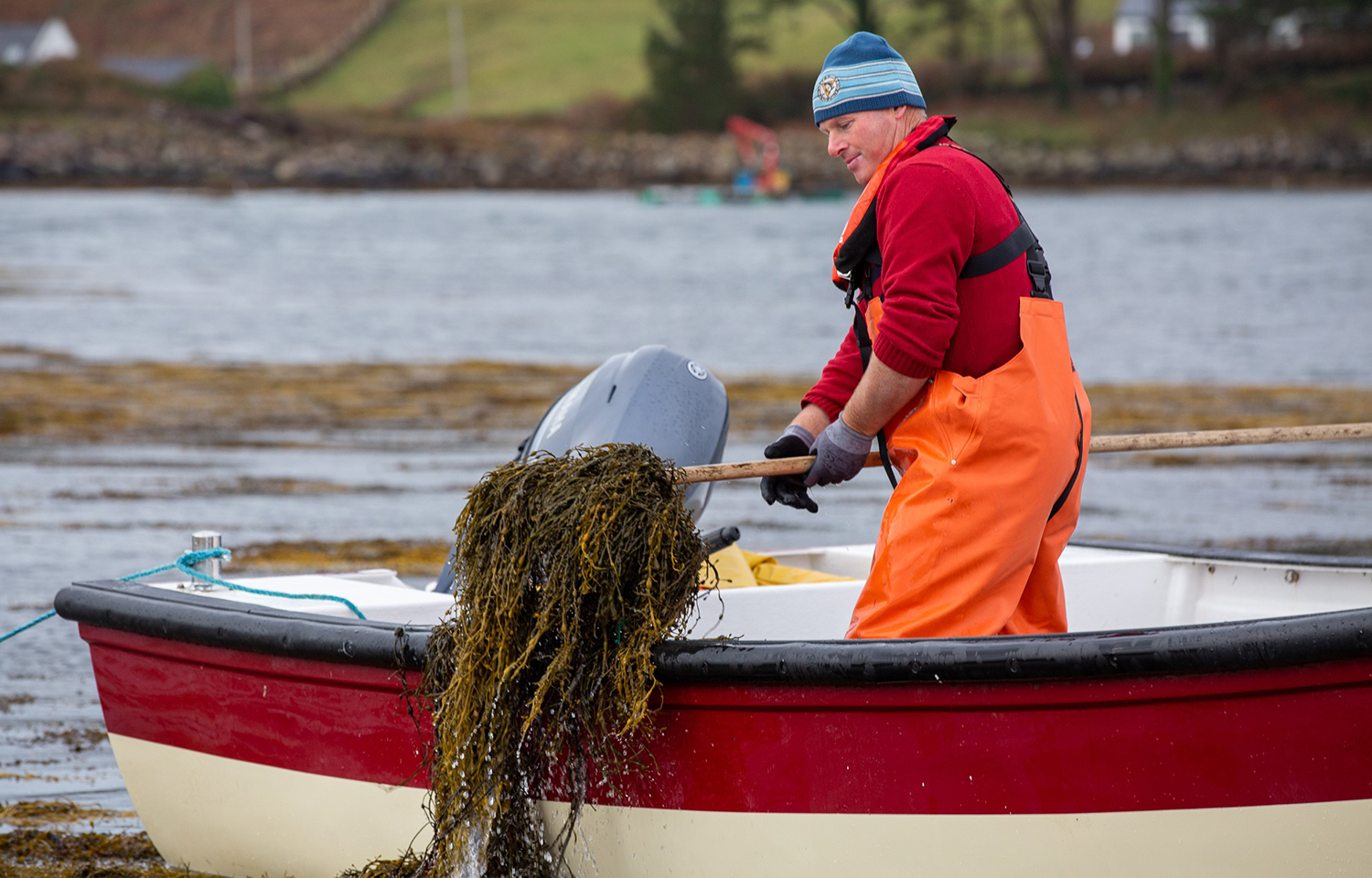
Ireland’s Maritime Area Regulatory Authority (MARA) announced earlier this year that it would be pausing the processing of applications for licenses to harvest wild seaweed from the country’s shoreline until 2027, citing order backlogs and myriad unresolved legal, regulatory, and environmental issues involving the practice.
The pause on applications comes as commercial seaweed-harvesting companies wait on the processing of applications to collect thousands of tons of seaweed off of Ireland’s coast, which has drawn fierce pushback from traditional harvesters and environmental groups.
The issue originally stems back to 2021, when Ireland passed the Maritime Planning Act, which required all wild seaweed harvesters to apply for a Marine Usage License (MUL) by 31 July 2028.
MARA was then created in 2023 to enforce the MUL process but immediately was bombarded with application requests, including submissions from large commercial companies that sought to secure rights to large swathes of Irish coastline, including Nova Scotia, Canada-based Acadian Seaplants Limited, which acquired Irish seaweed firm Arramara Teoranta in 2014 and is seeking to harvest 40,000 tons of seaweed per year, and Irish firm BioAtlantis, which is seeking a license to harvest over 10,000 tons per year.
At the same time, MARA announced that small-scale harvesters who have folio rights to harvest, which were traditionally attached to the ownership of farmland that runs to the shoreline, must register those rights with state agency Tailte Eireann.
A separate category of harvester, with “profit a prendre” rights to harvest, or rights to take an item from the land of another, were also now required to register with Tailte Eireann.
These updated requirements inevitably created a rush of applications from the small-scale sector, too, many of whom have expressed worry that their traditional rights may be impinged upon in favor of larger commercial operators that have applied to harvest large volumes.
“An application from Canadian-owned Arramara led to major concerns about overharvesting; the denial of the rights of traditional harvesters, particularly those with unregistered rights; and the licensing system giving an unfair advantage to large corporations when most harvesters don’t make enough money from harvesting to justify the cost of the license,” Parliamentary Assistant Míde Nic Fhionnlaoich said in April of this year. “There are genuine fears that granting licences to big companies undermines traditional rights and that larger-scale harvesting presents a risk to the ecosystem along our coast. The Minister for the Marine [Martin Heydon] must listen to the concerns of traditional harvesters when it comes to the licensing system.”
Other conservationists and local politicians have also expressed anxiety over the large volumes sought by companies applying for licenses, especially regarding Clew Bay in County Mayo, which is subject to a license application from BioAtlantis but is protected under E.U. law as a Special Area of Conservation (SAC).
Paul Lawless, a teachta dála, or member of Irish Parliament, representing County Mayo, pointed out that the maximum sustainable harvest yield for the county is 16,000 tons, with BioAtlantis seeking over 10,000 tons.
“Does that mean that BioAtlantis takes most of the 16,000 tons?” Lawless said.
Marine ecologist Karin Dubsky emphasized that overharvesting would directly contradict Ireland’s requirements for nature restoration as an E.U. member.
“Under the nature restoration regulations passed in 2024, 30 percent of our brown seaweed forests are to be restored by 2030,” she said.
Speaking to Irish Parliament, harvester Mike O’Curraoin added that licenses should only be given to local landowners and harvesters, “not multinational companies whose primary interest is profit.”
“Our concern is that if large-scale industrial harvesting is allowed, of hundreds or even thousands of tons each year, the shore may not be protected in the same way, especially if harvesting is carried out by people with little understanding of the environment they are working in,” he said.
Replying to O'Curraoin's comments, BioAtlantis CEO John O’Sullivan said his company’s license application for Clew Bay has “taken out areas where there are potentially environmental concerns.”
“We have done a thorough analysis,” he said, adding that his company previously engaged with state agencies to ensure its plans were sustainable.
Meanwhile, Irish clients of seaweed harvesters have expressed concern amid the rising tension that the new licensing regime is generating uncertainty over securing long-term supply.
“It’s definitely on our radar,” Martin Dempsey, the CEO of Sealac, which uses seaweed extracts in animal medicines and purchases from traditional harvesters from counties Mayo and Galway, told SeafoodSource. “If big companies get the rights to the seaweed, where does it leave us?”
Dempsey said he’s worried by the fact that “large companies are looking to control the rights to harvest,” as his own company and others don’t have the financial power to put together an application for a license to compete with larger applicants. “We will wait and see.”
He further explained that the issue is an emotional one for the harvesters from whom he sources.
“Whether they have folio [rights] or not, it’s more than that; it’s tradition. Generation to generation, it’s very deep,” he said.
Dolf D’hondt, the director of marine environmental group StreamScapes, suggested that aquaculture could help fill the gap if more supply is needed.
“If we as a country need more seaweed, we should try to grow it through aquaculture as opposed to trying to fight our coastal communities for the right to harvest wild seaweed,” he said.
To that end, Michael O'Neill, the CEO of Pure Ocean Algae, which farms red seaweed on 100 hectares in Southern Ireland, said a restructured licensing system could, if done properly, allow farmed and wild harvest seaweed to prosper together.
“We can co-exist with these applications," O'Neill said.
Pure Ocean, which is currently focused on the Irish market but hopes to soon tap U.K. and U.S. demand, supplies the human food and nutritional sector. The company has applied for aquaculture licenses for an additional 400 hectares.
O’Neill described Ireland’s seaweed industry as a broad church, pointing to thriving demand for seaweed-sourced biostimulants used in agriculture as one such innovative use case drawing increased demand.
“Looking at the way the seaweed sector is growing over recent years, the industry has a very bright future,” O’Neill told SeafoodSource.
