




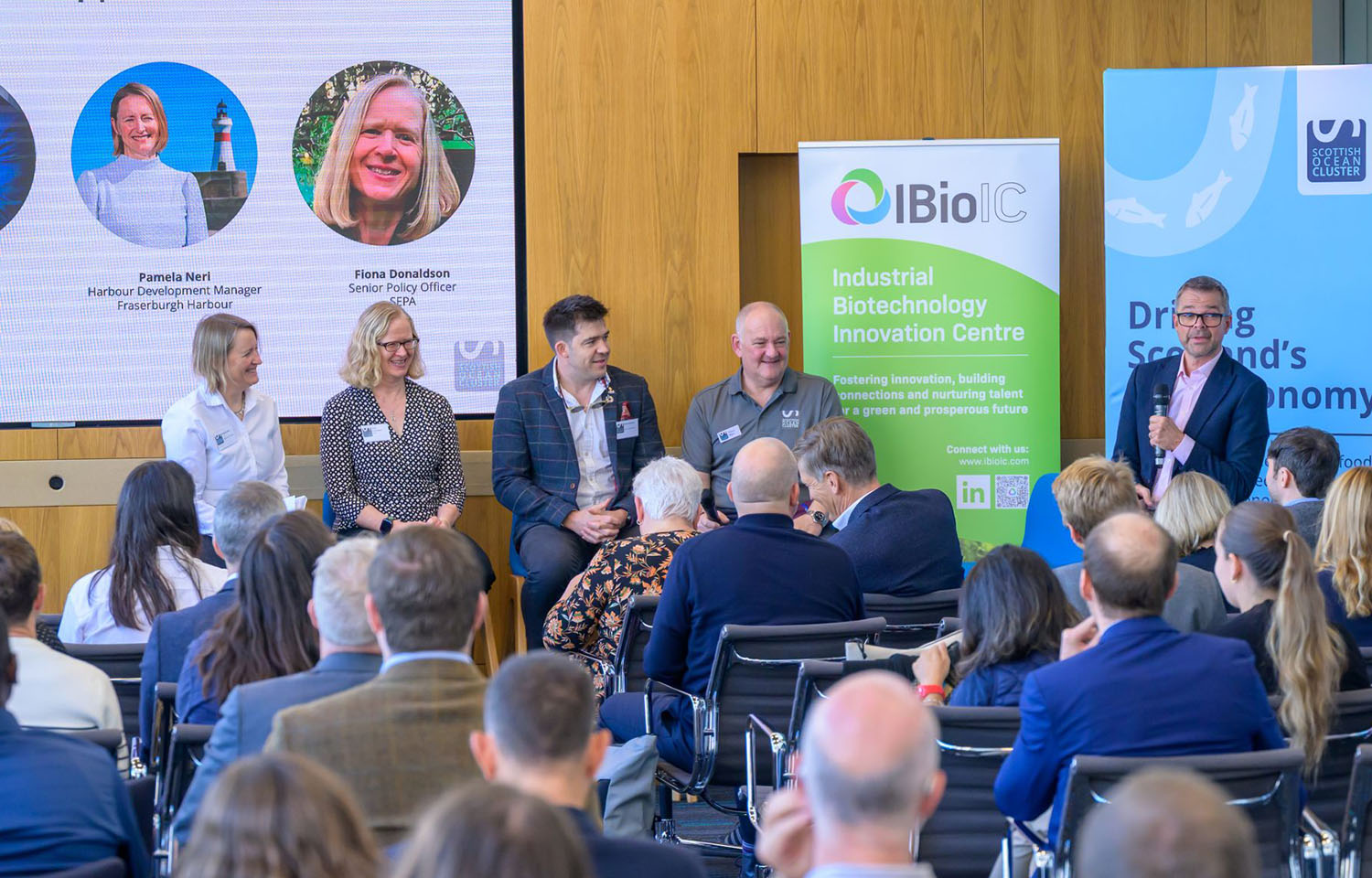
Waste capture could be a major enabler of growth for Scotland's aquaculture sector while creating new market opportunities around the collection, processing, and valorization of seafood side-streams, and the Scottish Ocean Cluster’s inaugural summit highlighted how it is already enabling greater production.
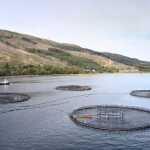
Loch Long Salmon Project Director Mark Shotter, during a panel discussing side-stream opportunities, said capturing waste from salmon farms could allow production to increase within existing environmental constraints by reducing the impact of farming activity on the seabed. He said Loch Long’s closed-containment approach has already demonstrated the scale of the opportunity.
“For the Loch Long site itself, without capturing waste, that one site may have achieved 450 metric tons [MT]. Capturing waste, that site has been consented for 3,450 MT,” he said. “This is an enormous opportunity.”
Loch Long Salmon's closed-pen system is designed to capture solid waste from salmon production, rather than allowing it to enter the surrounding marine environment. The company says its system will capture 88 percent of solid waste for use in green energy production.
Shotter said waste capture therefore offered more than an opportunity to generate value from a previously unwanted material. He suggested Scottish salmon production could ultimately generate a substantial new feedstock for businesses able to collect, process, and find markets for aquaculture waste.
He noted that in a good year, Scotland grows around 200,000 MT of salmon, which means putting about 300,000 MT of feed into those production sites. Some 15 percent of that feed becomes waste.
Estimating, this could amount to around 45,000 MT of dry waste, or potentially around 90,000 MT of material depending on moisture content. The development of waste capture across the sector could create a significant new resource stream, Shotter said.
“Every site that comes online, firstly, it increases the entire pie, absolutely, because of this avenue for sustainable growth,” he said. “But it represents a new challenge: Where does that waste go?”
Shotter said Loch Long Salmon wouldn’t want to become responsible for coordinating waste collection, processing, logistics, funding, and contracts with end users, and would prefer to stick with one company or contract to make waste collection viable. That could create an opportunity for specialist businesses able to take waste from producers, manage its processing, and then sell the resulting material or products into established markets.
“Loch Long Salmon also don't want to make money from this waste. We don't mind someone else making money. We don't want to lose a lot of money, but we're still happy to pay for someone to take that waste,” Shotter said. “So, there's an opportunity for that company to get paid twice: paid once by the farmer by taking the waste, and being paid by the off-taker for this by-product as well.”
Scottish Environment Protection Agency (SEPA) Senior Policy Officer Fiona Donaldson said the body’s objective was to ensure the country’s rules are proportionate to environmental risk while allowing promising innovations to develop.
“We want to work out, is it a waste at all?” she said. “If it is, okay; it's a waste. Let's work out how can we end a waste. Is it an actual legal by-product?”
For emerging technologies, early engagement and good information could make the regulatory process easier, she said, explaining that SEPA needs to understand what materials contain, including nutrients and salinity, as well as what happens during processing and what waste streams or emissions may result.
“The more information you can come to us with, the easier that makes our job,” she said.
The discussion also raised the possibility of a regulatory sandbox for emerging seafood side-stream applications, with Donaldson indicating that SEPA could potentially participate in such an initiative led by another organization.
Scottish Ocean Cluster Engagement Manager Steve Marr, who was formerly involved in food and seafood manufacturing, said one of the biggest barriers to making waste utilization a reality is it is not widely seen by industry as its “core job,” with processors primarily focused on getting their principal products to market.
Scotland's fragmented seafood sector also creates challenges, he said.
“We have 65 species landed here in Scotland,” Marr said. “There are very, very few factories that are working on just one or two species. They're dealing with multiple products, which then gives us a challenge in terms of segregation of those materials, in terms of the volumes we've got that can take into commerciality.”
That fragmentation means collaboration will be essential to adding value to by-products moving forward, he said.
The opportunity therefore lies in connecting seafood businesses with biotechnology companies, research organizations, and other specialists able to turn those materials into commercially viable products.
For the emerging Scottish seafood bioeconomy, that points toward a potentially important new category of business: companies that can act as the commercial integrator between seafood producers and end markets. In this regard, Marr insisted that Scotland already has many of the necessary capabilities across biotechnology, research, enterprise support, and industry, but needed a mechanism to connect them.
“There needs to be a pathway between having this brilliant idea or having a problem that's being solved to seeing that through to the solution,” he said.
The Scottish Ocean Cluster's role, he suggested, can be to act as a hub that directs companies and innovators toward the appropriate expertise, funding, technology, and regulatory contacts.
Seafood Scotland CEO and leader of the Scottish Ocean Cluster Steering Group Donna Fordyce said the challenge now is to make opportunities actionable across the supply chain.
“We've got to communicate to fishermen that every part of that product is valuable, and get it landed properly, get it transported to the factories properly, get it through the factories properly, and sell it for the right price. That is going to take much more than an individual or a single organization,” she said.
