






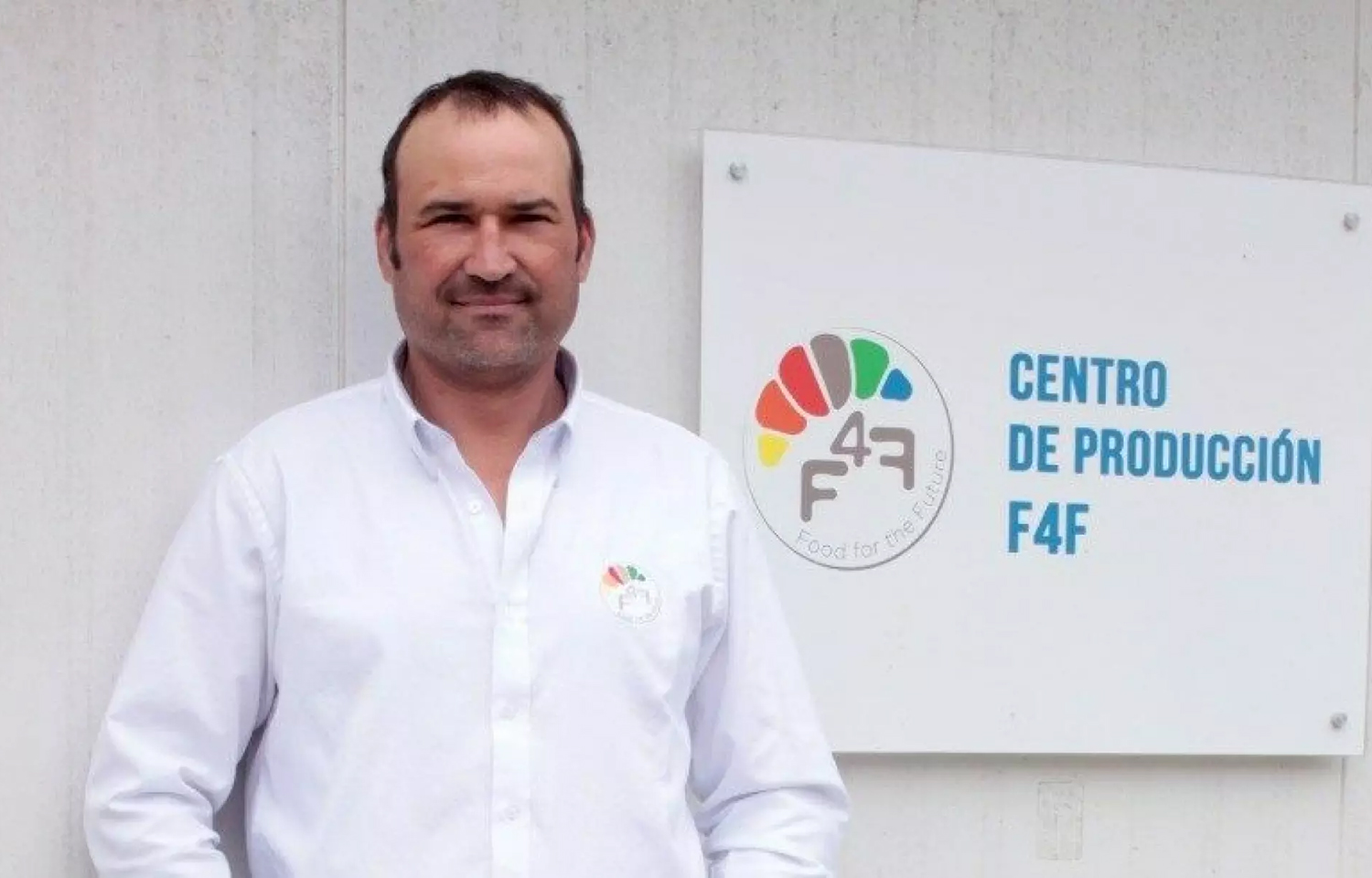
Chilean startup Food for the Future (F4F) breeds black soldier flies to produce alternative aquafeed.
In a recent interview, F4F Commercial Manager Felipe Mayol provided SeafoodSource with information on how far the company has come in its 10 years of existence, an inside view of the company’s current operations, and a look into its future plans.
SeafoodSource: You have a joint commercial campaign with salmon-farming firm Caleta Bay, which uses your feed and markets the end product as environmentally friendly. Is Caleta Bay your largest customer?
Mayol: No, aquafeed manufacturers are my principal customers. They include our alternative aquafeed in their freshwater diets.
This year, 80 percent of our aquafeed is being sold to Skretting, for example. Also, the organic waste coming from two of their plants ends up at our plant [for the breeding of black soldier flies], so it is a perfect circular economy. Then, they sell the feed to the salmon farmers, and we’re not involved in that negotiation.
With respect to the farmers themselves, at one point, we did a complete cycle with some salmon from Multi Export, without antibiotics, in freshwater and seawater. But, today, the farmer with which we have worked the most and have the most developed concept is clearly Caleta Bay.
SeafoodSource: How did this come about?
Mayol: I’ve had to convince technicians at feed plants to include my ingredient in a formula to offer to salmon farmers. We were getting into very technical issues, and in the first few years, it was just a lot of research, learning about nutrition and making sure that our ingredients and our protein meet the amino acid profiles and other things salmon require.
Once the feed manufacturer formulates the diet, they have to sell that diet to the technical manager of a salmon farm, who is another technician and is going to question some things. When the salmon farmer agrees, we have to make sure we’re getting that ingredient to the plant.
Our problem in the first few years was getting our ingredients in the feed plants, and today, we have worked with all of them. We’ve had to climb a mini Everest to get there, and that took us a few years; I’d say we’re in a good place now.
We have also done some tests with coho in [the southern region of] Aysén. The ingredient is already validated in nutritional terms. What has to be checked is scalability, and we at F4F are at that stage.
SeafoodSource: Where are your current operations located?
Mayol: Our plant was located in [the southern city of] Puerto Montt until 2020, but we are now in Talca in the Maule region [in south-central Chile]. Once we demonstrated that the model was scalable, we were producing little and processing a low amount of waste. So, we raised capital and moved to Talca in 2020; during the pandemic, we raised capital because the larva of the black soldier fly is by far the most efficient organism. To produce 1 metric ton [MT] of aquafeed, I need 20 MT of organic waste to feed the larva, have it reach its adult state, and then transform that into protein.
We moved to Talca for industrial scaling to have much greater access to organic waste. Currently, we are receiving approximately 1,000 MT of organic waste per month to manufacture between 35 MT and 40 MT of protein per month.
We sell 90 percent to 95 percent of the feed to the aquaculture industry, with the rest going to petfood and poultry.
SeafoodSource: In the aquaculture sector, your product is meant to complement traditional fishmeal, right?
Mayol: Yes, this insect meal is ready as an alternative protein.
In salmon farming, 70 percent of the industry’s carbon footprint is in the manufacture of feed. We say that the insect protein from the black soldier fly has a negative carbon footprint compared to soybean meal and fishmeal because of the recovery of organic waste that we use to feed our larvae. If that organic waste decomposes in a landfill, that emits greenhouse gases – mainly methane.
We also say that it is a regenerative protein. Although we do not fully replace fishmeal, we help reduce the pressure on the ocean because producing insect protein entails much less fishing in the sea. We help to reduce the forage fish dependency ratio (FFDR), and that is something that certain customers in the U.S. are beginning to demand from their suppliers, which in this case are Chilean salmon farmers. I'm talking about Walmart and other supermarket chains that are already getting involved in the carbon footprint associated with the food they distribute. That’s where the trend is going.
By decreasing use, you automatically decrease the pressure and dependence on pelagic fishing, but I’m never going to have the necessary volume to replace that number of tons [of traditional fishmeal]. That is why it’s an alternative protein; others don’t see us as a threat. In fact, the same fishmeal manufacturers are already seeing their offerings complemented with this type of protein that can be a little more expensive. Supermarkets are already aware of this.
SeafoodSource: What are your projections for the coming years?
Mayol: We’re scaling; every month, we should produce more than the previous one. That means that this year, we are going to close about 450 MT to 500 MT of aquafeed, and the projection for next year is to reach 1,000 MT. Our plant has installed capacity to produce 1,000 MT to 1200 MT per year.
This solution can be replicated in other places where a lot of organic waste is generated and you don’t want to transport it and send it to the landfill. I know that in Chiloé and Puerto Montt, all organic waste ends up in a landfill in Los Ángeles.
At the end of the day, the problem of organic waste is tremendous, and companies and municipalities need additional solutions and alternatives. We operate as a landfill; we have the environmental impact statement, so companies seek us out because they need to dispose of their organic waste in places that are not traditional landfills.
SeafoodSource: Is your focus just in Chile?
Mayol: We have a couple of international projections – mainly the U.S. and Europe – but it has to be a very important client or a very attractive business to replace what we are delivering today. In South America, we have made inroads with Argentina, Peru, and especially Ecuador for shrimp. I think it would be the natural market to export to because they work with the same feed manufacturers and the same companies, so it’s a natural path.
But, Chile is the world's second-largest producer of salmon; there are people who would kill to be in the place where we are to be able to deliver, so we have to make the most of that.
Being in Chile has an advantage over other protein and insect plants in the world because we are close to the salmon. In general, other plants are not in the same country, like in Norway. Chile consumes more than 1 million MT of feed per year. If our ingredient could cover between 1 percent and 10 percent of that total, we’re talking about thousands of tons of insect protein.
The market for us is super attractive with salmon, and we’ll explore petfood, too.
