

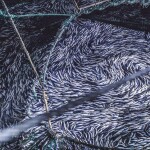

Russia is experiencing a banner salmon season, with the catch so bountiful that fishermen are destroying tons of seafood so as to protect its price in domestic markets.
When the salmon season 2018 started in Russia on 1 June, 2018, the forecast was very promising. The actual results are beyond even those expectations, and the season will undoubtedly reach an all-time high. As of 3 September, 2018, Russian fisheries have caught 587,700 metric tons (MT) of Pacific salmon during the salmon season, which is 63 percent more than during the corresponding period of 2016, the Russia’s Federal Agency for Fisheries (Rosrybolovstvo) announced.
According to Rosrybolovstvo, 116,000 MT of salmon were reported to have been delivered and handled in ports, with 95,000 MT already transported to central regions of Russia. The remainder of the catch will be delivered to ports and handled soon or has been exported, according to the agency.
The total biomass of salmon reaching Russia’s rivers was so great that much of it was not caught and died on shores of the Kamchatka region. In a video posted on Youtube, a local resident revealed tons of Pacific salmon that had beached and lay dying on shores.
Besides the putrid smell, another downside for local residents is that the price for salmon has declined to all-time lows as a result of the glut. The price for salmon is now at RUB 80 to 90 (USD 1.17 to 1.32, EUR 1.00 to 1.12) per kilogram in Russian markets, according to Pravda. The country’s processing facilities weren’t prepared for the record catch, and many have been disposing of excessive volumes of salmon, including dumping them on roadsides and in forests, Pravda reported.
The Russia’s Federal Agency for Fisheries has reported that prices may not change until the end of September, when the vast majority of the catch has been delivered to end consumers.
Broken down by species, Russia has landed 484,000 MT of humpback salmon, 56,000 MT of Siberian salmon, and 42,300 MT red salmon.
The lion’s share of the catch – 477,000 MT – was taken in the Kamchatka region, more than twice its 2016 catch. The Chukotka region also saw a massive, 86-percent rise in its catch to 2,800 MT. The Magadan region caught 7,000 MT of salmon, again more twice as much as in 2016. These figures support the opinion of the head of the Russia’s Federal Agency for Fisheries, Ilya Shestakov, who said in late 2017 that habitats of salmon are moving northward due to climate change.
Other regions, located southward of the record-breaking ones, show negative dynamics or rather modest growth – another argument in favor of the climate change theory – though bad weather conditions also contributed to their lower harvests. The Sakhalin region and the Kuril islands recorded a catch of 74,700 MT, up by just 1,200 MT over 2016, while the Khabarovsk krai region registered a 47 percent decrease in its catch, pulling in just 24,700 MT. The Primorski krai region caught just 2,000 MT of salmon, seven times lower than two years ago, primarily due to bad weather.
