


While fishing is one of Iceland’s most important industries, directly contributing more than 8 percent of GDP, or 25 percent if the indirect effects of the ocean cluster are taken into account, the country is also home to an aspiring aquaculture sector with the recently reintroduced farming of Atlantic salmon leading the current charge.
“It is a small industry but it’s growing,” said Einar Gudfinnsson, chairman of the Icelandic Aquaculture Association (IAA). “It was only last year that we began farming salmon again, producing around 8,000 metric tons (MT). However, we will see in the foreseeable future a slow but steady growth of the salmon sector. This year, we reckon we will see something like 10,000 to 12,000 MT.”
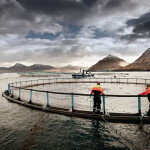
The main areas for producing Atlantic salmon are the west fjords, Patreksfjordur, Talknafjordur, Arnarfjordur, Dyrafjordur and Isafjardardjup and on the east fjords in Berufjordur, Faskrudsfjordur and Reydarfjordur.
At the same time, Iceland has been producing rainbow trout (4,000 MT annually) and Arctic char. In fact, the country is the lead producer of Arctic char; its output – also 4,000 MT – accounts for approximately 80 percent of world production. The species is farmed in land-based stations.
“When it comes to quantity, it’s not huge,” acknowledged Gudfinnsson. “But we will see continuous growth of the Arctic char over the coming years.
“The greatest growth in production, though, will come from salmon farming. There are five companies that are now preparing for the production of salmon. In 2018/19 we will come close to 20,000 MT and after that we will reach the limit of 25,000 MT of salmon. Definitely it is a growing industry, but the overall capacity is limited.”
There are a number of reasons behind this slow but steady growth forecast. From the outset, before anyone can obtain a permit to produce salmon in open sea cages, authorities need to be satisfied on a number of criteria. Crucially, the Marine Research Institute (MRI) has to make an evaluation of how much production can be achieved by the area in question, and before this evaluation can be made a lot of scientific studies need to take place.
No work can be conducted by producers at these locations until the MRI’s evaluation has been made, explained Gudfinnsson.
Next, there are several aspects that need clarification, which is “a complex and slow process,” which in IAA’s experience can take years before permits are issued.
Last but not least, there is very limited salmon smolt production in Iceland, which limits the industry’s production to the aforementioned 25,000 MT. While it is clear that the industry needs to invest “considerable sums” in additional smolt facilities, no company is willing to take those steps until the permission process has been clarified and it has been confirmed they can get the permits that they have applied for, said Gudfinnsson.
“So there is this delay. The limit now is just 25,000 MT and I am of the opinion that in the next four to five years the limit will remain at that level. Only after authorities have given permission can the companies start growing their smolt facilities and their smolt production. That goes some way to explaining how slow the progress will be over the next coming years.
“I have been very hesitant to state on how this will look in the long run as there are many questions to be answered. However, from my point of view, there is great potential for further growth, but it will take time.”
With regard to the consumption of Icelandic salmon, the lion’s share of production is going to overseas markets.
“Iceland is such a small domestic market. The population is just around 330,000 people plus a prosperous tourism sector. Therefore, the overriding proportion of production goes abroad, particularly the United States, where Whole Foods is a major buyer of these products.
“Our salmon and trout products are also going to Europe, but we see a lot of potential in new markets, such as China. Iceland is one of the few countries in the world and unique in Europe to have a free trade agreement with China so we have great hopes for being able to export to that market with success in the near future,” said Gudfinnsson.
