






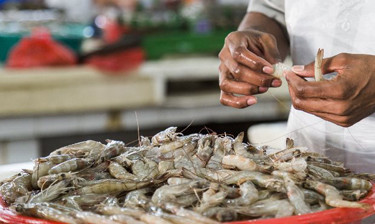
Earnings from India’s shrimp exports will near double to USD 7 billion (EUR 5.9 billion) by 2020, expects international ratings and analysis agency CRISIL, with the growth driven by strong demand, high quality, improved product mix, and an increase in the aquaculture areas in Andhra Pradesh, Gujarat, Odisha and West Bengal.
According to CRISIL, in fiscal 2016, India became the biggest exporter of shrimp, surpassing Vietnam by USD 100 million (EUR 84.8 million). A year on, the country has "decisively pulled ahead," racking up USD 3.8 billion (EUR 3.2 billion) in exports as Vietnam “flatlined” at USD 3 billion (EUR 2.5 billion).
It said that since 2010, Vietnam’s shrimp production had declined by around 40 percent from its peak levels because of a shortage of fresh water, salinity intrusion and illegal shrimp farming, while Thailand, which was once the top exporter, is now ranked 5th after a 65 percent “plunge” in production. Furthermore, in 2016, China’s shrimp production “nosedived” by 60 percent while its consumption more than doubled, rendering it a marginal exporter. These countries also faced significant quality challenges, it added.
In contrast, CRISIL said that in recent years Indian exporters have put emphasis on lower-density shrimp farms to control diseases, while maintaining quality across the value chain. The sector has also been helped through the use of resilient specific pathogen free (SPF) broodstock imported from the United States. Consequently, between fiscal 2012 and 2017, India’s shrimp production doubled, and helped it grab the opportunity created by lower supplies from Asia.
It rated 75 shrimp exporters, whose revenues grew at a compound annual growth rate of 9 percent between fiscals 2015 and 2017 to more than USD 2.2 billion (EUR 1.9 billion) and contributed to 60 percent of India’s shrimp exports.
It acknowledged that rival producing nations are trying to get their house in order. For example, improving hatchery procedures are helping Thailand recover slowly, but added that Vietnam is expected to take more time to sort out its quality issues, while China is struggling with both structural issues and surging domestic demand.
Consequently, India’s primacy in shrimp exports is unlikely to be seriously challenged over the medium-term, said CRISIL. Additionally, larger Indian exporters are expanding infrastructure to cater to increasing demand for value-added products from big global retail chains and restaurants. Therefore, its also foresees value-added exports rising significantly from the current level of around 15 percent.
“Strong volume growth and higher proportion of value-added products will bolster the operating profitability of CRISIL-rated shrimp exporters. Additionally, healthy accretions and the absence of major debt-funded capital expenditure will reduce leverage and further strengthen their credit profiles,” said Rahul Guha, director of CRISIL Ratings.
