





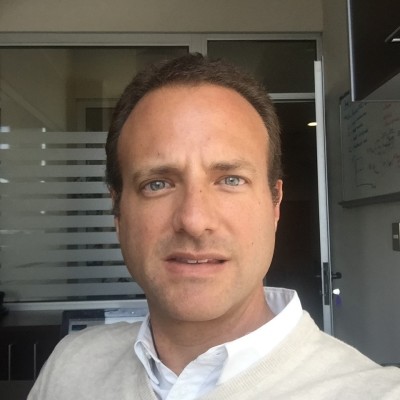
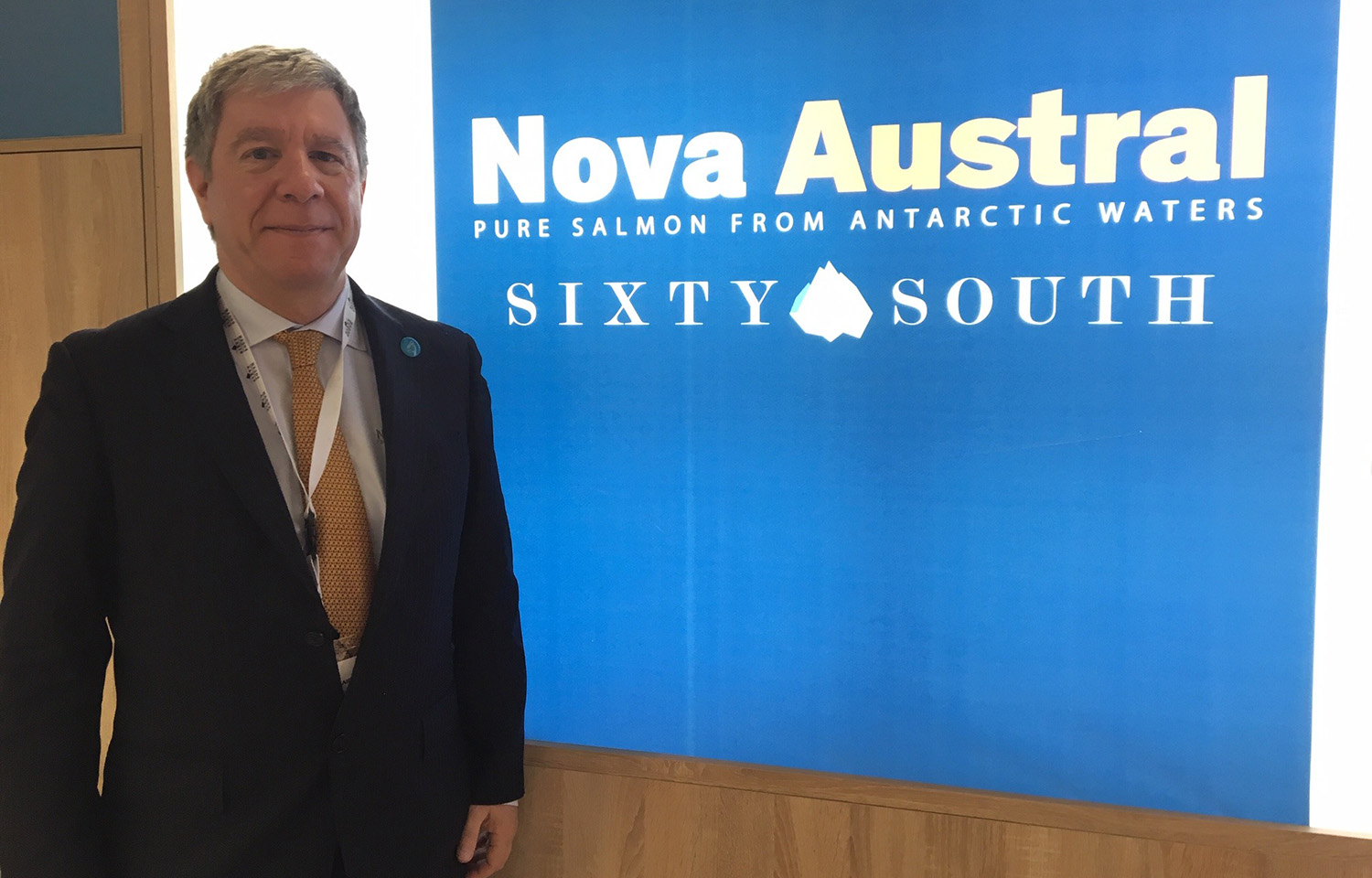
Nicos Nicolaides – the former CEO of salmon-farming firm Nova Austral who in January was fully acquitted of all charges levied against him for supposed crimes committed when he worked at the firm – has begun to publicly discuss his case and its impact on the Chilean salmon industry.
In an interview broadcast on the radio program “Salmon en la Patagonia” on Patagonia Radio, the former CEO discussed both the court ruling and the personal and industry consequences suffered as a result of the case.
The latest, binding decision from the court of appeals in Chile’s southernmost city of Punta Arenas reversed a criminal conviction of Nicolaides issued in July 2025 in which he and other former Nova Austral executives were sentenced to prison and ordered to pay fines for alleged environmental crimes committed between 2016 and 2019.
The executives had been accused of not only falsifying mortality reports, for which Chile’s National Fisheries and Aquaculture Service (Sernapesca) began investigating Nova Austral in 2019, but of also having the company stock salmon beyond legal limits. The prosecutor in the case said that the accused individuals had introduced sand and chemicals into the waters at the company’s salmon farms located in Alberto de Agostini National Park to cover up pollution caused by that overproduction.
The former Nova Austral executives were also accused of fraud by deceitfully obtaining CLP 59 billion (USD 62.5 million, EUR 54.5 million) for the firm through bonuses under the nation’s Navarino Law – a regime under which the government offers tax and customs benefits for industrial companies that operate in Chile’s Magallanes region.
Nicolaides now has said that the most difficult part of this six-year process was having to endure the personal attacks against him, including from Nova Austral’s Norwegian owners at the time.
“The Norwegians, I think badly advised, said, ‘Let’s give compensated denunciation a try because if we use Nicos as a scapegoat, maybe nothing will happen to the company.’ They threw me under the bus,” he said. “But even worse, I am not the one who sent the [falsified] information … although my board and I were absolutely aware of it. So, it was a true betrayal that my accomplices in this matter started to get angry and even started attacking me. I would say that's the hardest thing of all.”
Responding to legal counsel at the time, Nicolaides remained silent throughout the process, which he noted was also frustrating.
“How does this work with social networks and the press? You're guilty. You have no right to defend yourself. They say bad things; they hit you very hard everywhere,” he said. “Not only can you not defend yourself, but there was also certain pressure from the company itself whose lawyers told me, ‘Don't talk to anyone.’ The Norwegian owners of the company, too … because [they] and the two investment funds didn’t want to get affected.”
Nicolaides said that with the acquittal, he now feels “happy.”
“It's been six years, which has been like carrying a very heavy backpack, going uphill with that backpack, and you get to the top and take off the backpack,” he said. “Everything is over; the sentence is absolute. That's the first effect that provides a lot of peace of mind because I had to dedicate a lot of resources, a lot of time to defend myself. Because in this system, you have to prove that you are innocent.”
Nicolaides admitted that the case raised awareness regarding environmental limits in the industry.
“I would say there was a laxity in the industry and particularly the company that I directed. We did not give it much importance and we adjusted the figures to our liking, which is not right,” he said, adding that the lax attitude changed when the government decided to enforce the law and make it a crime to overproduce or misreport. “No company in Chile wants its manager to go to jail and for something of such little relevance and so little effect.”
Another effect of the case, according to Nicolaides, was that companies began to improve their control systems to avoid any mistakes or failures in their production systems, explaining that the industry has become highly regulated today.
Though he admitted to environmental offenses, Nicolaides said what took place at Nova Austral “was not serious.”
“It was not pollution, it was not a health problem, and it did not affect third parties,” he said.
The executive also said that Nova Austral’s early development was still a source of personal and professional pride. The firm was bankrupt when he took over in 2014, and Porvenir, where the firm is based, was experiencing a shrinking population of about 2 percent per year when he took over.
Nicolaides said he was able to turn the company around within three years, making it “by far the best salmon farm in Chile – the only one that to this day farms without using a drop of antibiotics.”
Under its Sixty South brand, named for its operations near the 60th southern parallel, the company was able to get onto restaurant menus, selling at 60 percent above average market prices, while its business activities resulted in an injection of CLP 2.5 billion (USD 2.88 million, EUR 2.44 million) per month into Porvenir’s economy. The company donated USD 600,000 (EUR 508,000) per year to the town to implement programs such as “English for the future” where American teachers were invited to live in the town and teach its schoolchildren, Nicolaides said.
With respect to his own future, Nicolaides did not rule out getting back into the salmon business.
“I think I have a lot to contribute, especially since no other company in Chile has achieved what we achieved at Nova Austral,” he said. “There is an experience that I would love to be able to share.”
In the meantime, though, the acquitted executive said he has found a new passion: ensuring sources of high-quality freshwater for various industries.
“We have solved rural drinking water problems for the population, and we have solved water quality issues for fish farming. We have many customers within the industry because fry need very good water quality to grow fast and vigorous,” he said. “Of course, there is also water for farmers. We have many farmers – cattle ranchers, dairy farmers, and fruit growers – who are our customers. So, today, I dedicate a lot of time to that and always with an eye on the [salmon] industry because it is an exciting thing.”
Nicolaides stepped down in 2019 over the accusations of environmental wrongdoing. After that, Nova Austral completely restructured its executive staff and sought to strengthen its internal practices and controls.
The firm also underwent a change of ownership in September 2024 following its judicial reorganization, whereby the Larta Investment Group took over as sole owner. Nova Austral now has a different management team, new shareholders, and a different board of directors than those in place at the time of the events outlined in the case.
