




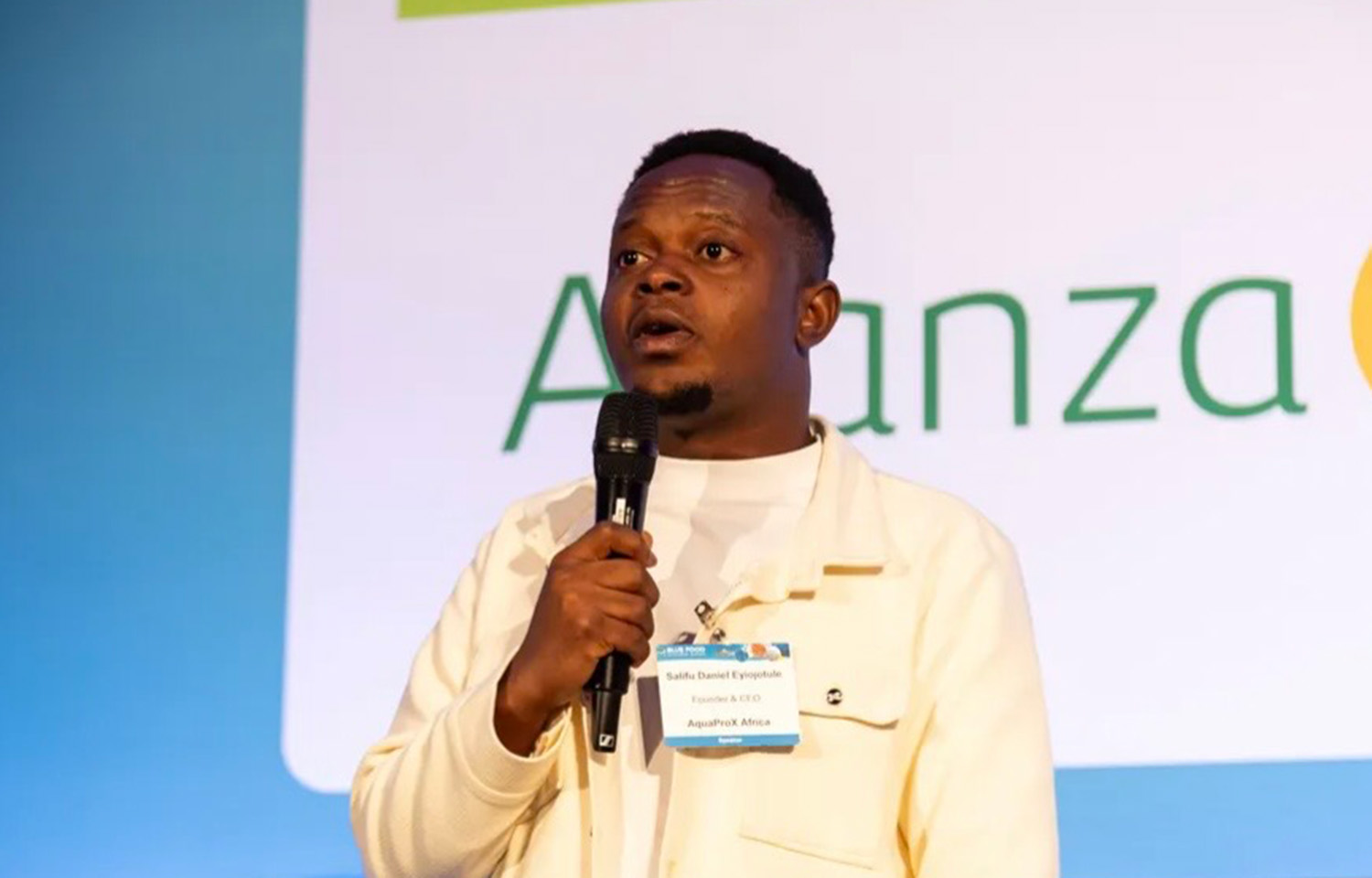
Salifu Eyiojotule Daniel is the founder and CEO of AquaProX Africa, a youth-led aquaculture innovation organization based in Abuja, Nigeria.
His work focuses on sustainable aquaculture, youth empowerment, food security, technology adoption, and blue economy development across Africa. He is currently leading the development of the AquaProX Hub, an initiative aimed at advancing aquaculture training, innovation, and enterprise development in Nigeria. He was the only African founder selected to pitch at the 2026 Blue Food Innovation Summit in London, where AquaProX Africa finished second in the audience vote
Standing on a salmon pen in Scotland earlier this year, surrounded by screens displaying fish health metrics, feeding patterns, environmental conditions, and production data in real time, I realized something important.
The gap between African aquaculture and many of the world’s most advanced aquaculture systems is not simply technology.
It is systems.
Over the past decade, conversations about African aquaculture have often focused on what the continent lacks: investment, infrastructure, technology, feed, equipment, financing, and technical expertise.
There is truth in those observations. Yet, after spending time this year at the Blue Food Innovation Summit in London and visiting leading aquaculture institutions and companies across England and Scotland, I came away convinced that the most important gap is not what many people think.
Africa does not suffer from a lack of opportunity. Africa suffers from a lack of systems that consistently transform opportunity into outcomes. That distinction matters because if we misunderstand the problem, we will continue investing in solutions that fail to achieve their potential.
The opportunity is already here
Nigeria alone consumes more fish than any other country in Africa. Yet, despite significant domestic production, the country still imports billions of dollars’ worth of fish annually.
For many observers, this statistic represents a problem. I see it as an opportunity.
Demand already exists. Entrepreneurs already exist. Farmers already exist. Young people eager to build careers in aquaculture already exist.
What remains is building the systems capable of connecting these elements into a productive and sustainable industry.
This challenge is not unique to Nigeria. Similar opportunities exist across much of Africa, where growing populations, increasing protein demand, and abundant aquatic resources create enormous potential for aquaculture expansion.
The question is no longer whether Africa can grow its aquaculture sector.
The question is how.
What I saw in the United Kingdom
Following the Blue Food Innovation Summit, I had the opportunity to visit a range of organizations across the United Kingdom, including the Institute of Aquaculture at the University of Stirling, Bakkafrost Scotland, BioMar, Cooke Aquaculture, ChalkStream Foods, Forth Marine Hatchery, and the National Robotarium at Heriot-Watt University.
Each organization operated in a different context. Each faced different challenges, yet they shared one characteristic: They were all built around systems.
At Bakkafrost Scotland, production decisions are supported by continuous monitoring and data collection. At BioMar, feed manufacturing is informed by research, nutritional science, environmental considerations, and long-term planning. At the University of Stirling, researchers work closely with industry to ensure scientific knowledge does not remain trapped within academic institutions.
At every site, information flowed continuously. Problems were identified early, decisions were measured, performance was monitored, and learning was institutionalized.
This was not simply about having more money or more technology; it was about creating environments where better decisions become possible.
The missing layer
In many African aquaculture systems, farmers often operate with limited access to timely information.
Disease outbreaks may only be detected after significant losses occur. Water quality issues are often identified after fish begin to show visible signs of stress. Feed decisions may be based on experience alone rather than data. Production records are frequently incomplete or nonexistent. Extension services remain limited in many areas.
None of this reflects a lack of intelligence or commitment on the part of farmers. African fish farmers are among the most resilient entrepreneurs I have ever met.
The challenge is that many are being asked to make complex production decisions without the support systems available to their counterparts elsewhere.
The result is predictable: higher risk, lower productivity, reduced profitability, and slower industry growth.
When conversations about aquaculture development focus exclusively on physical infrastructure, we often overlook this missing layer.
Information infrastructure matters, knowledge systems matter, decision-support systems matter, and data matters.
Why technology alone is not enough
Technology is frequently presented as the answer to Africa’s aquaculture challenges.
Technology certainly has an important role to play. Artificial intelligence, remote monitoring, predictive analytics, automated feeding systems, digital record keeping, and improved communication tools all have enormous potential.
However, technology alone will not solve the problem.
Technology becomes transformative only when it is integrated into broader systems of training, education, management, collaboration, and knowledge exchange. A sophisticated monitoring platform is useless if farmers lack the skills to interpret the information it provides. A mobile application cannot replace effective extension support. Artificial intelligence cannot substitute for strong institutions.
The future of African aquaculture will not be built by technology alone. It will be built by combining technology with people, partnerships, education, and systems thinking.
The role of youth
One of Africa’s greatest advantages is its young population.
Across the continent, young entrepreneurs are entering aquaculture not simply as producers but as innovators.
They are building digital tools, they are developing new business models, and they are creating solutions tailored to African realities.
This is where I believe some of the most exciting opportunities exist.
The future of African aquaculture may not look exactly like the systems developed in Scotland, Norway, Canada, or Chile, nor should it.
Africa’s future will be shaped by adapting global lessons to local conditions.
The goal is not replication. The goal is innovation.
Building bridges, not copying models
One of the most valuable lessons from my recent experiences is that international collaboration works best when it focuses on exchange rather than imitation.
Africa does not need to become a copy of Europe. European aquaculture systems developed within specific economic, regulatory, environmental, and social contexts. African systems will develop within different realities.
What matters is learning from proven approaches while building solutions that reflect local needs.
Partnerships between universities, companies, governments, entrepreneurs, and development organizations can accelerate this process.
Knowledge transfer may ultimately prove more valuable than equipment transfer, relationships may prove more valuable than donations.
Systems may prove more valuable than individual projects.
Looking forward
The future of African aquaculture is bright. Demand is growing, innovation is accelerating, young entrepreneurs are stepping forward, international interest is increasing.
Achieving the sector’s potential will require a shift in thinking.
We must move beyond conversations focused solely on production volumes and infrastructure investments.
We must pay equal attention to information systems, knowledge networks, decision-support tools, workforce development, research partnerships, and institutional capacity.
The future of aquaculture will not belong to those with the largest farms.
It will belong to those who consistently make the best decisions using the best information available.
Africa does not need saving; Africa needs systems. If we build them well, the continent will become one of the most important aquaculture growth stories of the 21st century.
