






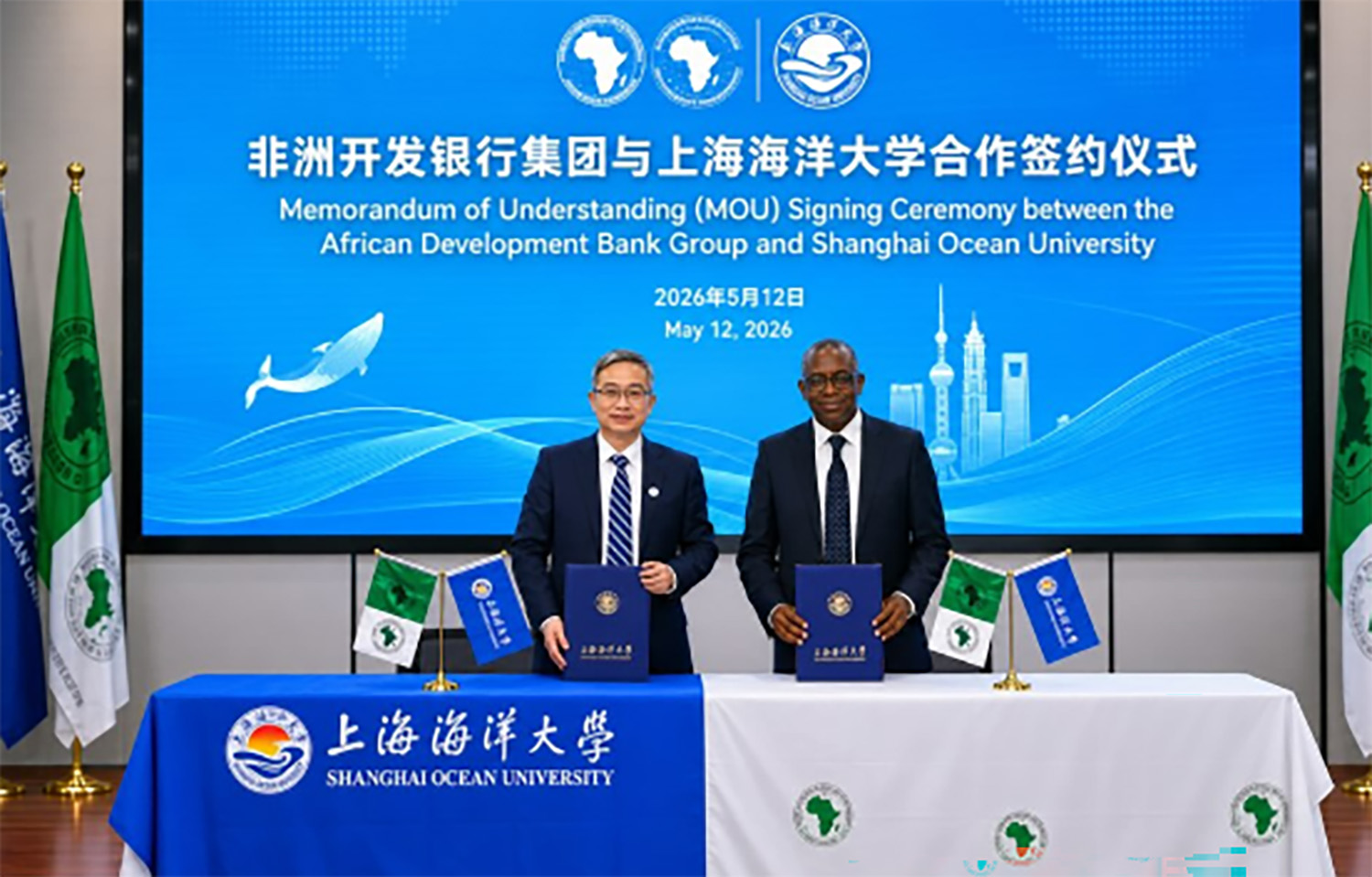
The African Development Bank (AfDB) recently signed a memorandum of understanding with Shanghai Ocean University, aiming to offer African entrepreneurs across the blue economy access to training, scholarships, short-term professional programs, collaborative research opportunities, and more.
AfDB Vice President Jacques Edjangue said the deal should help modernize how Africa approaches its aquaculture and wild capture operations.
"Shanghai Ocean University has worked together with AfDB in the past. We want to formalize the partnership that we've already embarked upon through joint training and capacity building programs," he said. “The one thing that I really felt like we need in Africa is how Shanghai Ocean University is using AI in this space. This represents exactly the kind of technology we have to explore moving forward.”
According to Shanghai Ocean University, the collaboration could also eventually include the future establishment of fisheries innovation hubs in African countries, with a particular focus on integrating cutting-edge technologies within maritime industries.
Officials across Africa have expressed hope that the deal will be helpful in advancing the continent’s seafood industry, as well as offering opportunities for professionals in the space to succeed.
Nor Daud Ibrahim, a fisheries biologist at the Somalian Ministry of Fisheries and Blue Economy, told SeafoodSource he hopes the deal will help Somalia harness Chinese technological know-how, specifically regarding fisheries management.
“The agreement is relevant to Somalia as part of a wider push toward technology-driven fisheries governance and capacity building in Africa, including training, research collaboration, scholarships, and potential use of AI-based vessel monitoring systems, which align with one of Somalia’s priorities for strengthening fisheries management, combating illegal fishing, and improving institutional capacity,” he said.
Osadobe Anwuzia, the founder and CEO of Extrapro International Company, which is a trade consultancy firm based in Port Harcourt, Nigeria, similarly said that Chinese expertise could help the continent’s seafood sector, such as by reversing poor yields at African aquaculture farms that are often caused by disease and other issues.
Besides knowledge sharing, he added that Chinese involvement more broadly may open up new avenues for financing in the African seafood sector, which would come in handy as support from African governments has been erratic.
“Many fish farmers struggle to get loans or investment support because banks often consider aquaculture risky,” he said. “High interest rates also discourage expansion.”
Anwuzia said government grants and low-interest loans could stimulate investment in local feed production, training, hatcheries, and cold chain infrastructure.
“Aquaculture in Nigeria has huge potential, but the industry faces many serious challenges,” Anwuzia told SeafoodSource, particularly pointing toward the cost of quality feed. “Most quality feeds are imported or produced with expensive raw materials, making production costs very high for farmers. Constant electricity is also needed for water pumps, aerators, cold storage, and hatcheries. Poor power supply forces farmers to rely on expensive generators.”
Luca Micciche, the global portfolio manager for aquaculture at Denmark-based firm Novonesis, agreed that China could act as a potential “enabler of global aquaculture growth.”
“My overall view would be that in emerging regions, including parts of Africa and Southeast Asia, China’s role is largely positive as it helps build the industry and lowers the barrier to entry,” he said. “In more mature, export-oriented segments, however, it is clearly a very strong competitor.”
Micciche further explained that the relatively undeveloped state of African fisheries presents “an opportunity to build the sector in a more structured way and, in some cases, to leapfrog directly to more modern farming systems if the right investment and partnerships are in place.”
“In simple terms, Asia is about scaling efficiently and managing risk, whereas Africa is about building the system and unlocking latent demand,” he said.
Though there is shared optimism, Anwuzia emphasized that major systemic, economic, and governance issues would have to be mitigated for the MoU to reach its full potential.
“Fish theft from ponds and insecurity in some farming areas discourage investment and increase operational risks. Bad roads make it difficult to transport fish feeds and deliver harvested fish to markets quickly,” he said, adding that competition from cheap imports also hurts the sector. “Imported frozen fish often sells cheaper, making it difficult for local fish farmers to compete effectively.”
Another issue with more Chinese involvement includes illegal fishing concerns surrounding China’s distant-water fishing fleet.
Nor said these concerns are particularly relevant in Somalia but the country still welcomes Chinese support.
“Concerns are often raised about foreign fishing activity in Somali waters, including reports involving Chinese fleets, which remain a sensitive issue in fisheries governance discussions,” he said. “However, Somalia also maintains close cooperation with China in parallel, including support for capacity building in fisheries and blue economy development and provision of scholarships for Somali students in various fields, including marine and related sectors.”
The MoU represents the latest action taken by Shanghai Ocean University to build links with African countries.
For instance, the university recently signed an MoU with the Seychelles aimed at “strengthening cooperation in the fields of fisheries science, aquaculture, ocean governance, marine technology, and capacity building.”
