




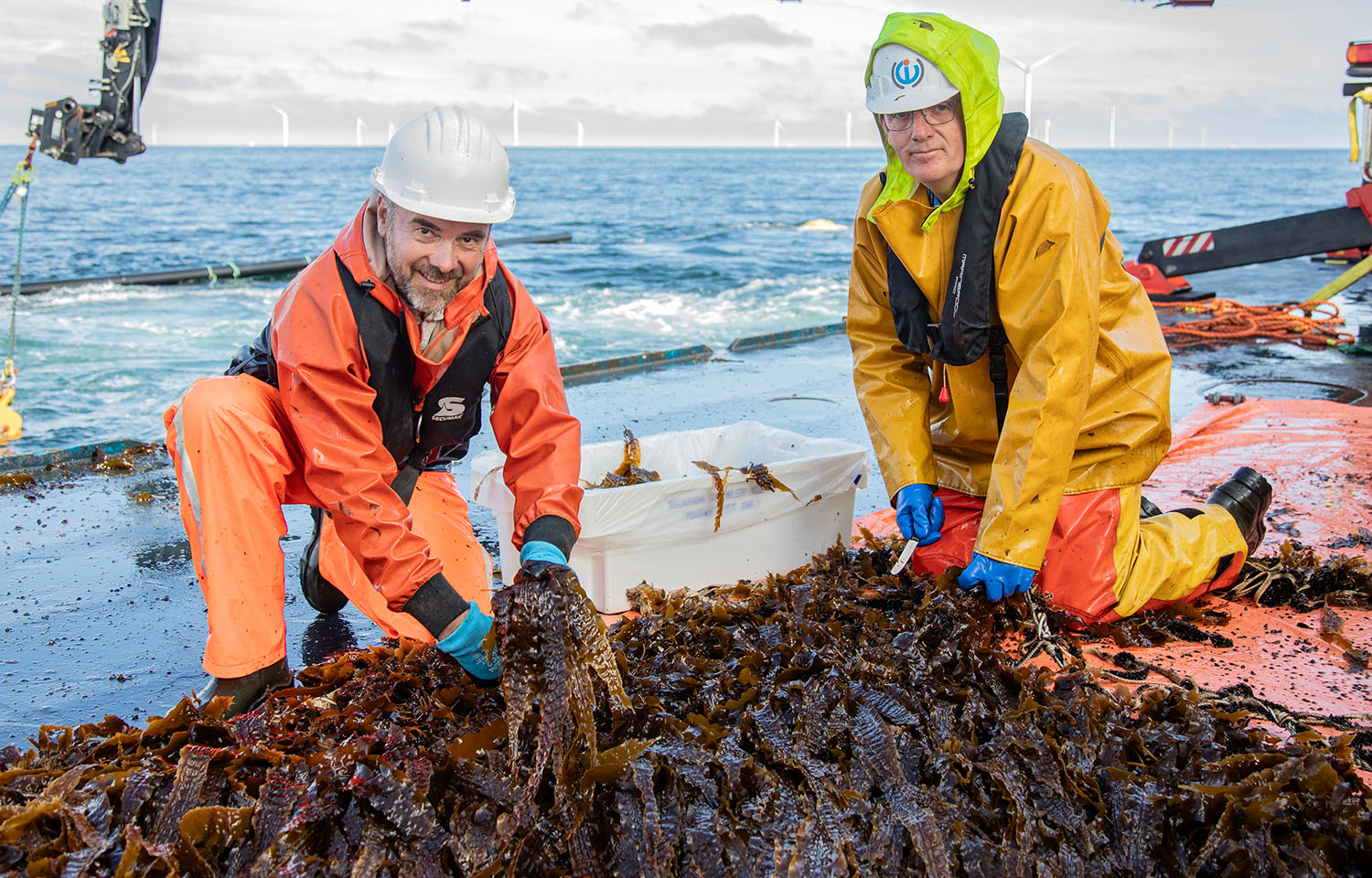
Scheveningen, Netherlands-based North Sea Farmers has completed its first seaweed harvest, the Amazon-backed company announced on 14 July.
North Sea Farm 1, the site where the harvest took place, is the world’s first commercial seaweed farm located in a field of wind turbines, which protects it from maritime traffic.
Amazon Netherlands and Belgium Country Manager Eva Faict called the harvest, which will not be sold but used for research purposes, a “significant moment” for the first-of-its-kind project.
"Together with North Sea Farmers, we have proven that cultivated seaweed farming among offshore wind turbines is a viable commercial concept,” Faict said.
When Amazon first partnered with North Sea Farmers, then-Amazon E.U. Director of Sustainability Zak Watts said that “seaweed could be a key tool in removing carbon dioxide from the atmosphere, yet it’s currently farmed on a relatively small scale in Europe.”
The North Seas Farmers project intended to change that while also addressing the issue of marine overcrowding, over which European fisheries and wind energy stakeholders have expressed their frustration.
North Sea Farmers Managing Director Eef Brouwers said, in the firm’s 14 July release, that the goal of the project was to "demonstrate whether farms like this can have a positive long-term impact on both biodiversity and climate change mitigation."
"At the same time, we're proving that seaweed production within an existing offshore infrastructure is possible at a commercial scale," he said.
Plymouth Marine Laboratory Climate Change Lead Professor Ana Queirós agreed that the harvest would help researchers “to understand the effects of the seaweed farm on the immediate and surrounding marine environment.” She is particularly interested, she said, in studying the project’s potential for carbon sequestration.
"It's vital projects like this are underpinned with rigorous scientific evidence, particularly given the urgency of the climate and biodiversity crisis and the need to find scalable mitigation measures that produce genuinely beneficial and sustainable outcomes,” Queirós said.
