



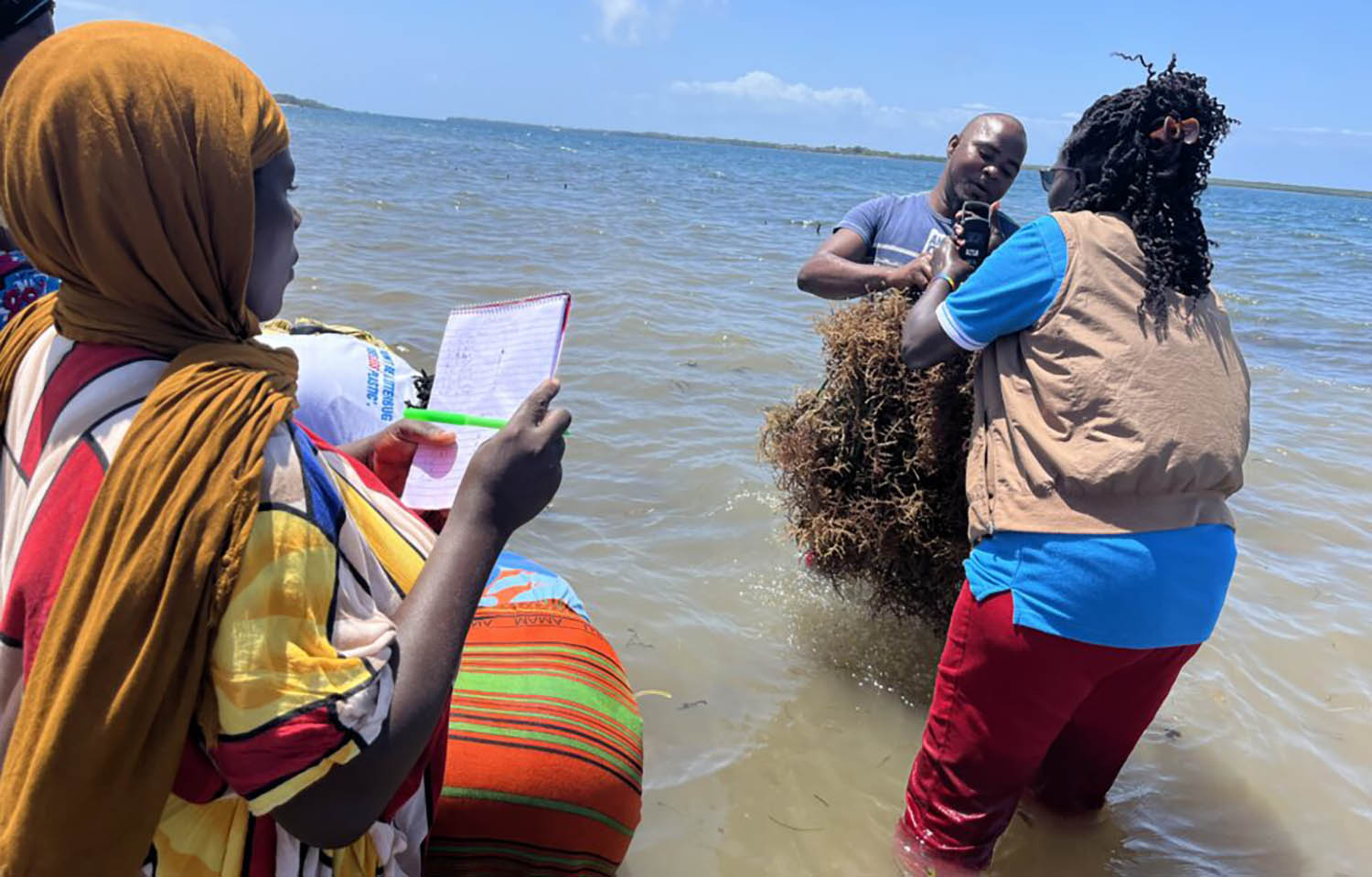
Female seaweed farmers operating in the Western Indian Ocean will have access to private-sector financing through a new project that will support them in introducing farming technology, both boosting the resilience of their enterprises against the adverse impacts of climate change and increasing production of high-quality seaweed.
At least 25,000 female seaweed farmers in Kenya, Tanzania, and Mozambique will have access to the financing between 2024 and 2028 under the Africa Fair Seaweed Finance Facility (AFSFF) project, supported by Toronto, Ontario, Canada-based investment firm Convergence, which blends private, public, and philanthropic capital for development in emerging markets.
“Coastal communities have encountered substantial challenges in accessing viable income sources due to climate change in recent years,” Convergence said. “Seaweed farmers, predominantly employing traditional techniques, face growing vulnerability to climate change impacts such as shifts in sea temperature and ocean acidification.”
Besides the implementation of new technology, through AFSFF, farmers will also benefit from training on high-yielding, deeper-water seaweed farming instead of the common off-bottom technique, also known as peg and line, that confines farmers’ operations to shallow waters where production is limited.
Further, female farmers would be connected to buyers of seaweed products both domestically and in international markets through the project over the next five years, boosting Africa’s seaweed trade volumes in the process.
Convergence is working with Tanzania-based aquaculture NGO Aqua-Farms Organization to mobilize at least USD 1 million (EUR 916,000) in capital in the first year of the program and USD 50 million (EUR 45.8 million) over the entire time frame.
The initiative has already secured a commitment of up to USD 200,000 (EUR 183,000) from Mawimbi Ocean Innovations, a private investment firm with operations in Kenya and Tanzania that helps seaweed farmers blend “traditional farming with modern, service-oriented business models, specifically tailored to seaweed cultivation,” according to Convergence.
To ensure continued funding throughout the project, Convergence said it hopes to attract more private equity, venture capital, and private credit lenders, as well as concessional sources such as loans and grants, for the region’s female seaweed farmers. According to Convergence, the farmers have historically had little or no access to affordable credit to support their small-scale seaweed business operations.
Other sources of funding include “carbon credits and other instruments to finance climate-resilient seaweed-farming technology to provide an additional source of income for the women-led groups while, at the same time, contributing to greenhouse gas emissions reduction," Convergence said.
The selection of Tanzania, Kenya, and Mozambique coincides with the three countries’ ongoing drive to increase public and private investment and add value to seaweed production, which also aids in food security.
Tanzania, which accounts for more than 90 percent of seaweed currently produced in Africa, is separately implementing the Agriculture and Fisheries Development Program, with support from the International Fund for Agricultural Development (IFAD), that aims to increase seaweed production through the support of at least 15,000 smallholder seaweed producers and processors, 80 percent of whom are women.
In Kenya, the government has identified at least 15 potential seaweed-farming areas along the country’s coast that are ideal for the production and processing of seaweed. Currently, the country is a net importer of agar and alginate, which are seaweed end products. The Kenyan government, however, says there is potential “to be self-sufficient or even an exporter of seaweed products” and is seeking to mobilize USD 25 million (EUR 22.9 million) for the development of seaweed farms, seaweed-processing plants, and using seaweed as a building material for housing industry.
Even with financing and good-intentioned seaweed initiatives such as the AFSFF project, Africa still faces several hurdles in its drive to achieve more seaweed production, expand the continent’s seaweed-processing capacity, and generate more export-oriented, value-added seaweed products.
Low productivity due to disease-susceptible seaweed species, inadequate investment in seaweed research and development, and a lack of appetite for investing in the African seaweed market are some of just a few challenges the continent faces, despite being home to more than 2,300 marine seaweed species along the Indian Ocean coast, the Red Sea, the Atlantic coast, and the Mediterranean Sea.
Africa’s seaweed trade is currently dominated by exports to Asia, with UN Trade and Development indicating the continent’s 2020 exports reached USD 14.7 million (EUR 13.4 million), while imports for the year were estimated at USD 3.8 million (EUR 3.5 million).
