






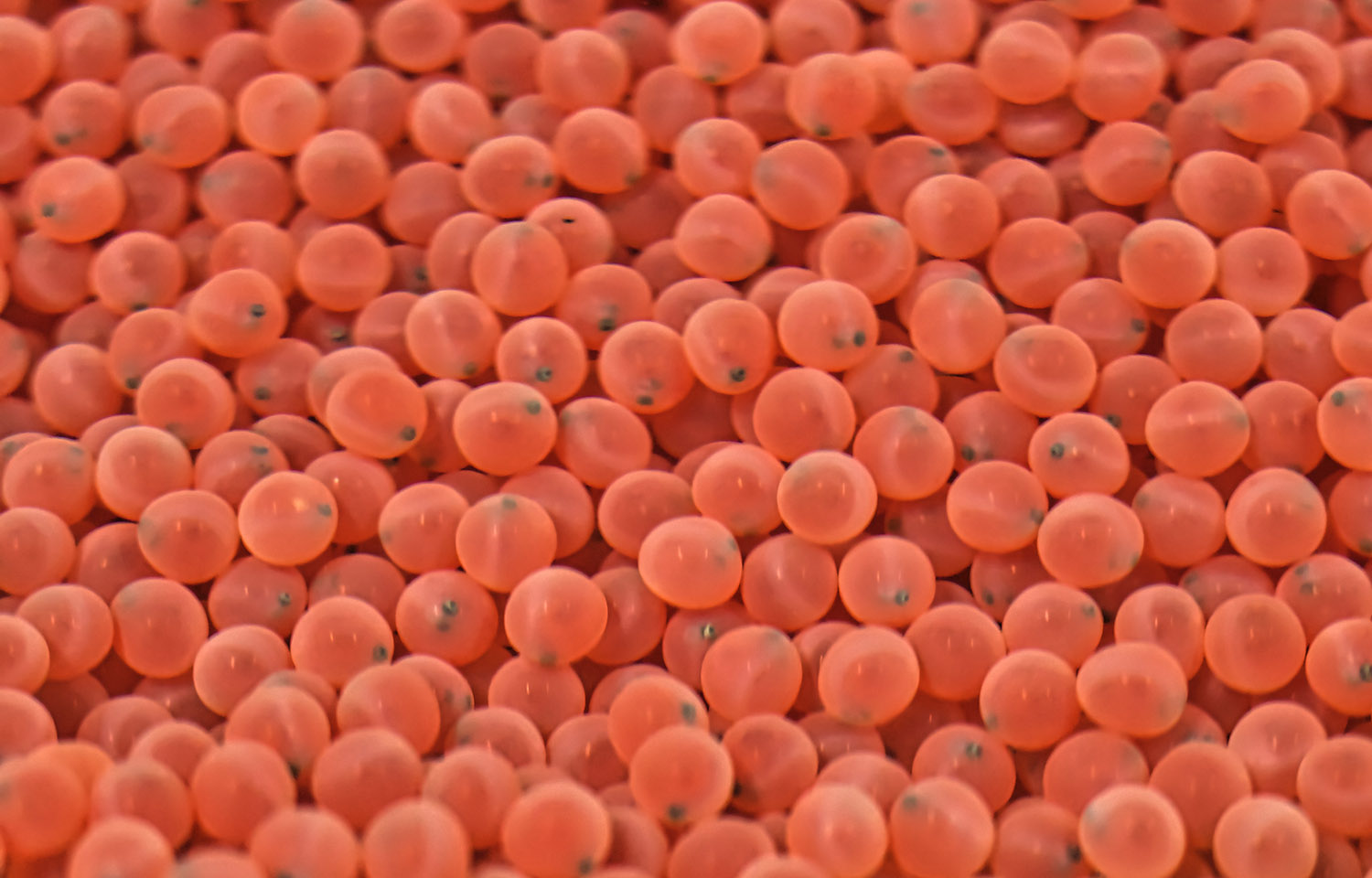
Faroe Islands-headquartered salmon-farming firm Bakkafrost is investing in perfecting, and then expanding, its production of roe to become self-sufficient in its operations.
The company is currently producing around 20 million roe annually, but is eyeing production of at least 50 million in the near future, Bakkafrost CEO Regin Jacobsen told SeafoodSource.
"We are investing in making ‘elite roe’ – roe that has a perfect immune system against all kinds of disease. We have found the correct markers in the DNA of our roe and are now working toward proving our findings," Jacobsen said.
One of the reasons why the firm is keen on expanding roe production is that it wants to enhance its branding by producing salmon that is 100 percent Faroese in the Faroe Islands and, likewise, completely Scottish in Scotland, with the DNA research to back those claims up.
“Our salmon has to be truly Faroese and truly from the Hebrides,” Jacobsen said. “In Scotland, we have an original breed from the Hebrides [archipelago] that produces roe there. We are expanding our production there, as well. The goal is that Bakkafrost is totally self-sustaining with roe in all of our production. But, we have to constantly observe how robust the roe we are producing are, how they survive disease, and how they flourish.”
To ensure the DNA is right before committing to expansion, Bakkafrost has been researching the roe its fish have been producing at two Faroese facilities it has been leasing for the past six years, according to Faroes media outlet Kringvarp Føroyas.
The firm has plans to buy the two sites and then upgrade them so they have the capacity to produce roe on the ambitious scale Bakkafrost is envisioning.
However, Bakkafrost said it still has to determine how to eliminate waste in its roe production – an issue the firm has yet to solve.
"In 2024, we produced 20 million roe, but we only used 6 million of them; there is a lot of waste at this point,” Jacobsen said, adding that his firm has no intention to sell its roe as of now.
Expansion of its current harvest capabilities would help toward using all of its roe.
The firm is currently expanding its Applecross facility in Scotland and has a longer-term harvest target of 165,000 metric tons (MT) by 2028, compared to just over 90,000 MT harvested in 2024.
In its most recent financial report covering its performance in the fourth quarter of 2024, Bakkafrost reported a dip in revenues but an increase in profits.
The group achieved Q4 2024 revenues of DKK 1.47 billion (USD 206.4 million, EUR 197 million), down from DKK 1.56 billion (USD 219 million, EUR 209.1 million) in Q4 2023, but its profit increased by DKK 85 million (USD 11.9 million, EUR 11.4 million) to DKK 477 million (USD 67 million, EUR 63.9 million) in the three-month span.
Bakkafrost’s Faroese operations enjoyed solid growth, delivering revenues of DKK 953 million (USD 133.8 million, EUR 127.7 million) and an operational EBIT of DKK 99.6 million (USD 14 million, EUR 13.4 million) in Q4 2024, versus DKK 909 million (USD 127.6 million, EUR 121.8 million) and DKK 64.2 million (USD 9 million, EUR 8.6 million) in Q4 2023.
"In the Faroe Islands, we are very happy about the result. We have good biology and have healthy farming on land and in the sea," Jacobsen told SeafoodSource.
As for its Scottish operations, Bakkafrost has set about mitigating the biological issues, like jellyfish blooms, that have plagued it in the past. The firm began to see the fruits of its de-risking strategies in 2024 and plans to continue those strategies in 2025 before ramping up production more heavily in 2026.
“We are pleased with the de-risking of our Scottish operations in 2024. Mortality has decreased significantly, and the fish harvested in Q4 were large,” Jacobsen said.
