






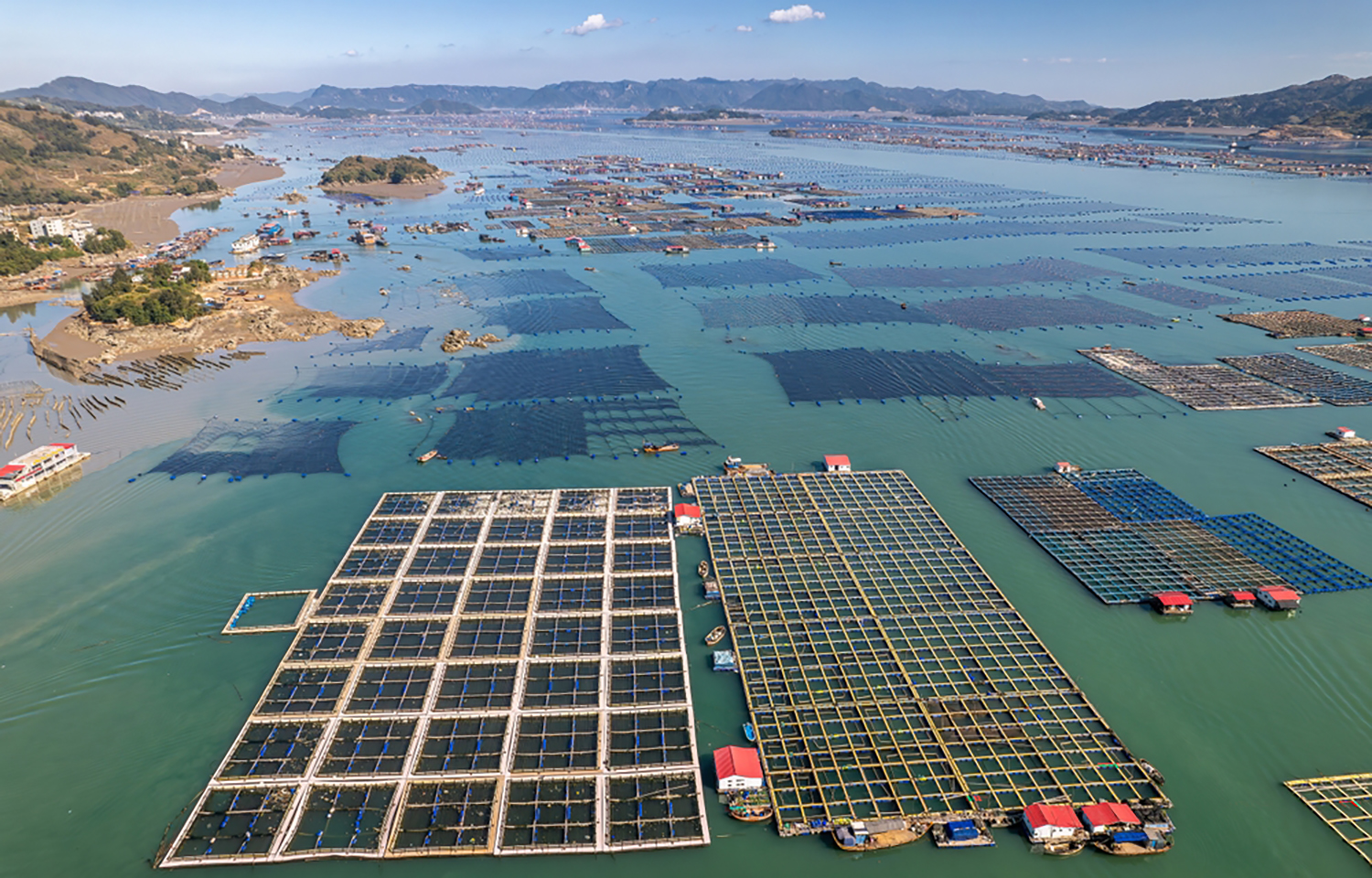
China’s newly revised fisheries law, which came into force in early May, is set to not only transform the nation’s wild capture sector through greater efforts to combat illegal, unreported, and unregulated (IUU) fishing, but also its aquaculture industry by modernizing production and cracking down on antibiotic overuse, among other changes.
According to Xuefei Shi, an affiliated researcher at Bergen, Norway-based Chr. Michelsen Institute, the revised law, if carried out as intended, will force the Chinese aquaculture sector to engage in more responsible practices, such as stricter stocking density requirements, wastewater treatment models, and reductions in antibiotic use, as well as strengthened regulatory oversight to monitor these requirements.
This, Shi said, is likely to prompt consolidation, as some operations will not be able to adhere to these regulations.
“The newer, stricter environmental requirements [in the law] are not favorable to small-scale fish farmers, who have been the backbone of China’s world-leading aquaculture industry,” he said. “This will probably lead to the exit of some farms, especially those managed by a retiring owner or those having been operated constantly at a loss.”
That consolidation is likely to benefit commercial entities highly attuned to market demand and not necessarily just large companies, Shi explained.
“The consequential consolidation [will] not necessarily [just involve] big companies but [also] younger fish farmers who are more tech-savvy, more into high-value species, and more capable at playing a role between farmers and big companies,” he said.
Overall, Shi said he expects the requirements of the new law to prompt a renewal of the sector, which will ensure aquaculture output ultimately continues to grow.
“For the younger generation, the cost to upgrade the environmental guardrails, in my understanding, can be seen as a one-time capex [expense], which can be diluted in the long run. [But], the exit of some smaller farmers will lead to further concentration, as concentration itself is a way to mitigate the shock,” he said.
Shi said Chinese government authorities will probably aim to moderate this consolidation a bit, walking a cautious line between modernizing aquaculture and preserving rural economic activity and jobs.
“The majority of Chinese small-scale fish farms are located inland, not coastal, with some even playing as the key industries in their regions,” he said. “So, they won’t disappear. Many will still hold up with mitigation measures from local governments, like subsidies for upgrading, just like what has happened in upgrading fishing vessels, and they remain important for both national and local food security and employment.”
Landy Chow, the general manager of seafood export firm Siam Canadian’s China office, said that overly stringent regulations in the new law could put Chinese production at a disadvantage compared to other locations in Asia, such as India.
“China’s aquaculture production risks being not competitive,” he said. “Chinese shrimp prices are [already] not competitive against India or Ecuador. If such a law is enforced, that will bring additional costs.”
Though some sectors might struggle under the new law, Chow said it could present a potentially positive outcome for the nation’s fragmented tilapia sector in the long run.
“China is the dominant player in tilapia farming, and enforcement of this law might push its tilapia farming to be more modernized,” he said.
To that end, Chengdu, China-based Tongwei Group, which farms tilapia and produces feed, described the implementation of the revised law as a “significant leap forward for the aquaculture industry,” putting a new emphasis on quality and sustainability.
“While wastewater treatment may seem to increase short-term costs, it is in fact a profound transformation that enhances core competitiveness,” Tongwei said on its official WeChat account.
The firm said purchases of Tongwei products would help farmers meet new requirements on wastewater pollution, as its feed “relies on precise formulations to create green feed products that are low in phosphorus, low in protein, and highly absorbable,” therefore meeting requirements outlined in the new law.
Iris Xin Wang, the head of market development in China for the Best Aquaculture Practices (BAP) certification scheme, said that the revised fisheries law is the latest move in an inexorable trend toward greater sustainability and that certifications can help bring producers into line with increasingly stringent Chinese government regulations.
Sustainability is mentioned more frequently in China’s aws and regulations,” she said. “I think it will bring long‑term positive attention to responsible fishery and aquaculture practices, which could benefit BAP in the long run.”
However, Laura Lee Cascada, director at the Aquaculture Accountability Project, questioned the benefits certifications may see from the new law, arguing that certifications are a market-access tool not a reform mechanism.
“For Chinese producers, BAP and Aquaculture Stewardship Council certification is primarily relevant to the roughly 6 percent of output that targets export markets in the U.S., E.U., and elsewhere,” she said. “The overwhelming majority of Chinese aquaculture production will never encounter these standards. This makes Western certification schemes a niche commercial instrument rather than a meaningful lever for sector-wide environmental improvement.”
