






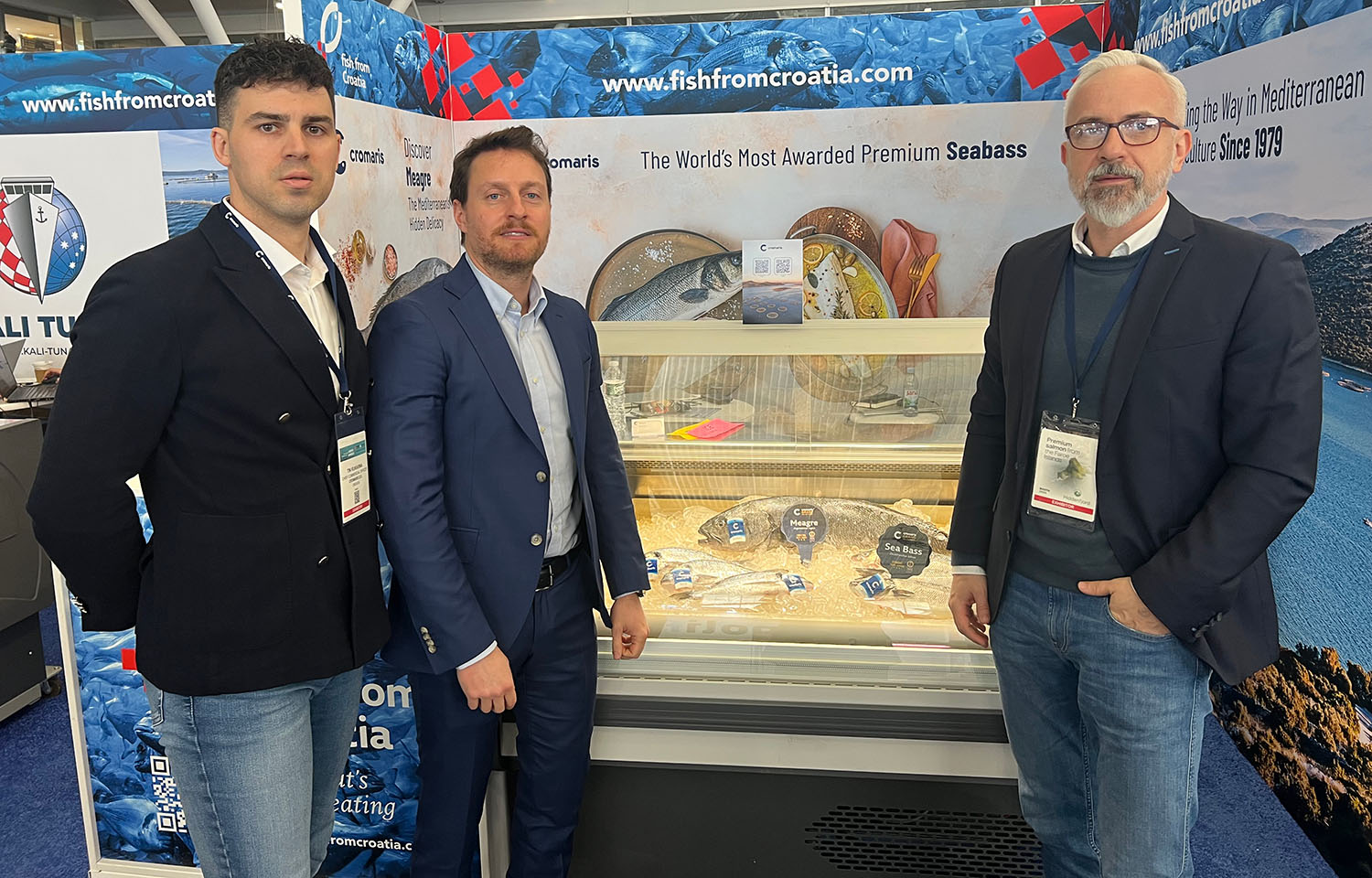
Despite all of the current difficulties associated with trying to penetrate the U.S. market, Zadar, Croatia-based aquaculture firm Cromaris remains steadfast in its goal of getting its Grand Selection line of products into high-end Mediterranean restaurants across America.
“We have quality products that we want to enter the U.S. market. It has taken time to figure out the logistics and deal with the current political [climate], but we hope this year we can start selling more heavily to this market with our premium product assortment,” Cromaris Marketing Manager Rafael Kačinari told SeafoodSource at the 2026 Seafood Expo North America (SENA).
Across multiple farms off the coast of Zadar, as well as one farm near the Croatian city of Pula, Cromaris produces around 15 percent of the world’s supply of farmed sea bass and sea bream, totaling output of around 90,000 tons a year. Around 85 percent of its farmed fish is exported, with the top market being neighboring Italy.
Other top markets for the firm include Germany, Spain, Poland, France, Switzerland, and more.
“The purity of Croatian water in the Adriatic Sea is well-known for providing good farming conditions. Our location is very close to big markets such as Italy, France, and Germany, so we can reach these markets 24 to 48 hours from harvest,” Kačinari said, adding that the firm’s vertical integration allows it to carefully control quality from hatchery to processing and transport.
Though its products are mostly found in Italy and other European nations, Kačinari said Cromaris’ Grand Selection line of farmed fish, which includes larger sizes of sea bass and meagre, also has a place in Italian and Spanish restaurants across the U.S.
Kačinari explained that sea bass already has market recognition in the U.S., but Cromaris is also trying to grow sales of meagre in the country by branding it as the “Mediterranean’s hidden delicacy.”
“It’s not as known in the U.S. as sea bass, but we think in the next few years, it could become a big thing on the restaurant scene because the taste is very similar to sea bass and the meat has good flavor," he said.
Besides sea bass and meagre, the firm’s Grand Selection line also includes dentex – an extremely aggressive predatory fish belonging to the same family as sea bream and porgies. Cromaris has become the first firm to farm the fish commercially, according to Chief Commercial Officer Tin Rukavina.
“Dentex is a predator. We are the first one globally that has successfully farmed it in a controlled environment. Because it is an aggressive predator, survival rates are really low, but we have now determined how to farm it at sustainable rates,” Rukavina told SeafoodSource. “It took hard work from our R&D department, which has been working on this for about 10 years.”
He added that a competitive advantage for the firm is that it can provide high-end restaurants with a stable supply of dentex, compared to the sporadic supply of wild-caught operations, allowing chefs to keep it on their menus.
Kačinari said that the 2026 edition of this year’s show was the second SENA Cromaris has attended and the firm is still learning about how best to make inroads in the U.S.
“We are still learning about the U.S. market. We are talking with distributors to build a story about our fish. It is a demanding market that wants quality,” he said.
