


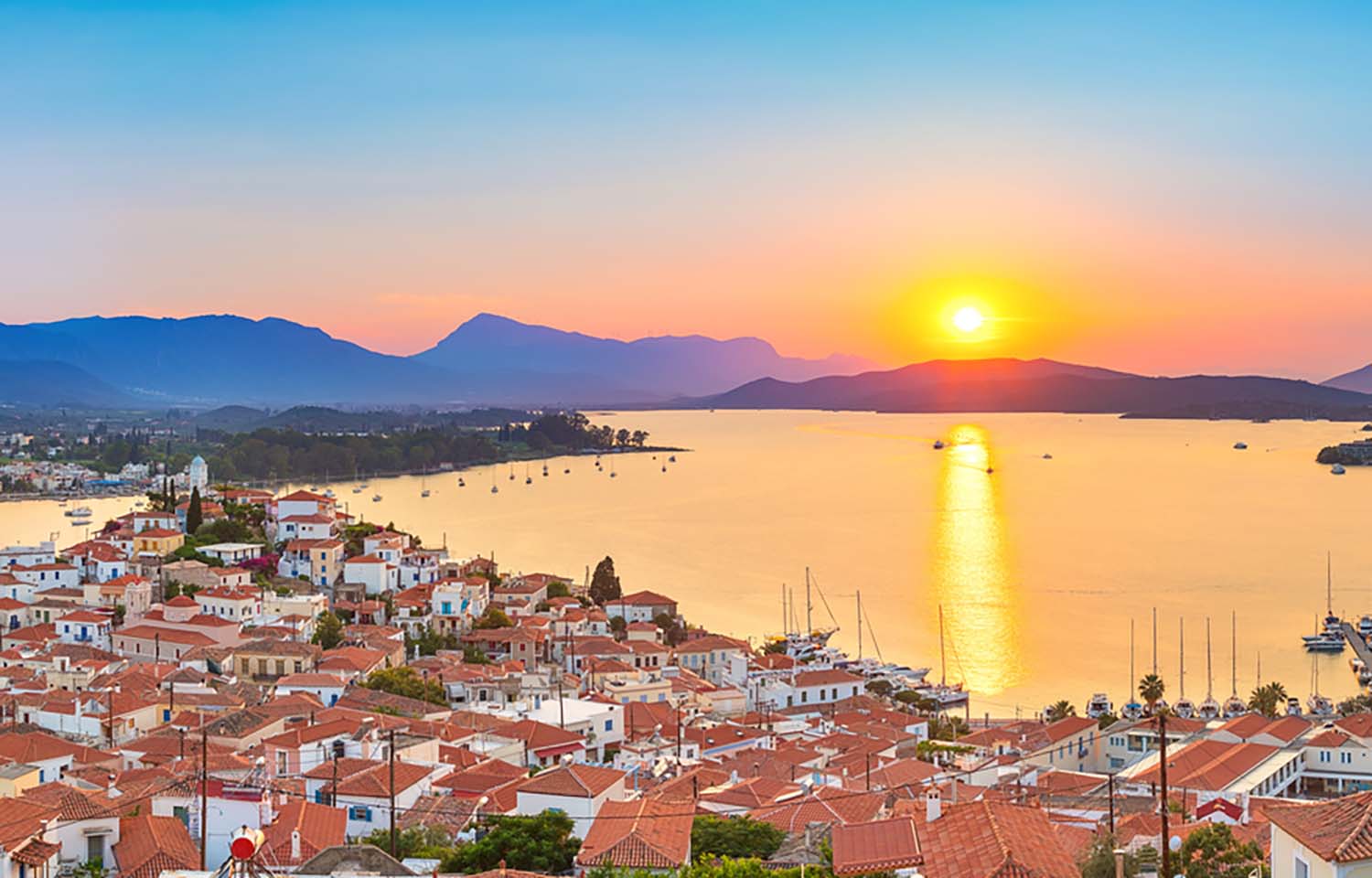
On the Greek island of Poros – just over 30 miles southwest of Athens – residents have protested the construction of aquaculture operations in the Saronic Gulf for over a decade, arguing that such farms cause environmental harm, bring little economic benefit to the island, and rarely consider public input in their design and implementation.
In early August, those protestors scored a big victory when Greece’s Central Council for Urban Planning and Disputes (KESYPOTHA) unanimously rejected plans to widely increase the allocated space for offshore fish farms off the coast of the 12-square-mile island, which has just about 4,000 full-time inhabitants.
The plan would have allowed Valencia, Spain-headquartered aquaculture firm Avramar to expand its operations on Poros from four small farms to eventually covering one-quarter of the island and surrounding waters. The expansion would have boosted the company's production of seabass and sea bream on the island from over 1,100 metric tons (MT) to over 8,800 MT.
In addition to shooting down the Avramar expansion, the council announced that a controversial 2011 law, which outlined a national plan to vastly expand new aquaculture zones across Greece, is now under revision, with possible new environmental impact statement, zoning, and public participation requirements coming down the pipeline.
“This ruling is the culmination of strong resistance from the community of Poros and new scientific evidence of the harm that’s already happening by current fish farms,” said Eva Douzinas, president of the Rauch Foundation, which is an advocacy group fighting against Greece’s aquaculture development plan. “It really gives us hope because it sets a precedent for other areas in Greece fighting the national aquaculture plan.”
Greece is the largest producer of seabass and sea bream in Europe, boasting total production of around 144,000 MT. The Greek government has prioritized aquaculture growth with support from the European Commission as part of a bloc-wide movement to expand sustainable fisheries and aquaculture operations.
The 2011 law was passed with that goal in mind, but came as Greece’s debt crisis was reaching a breaking point; therefore, it went largely unnoticed and sat untouched for several years as the country primarily focused on solving its financial emergency.
The law established 25 zones across the country for future development, known as areas of organized development of aquaculture activities (POAY), effectively granting large exclusive rights to coastal areas with little red tape for firms to sift through.
Once firms began using the law for expansion plans, backlash arose in the form of an almost 15-year movement by Greek residents, nonprofit and research organizations, and scientists to halt such projects.
“The fish-farming story is very indicative of a democratic deficit where the local communities are not at all implicated on the design or any part of the process,” said Elina Makri, a Greek independent journalist and spokesperson for AKTAIA, the Panhellenic Alliance for the Protection of the Marine Environment from Industrial Fish Farming. “Though the government, because it's receiving European funds for this, is obliged to hold public deliberations, these are done in a very superficial way.”
All POAYs were established in 2011, but each separate development requires its own EIA and a presidential decree.
According to Douzinas, the EIAs for these projects – some up to 800 pages long and containing dense and complex impact models that require specialists to fully dissect – were sent to small communities that were only given 30 to 45 days to respond.
“The chance that a community would understand [the EIA] is zero, and a chance that [even] the Ministry of the Environment would understand is extremely low,” Douzinas said.
When 10 EIAs for different projects across Greece were reviewed in 2023 by an aquaculture specialist funded by the Rauch Foundation, they were found to contain not only the widespread use of outdated data, as KESYPOTHA recently confirmed with Avramar’s Poros EIA, but also the misuse of models and a severe downplaying of potential environmental impact.
Further, the assessments contained “significant omission, and several had outright meaningful errors where severe environmental damage is predicted using their own data,” according to the published Rauch Foundation report.
“The actual results would say, ‘This is going to cause severe damage.’ But they would write, ‘The results are a little less than good, but we still recommend proceeding,’” Douzinas said. “Each report would recommend three to four different scenarios of production, and in every single case, they recommended the largest production.”
These recommendations came despite studies that have highlighted existing damage caused by fish farms off of Greece.
For example, a study published by the University of Oxford in July found extensive damage to Posidonia oceanica – a seagrass endemic to the Mediterranean and vital to carbon sequestration and biodiversity – in areas surrounding existing farms off Poros.
The report found that seagrass meadow cover was 46 percent lower and leaves were 36 percent shorter within 650 meters of the studied fish farms. The study also said that the impacts traveled as far as 900 meters away from the fish farms studied and damage lasted over a decade after farms had been removed, with full recovery potentially taking a century.
“The Posidonia meadows are the Mediterranean’s greatest line of defense against climate change,” Douzinas said. “It's the most powerful carbon sink – 35 times more powerful than the rainforest.”
Previous studies had already warned of this impact prior to the passing of the 2011 law.
A 2008 study involving scientists from the Hellenic Center for Marine Research recommended a minimum distance of 400 meters between all fish farms and Posidonia meadows. This recommendation was not included in the 2011 national plan.
For many Greek protestors, the expansion of aquaculture is more than just an environmental issue.
Poros heavily relies on tourism, and a wide swath of residents fear that with 25 percent of the land and sea used for fish farming, Poros will lose its appeal to visitors.
“No single user has the right to use Greek waters to the detriment of others. For thousands of years, Greek seas have been shared in relative harmony by fishers, recreational boaters, sea transportation, commercial shipping, tourism-related businesses, and year-round and seasonal homeowners,” Fay Orfanidou, a member of AKTAIA, said in a guest post for NGO Foodrise. “Our seas belong to life and to all – not to the sterile pursuit of profit.”
Poros is not the only location where protests have arisen.
The Council of State, the highest court in Greece, is currently deliberating a lawsuit brought forward by the municipality of Xiromero in Western Greece, which is currently aiming to stop one of the largest planned expansions in the country.
The plan, which has already received a presidential decree and would be the first new development in Greece to go forward since the passing of the 2011 law, would result in the production of more farmed seabass and sea bream than all of the production in Spain, which is the second-largest producer of those species in the E.U.
“It’s actually citizens alone who are fighting this, and if we manage to win, it will create jurisprudence,” said Makri, who lives in Xiromero. “It will create a precedent for the other areas in Greece that are waiting for a presidential decree for these installation zones to be created.”
