




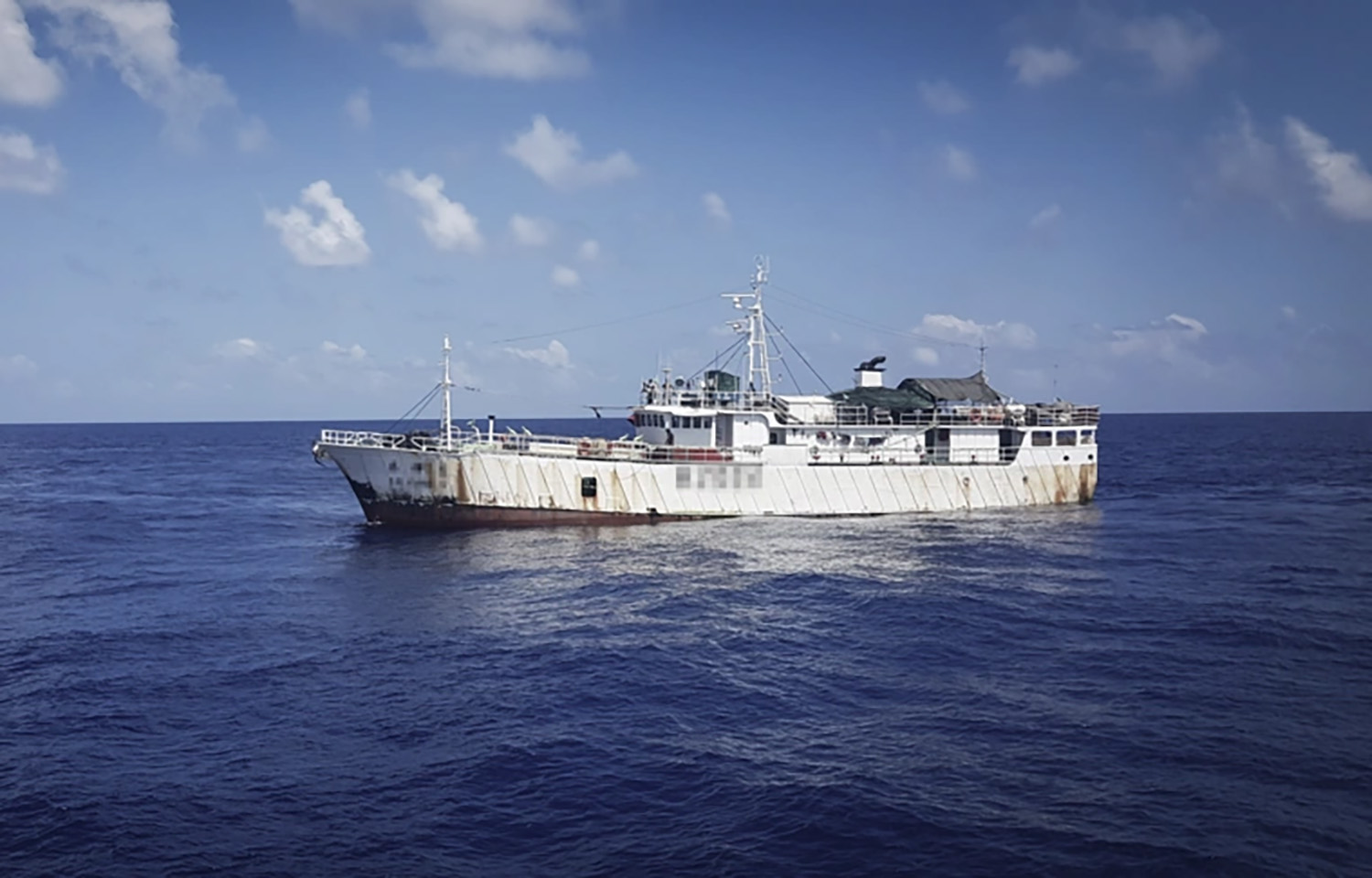
In response to U.S. allegations that China continues to engage in illegal, unreported, and unregulated (IUU) fishing activities, China's Ministry of Foreign Affairs has, in turn, accused the U.S. of “a long history of illegal fishing, damaging marine resources, and polluting the marine environment.”
The retaliatory remarks, which also included allegations the U.S. has long exceeded its tuna quotas in the Central and Western Pacific Ocean, came shortly after a recent NOAA report identified six nations engaged in IUU fishing based on the activities of those foreign governments from 2022 through 2024.
The nations included Costa Rica, Morocco, Russia, Mexico, Grenada, and China, the latter three of which were also listed in the 2023 version of the report and were given negative certifications for failing to improve in the interim between the two reports.
Immediately after the report was released, Chinese officials dismissed the findings as “political manipulation.”
“These ‘certifications’ announced by the U.S. pursuant to its domestic law have neither factual evidence nor basis in international law. It is stark political manipulation with the malicious aim of thwarting the development of China’s distant-water fishing industry. We deplore and reject this move,” China Ministry of Foreign Affairs Spokesperson Guo Jiakun said at the time. “China is a responsible fishing nation with a zero-tolerance policy for illegal fishing. With sound legislation, strict enforcement, and rigorous judicial oversight, it has ranked among the top in compliance assessments of regional fisheries management organizations.”
Maritime crime expert Dyhia Belhabib told SeafoodSource that such accusations the U.S. is being hypocritical may be hyperbolic, but have some basis in fact.
“The U.S., at times, disregards and, hence, surpasses tuna quota and basically announces what they want to do as opposed to negotiating it,” she said. “For example, this year, they announced they will not include recreational catch as part of a quota for bluefin tuna in the region [overseen by the International Commission for the Conservation of Atlantic Tunas].”
Belhabib added that China, though its reputation is largely earned, garners more attention when it comes to IUU fishing than other nations around the world.
“There is definitely a spotlight on China and a targeting of Chinese vessels for illegal fishing. It is something I have documented over the years when other nations proportionally commit similar offenses,” she said.
Still, she clarified that China frequently lashes out at such accusations and tends to exaggerate in its retaliatory remarks.
“There is no evidence that the U.S. is inherently as bad as China when it comes to illegal fishing, even when adjusting for fleet size. There will always be a few instances of illegal fishing, but China is pushing it by claiming that the U.S. has a long history of illegal fishing,” she said. “The U.S. has in fact, prior to the current administration, a long history of helping countries fight illegal fishing and maritime crime more broadly by securing maritime borders, providing at-sea training, and financing maritime domain awareness training.”
China operates the largest distant-water fishing fleet in the world, which has been the subject of myriad IUU accusations. The Environmental Justice Foundation (EJF) recently released a report highlighting that Dakar, Senegal, serves as a “regional hub” for illegal shark fin trade associated with Chinese and Taiwanese distant-water tuna longliners operating in the Atlantic Ocean.
The report found around 57 percent of Chinese vessels and 23 percent of Taiwanese vessels authorized to fish for tuna in the Atlantic were alleged by interviewed fishers to have engaged in shark finning, and the practice was heavily present on vessels calling at Dakar.
