





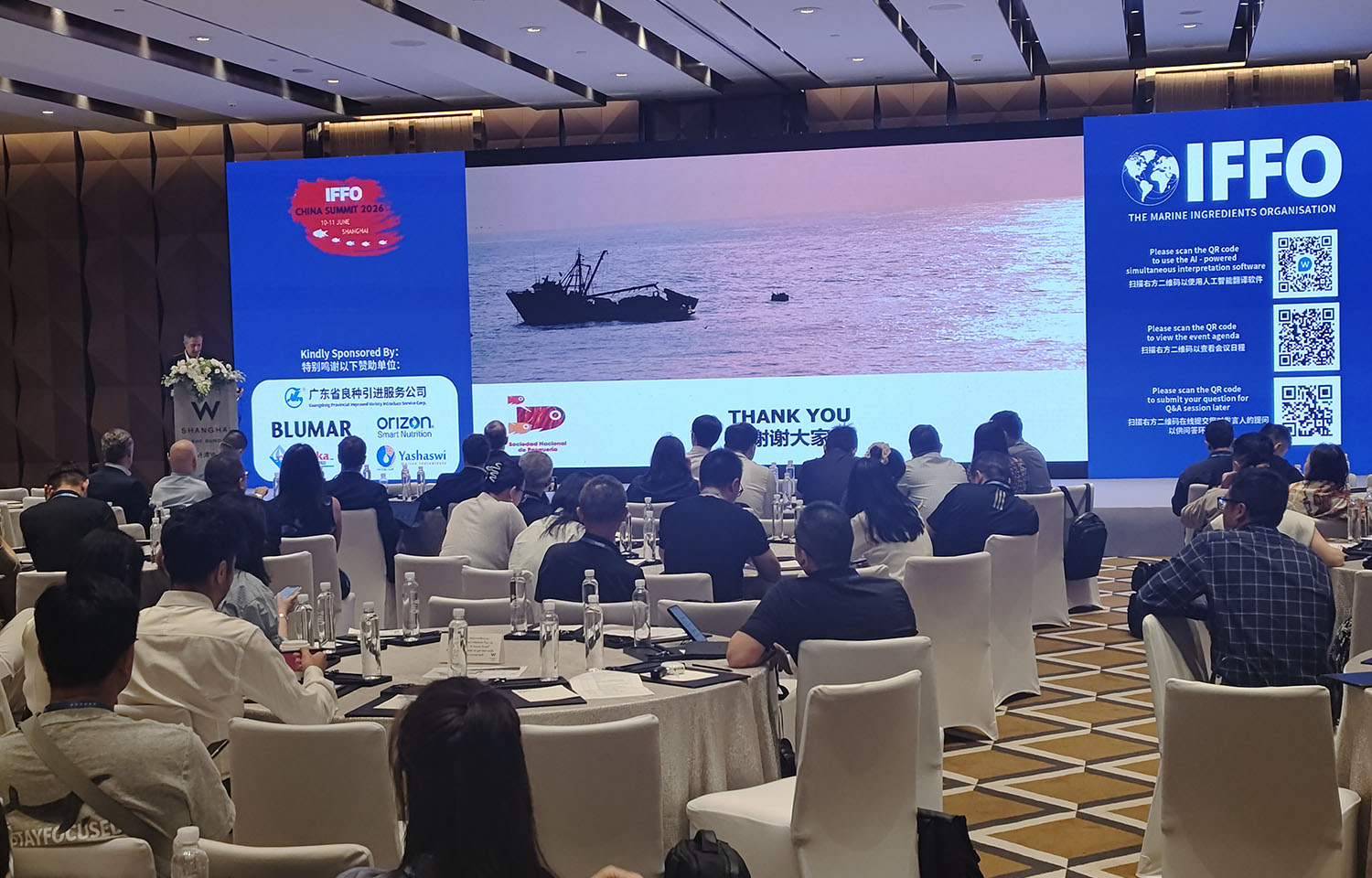
IFFO – the Marine Ingredients Organization held its annual China Summit recently in Shanghai, where it highlighted the nation’s growing demand for marine ingredients and aquafeed, as well as the impending supply crunch.
The event covered a number of discussions surrounding fishmeal and fish oil and the market developments in key production regions like Northern Europe, Peru, and China. Production has remained relatively consistent over the last decade, but consumption in China, as well as globally overall, has continued to soar.
According to IFFO Market Research Director Enrico Bachis, Asia currently has an annual supply gap of 1.2 million metric tons (MT) for fishmeal and 80,000 MT for fish oil used in aquafeed and for direct human consumption, meaning those countries will continue to rely on imports to meet local demand.
A significant portion of that demand will come from China. OECD-FAO estimates predict China will account for 42 percent of global fishmeal consumption by 2034.
Evergreen International Trade President Zhaogang Jiang said that reduced domestic production in 2025 led to tight raw material supply in China, leading to a push for imports to fill the gaps. However, he added China’s market is segmented and complicated.
“China isn't a single market but rather dozens of segmented markets. Eel is one market, shrimp is another, and California bass is yet another,” he said. “Their fishmeal demand behaviors’ are completely different. Feed companies, caught in the middle, should find a new balance between supply security and cost control.”
Outside China’s growing demand, the impact of El Niño in Peru was a hot topic for the summit as the country has been forced to pause anchovy fishing, a pause that was extended a day after the summit concluded.
Peru Sociedad Nacional de Pesquería (SNP) General Manager Jorge Risi said the closures are essential to maintaining the sustainability of the anchovy stock long term, and El Niño’s instability means landings have fallen.
“The future competitiveness of Peruvian marine ingredients relies on the responsible management of its fisheries, which is based solely on scientific evidence,” he said.
That decreased supply comes as demand continues to increase across virtually every market. Alongside the aforementioned China, markets in Europe, India, and Vietnam are also all growing as aquaculture grows.
Europe’s demand is also growing even as its supplies dwindle due to sustainability issues and reductions in quotas of certain wild-caught species.
Meanwhile, in India, growth in production has made it a top three global producer of fish, and the lifting of restrictions on new fishmeal and fish oil plants has allowed for growth in ingredient production.
Vietnam’s demand for ingredients is also rising thanks to shrimp, pangasius, and marine fish farming, according to Ngo Nha Truc of Kanematsu. Truc said Vietnam is increasingly using byproducts as a means of meeting demand, but production is still insufficient.
“Despite the significant domestic production of marine ingredients, Vietnam remains heavily dependent on imported marine ingredients for premium aquafeed production,” Truc said.
