




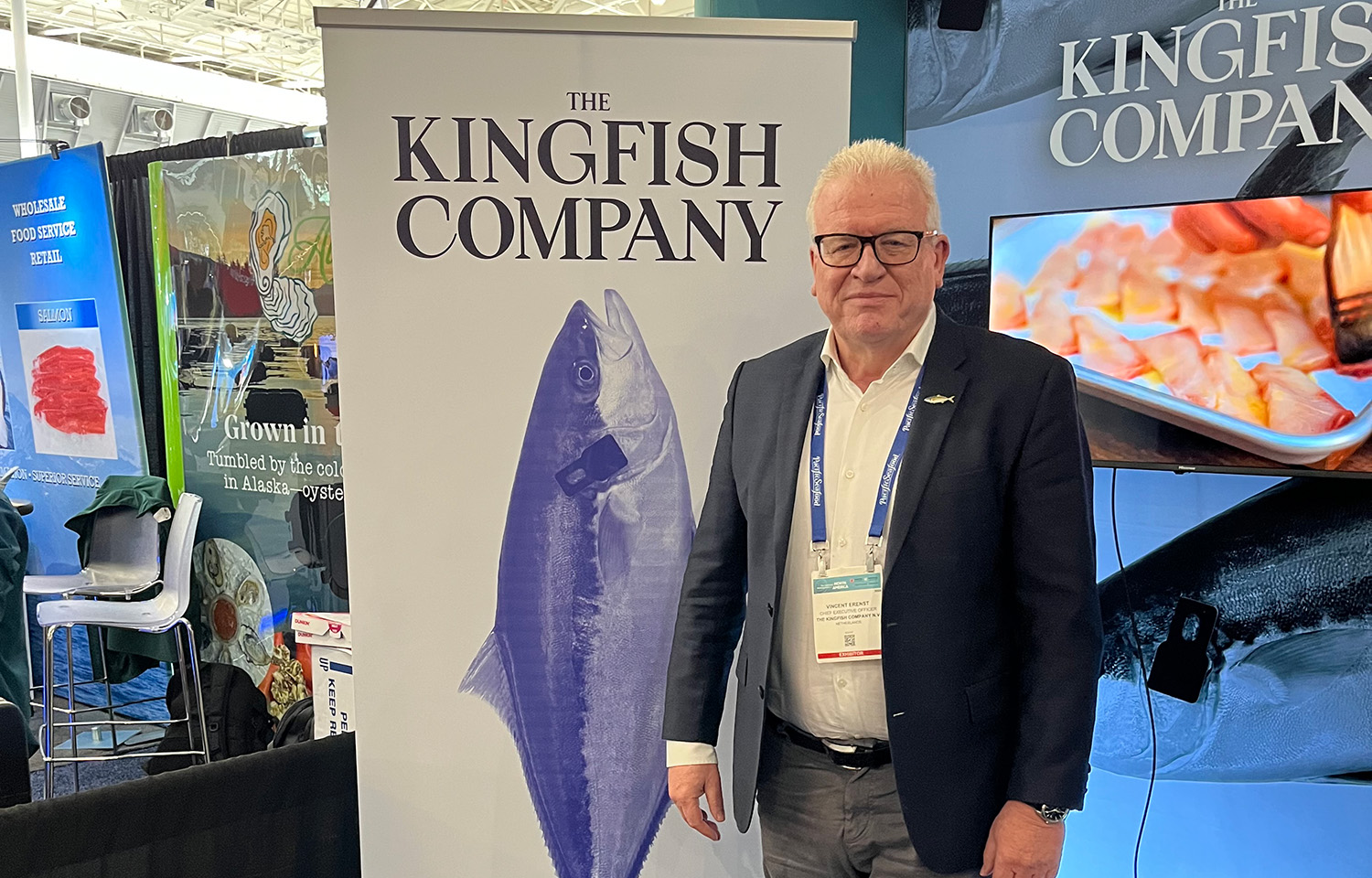
Land-based yellowtail kingfish farmer The Kingfish Company, headquartered in Kats, Netherlands, came to the 2025 Seafood Expo North America (SENA) with a clear goal: Build a market for a little-known fish species that has huge potential.
“We [started out] selling an unknown product," CEO Vincent Erenst said. "So, we are building the market bit by bit, box by box, all over Europe.”
Erenst has held executive roles across the global aquaculture industry, including at Stolt Sea Farm, Mowi, Avramar, and Barramundi Group, among others, and said that yellowtail kingfish has been a unique challenge compared to the other species he has been involved with.
“It’s not like [selling] salmon where you have 1,000 tons, you make three calls, and it’s gone," he said. "We have to sell box by box, find distributors, convince them it's good, and let them try [it].”
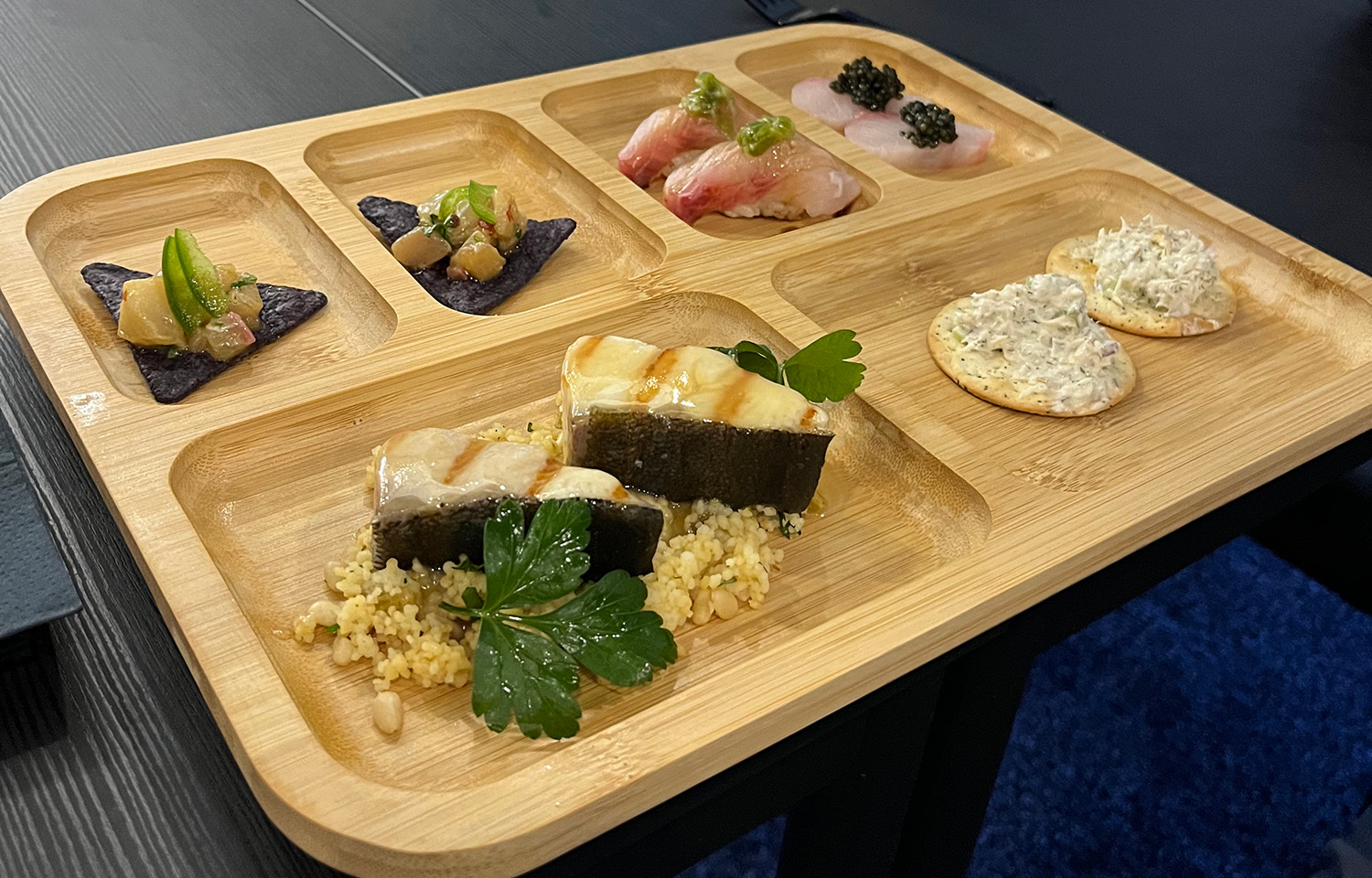
The company used this strategy to get the word out about its product at SENA, bringing along two acclaimed chefs, Masa Endo and Mark Allison, to serve both hot and cold yellowtail kingfish preparations. Instead of hosting tastings periodically throughout the event, the chefs prepared fish attendees could try continuously throughout the show.
This was a considerable investment for the Kingfish Company in order to make sure as many attendees as possible could taste its fish for themselves, but as Erenst told SeafoodSource, this strategy has worked for the firm so far. Since the company primarily sells to distributors that serve white tablecloth restaurants, tastings are a key distribution strategy.
“[We] organize a lot of events to get chefs to try the product. The reaction usually is fantastic. Most people love it,” Erenst said.
The company first introduced its yellowtail kingfish domestically by getting it into the Netherlands' top restaurants and then moved into Italy, where the species was already somewhat well known.
“That went very well, and they were very ambitious; they found the capital to grow,” Erenst said.
As The Kingfish Company earned accolades from top chefs, major investors got excited. The company’s biggest shareholder, with a 22.1 percent stake in the company, is Creadev International S.A.S., a family-owned investment group founded by the Mulliez family, owners of one of the world’s largest multinational retailers, Auchan.
Major Dutch insurance company ASR Nederland owns 15 percent, Rabo Participaties B.V., the mission-driven investment arm of Rabobank, owns 12.5 percent, and Stolt-Nielsen, which has invested heavily in aquaculture elsewhere, owns 12.3 percent.
“We have very large investors … behind us, who all see this as a very interesting way of growing fish in a sustainable way. It could have a large future. They don’t know, but they’d like to be part of it,” Erenst explained.
Unsurprisingly, Erenst said, Covid-19 put a halt on the company’s rapid expansion. Nevertheless, its supportive investors meant that the company could survive the Covid-related downturn, which closed the restaurants to which The Kingfish Company primarily supplies.
The pandemic did provide the company with an opportunity to diversify, however, Erenst said. A retail and frozen arm of the business, which grew organically in Italy, now makes up about 25 percent of the company’s profits.
“But still, our ambition for the moment is foodservice,” Erenst said. “With the volume that we do right now and our price ambitions, foodservice is our place to go.”
Erenst said that the company’s key markets are currently Italy, Belgium, Luxembourg, Holland, Spain, Portugal, the U.K., Germany, and most recently France.
“We would really like to pound on those markets,” he said. “We are really going at it. Last year, we sold 2,000 tons. This year, we want to do considerably more. Our facility can produce 3,500 to 4,000 tons. But, we have to build that market.”
While The Kingfish Company sells a lot of its product to white tablecloth restaurants, it is also popular with sushi restaurants, where its price positions it as a bridge between tuna and salmon.
“The star of the sushi market is bluefin tuna,” Erenst said. “We’re below that; we’re not at that level. But, if you take salmon, which is also super popular, we’re almost twice the price of salmon.”
Besides getting yellowtail kingfish in front of as many prospective customers as possible, the company’s prime strategy, according to Strategic Marketing Manager Ishani Nanninga-Mukerji, is simply to produce great fish sustainably.
“Quality is our tagline. We’re going to keep making the best fish that’s out there,” Nanninga-Mukerji said.
The quality comes from a production process which mirrors the natural food chain, Erenst explained. Broodstock comes from Chile, New Zealand, and Australia, where the fish is a native species.
“We manipulate the temperature and the light so that they think it’s spawning time,” Erenst said, explaining that this allows The Kingfish Company to produce eggs year round, almost every day, without any hormones.
The eggs are then incubated to produce the fish’s larval form, a tiny creature only around 1 milligram in weight. Within 48 hours, the larvae start eating live feed. This process continues for the first 25 days of their lives, by which point they have grown to around 150 milligrams.
At 25 days, the fish are weaned onto “very high-quality dry feed.” Within a year, they have grown to 3 kilograms in size.
Erenst said that his company's whole facility contains about 12,000 cubic meters of tank, into which they infuse 6,000 cubic meters of fresh ocean water each day. The water is filtered and UV-treated and circulates through the entire system every 15 minutes.
The firm's Kats facility also contains a processing plant so that fish can be humanely harvested, through electric stunning, and cut to customer specifications on site.
“They start harvesting at 4 in the morning, start processing at 7, [are] done by 3 or 4 in the afternoon, and [then] the truck goes out,” Erenst said.
Nanninga-Mukerji said that The Kingfish Company is usually able to deliver to its European customers within 24 hours of harvest and to its worldwide customers within 48 hours, leaving its customers satisfied with its freshness and quality, according to Nanninga-Mukerji.
“[At SENA], someone said, ‘Come on, give me your sales pitch.’ I said, ‘I don’t have one. Just try it. It speaks for itself,'” she said.
