






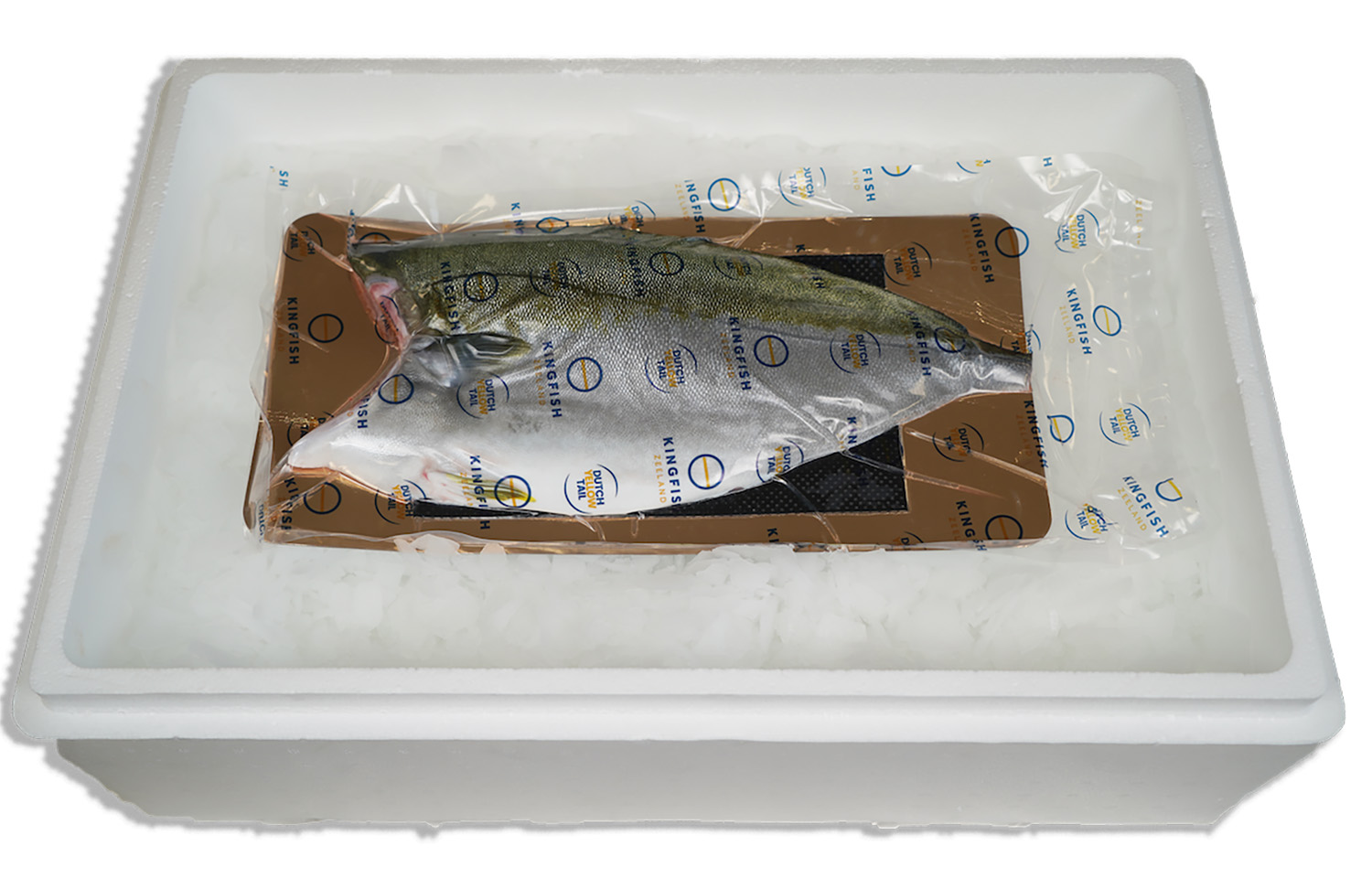
Kats, Netherlands-headquartered land-based aquaculture firm The Kingfish Company has decided to scale back fresh sales in the United States in response to import tariffs and the exchange rate compared to the U.S. dollar.
In a press release delivering its H1 2025 results to investors, the company said “current conditions [in the U.S.] do not support profitable operations.” Kingfish said it will continue to sell frozen product in the U.S., and remains committed to a long term strategy in the nation, including its Kingfish Maine project.
“We will monitor developments closely and revisit our commercial approach once the economic environment becomes more supportive,” the company said.
The company posted EUR 17.0 million (USD 19.9 million) in revenue in H1 2025, up 31 percent from EUR 13.2 million (USD 15.5 million) in the H1 2024. Sales volume for H1 2025 set a new record for the company, reaching 1,301 metric tons (MT), up 41 percent from 944 MT the company sold in the same period of 2024.
Kingfish attributed its overall revenue and volume increases to continued strong demand for yellowtail kingfish, which Kingfish has worked hard to introduce to the gastronomic community.
Revenue per kilogram decreased, however, to EUR 13.10 (USD 15.50) in H1 2025, down from EUR 14.30 (USD 16.80) in H1 2024. The company said the revenue decline was temporary, a consequence of targeted promotional pricing in the period and the company’s efforts to balance production and sales volume through higher than usual sales of frozen product.
Gross margin per kilogram was also down to EUR 1.70 (USD 2.00) in H1 2025 from EUR 3.60 (USD 4.20) in H1 2024. The company attributed the reduction to the decreased revenue per kilogram and elevated farming costs.
Operational EBITDA per kilogram was a loss of EUR 2.00 (USD 2.4), down from a loss of EUR 1.10 (USD 1.30) in H1 2024. Kingfish said that while higher sales volumes had reduced selling, general, and administration expenses (SG&A), it had made “significant strategic investments in commercial capabilities” during the period, which lowered the operational EBITDA.
The company said that it anticipated achieving positive operational EBITDA in 2026, one to two quarters later than it had originally planned.
“The performance in the first six months validates our commercial strategy and the strength of our market positioning,” CEO Vincent Erenst said. “After earlier challenges with high biomass levels in the farm, we have now reached a balance between production and sales volumes, and farming conditions have normalized. These improvements are laying a solid foundation for margin improvement and long-term value creation as we scale.”
The company said that its farm is now “operating close to optimal biomass levels” after a year-long process intended to stabilize farm conditions and normalize its feed conversion ratio (FCR), which the company said will be complete by the end of 2025. By 30 June 2025, Kingfish said standing biomass was 972 MT, down from 1,118 MT in December 2024. The company’s FCR was reduced from 1.9 in Q1 2025 to 1.6 in Q2 2025, but the company said it “remains above our target.”
CEO Vincent Erenst told SeafoodSource in March 2024 that the challenge his company faced was developing a market for an unknown product. At the time, the company was making significant investments in getting its fish to chefs and fine dining distributors through tastings and events.
In August, the company reported strong volume increases but that import challenges, primarily caused by tariffs on the E.U., were slowing U.S. sales.
The Kingfish Maine project, however, would alleviate these pressures by allowing the company to distribute directly to the U.S. market. While it is fully permitted, The Kingfish Company said that, given the many challenges the project has faced, it is currently considering bringing in partners to “help accelerate the project’s execution.”
In August Erenst, a longtime aquaculture sector veteran, announced that he would retire from his position at the end of 2025, and the company’s board is currently at work searching for a successor.
