






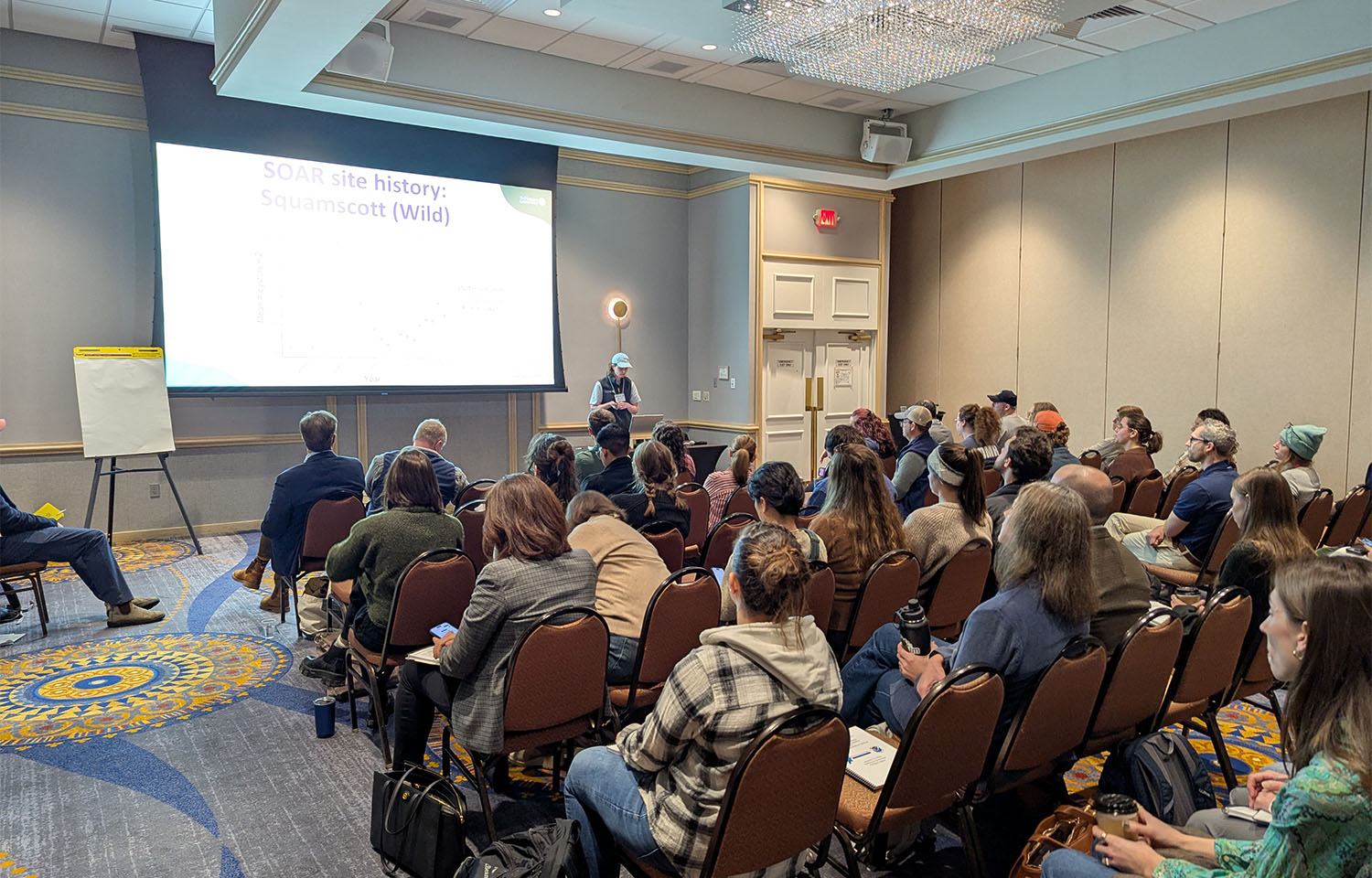
Over 700 attendees gathered in Portland, Maine, for the largest-ever Northeast Aquaculture Conference and Exposition, which ran from 7 to 9 January, and event organizers said the growth of the gathering reflects the increasing importance of aquaculture in the region.
Founded in 1998, the Northeast Aquaculture Conference (NACE) was created by the Maine Aquaculture Innovation Center (MAIC) to bring together multiple facets of the industry, including researchers, producers, equipment vendors, and managers, to collaborate on relevant issues. The event runs alongside the Milford Aquaculture Seminar, an older event which came together under similar circumstances.
MAIC Executive Director Anne Langston Noll, who is part of the organizing committee for the conference, told SeafoodSource that this year was the first time that they have had to extend the program to seven concurrent sessions on one day.
“They were all packed, every single one,” Noll said.
The event consisted of 185 oral presentations and 43 poster presentations on topics ranging from a panel on seaweed food safety guidance to recapturing and reusing plastics in the aquaculture industry.
Noll said the attendance tends to consist of an equal spread of members of the aquaculture industry, researchers, and public resource managers, along with the Sea Grant programs of Maine, New Hampshire, Connecticut, Rhode Island, and more. Officials with the National Marine Fisheries Service also attended, and Noll said over 20 K-12 educators also came to learn about how to teach their classrooms more about the aquaculture industry.
“We have every stakeholder group, pretty much, represented,” she said. “I think that’s one of the really great things about this conference is it brings all the pieces together. It doesn't have people in silos, and that’s really our aim: to try and promote that sharing of knowledge between states and between parts of the sector so we bring it all together and learn from each other.”
Deer Isle Oyster Company Owner Abby Barrows told SeafoodSource she’s been attending for a decade and that the collaborative nature of the aquaculture industry is part of why she has been attending for so long.
“It’s really interesting to see the latest science, and I can pick up on tidbits of information about everything,” she said. “I love that it’s this wide sweep of pretty technical data on stuff like lab experiments and then also things like how to move on the water so you don’t hurt your back.”
Maine Aquaculture Association and National Aquaculture Association President Sebastian Belle said his organization has been involved with the conference right from the beginning and has seen it grow from a “very small meeting.”
“It was a lot of people who were organizing the conference who were at the conference ... and now this is an all time high,” Belle said. “We have over 700 people, and we didn’t anticipate that number. I think we only printed 680 booklets.”
Martha's Vineyard Shellfish Group Director Emeritus Rick Karney told SeafoodSource he’s been attending the conference since before it was NACE and attended the first Milford Conference over 40 years ago.
“The first was probably about eight people in a room in Milford, Connecticut,” Karney said. “A lot of us old timers are here, and we’re going on recollecting about how it’s grown.”
Karney said through his long tenure in aquaculture on Martha's Vineyard he’s watched the industry shift from one comprising a few people trying to start a fledgling industry to one that’s large enough to be considered an essential part of the community economy.
“I think size matters, not size of individuals but how many people are involved. We had our first closure for vibrio, and there were enough growers and enough money that they were bringing into the community that we had the state officials come down,” Karney said. “The part of the community is large enough economically; you get the attention.”
Karney, Noll, and Belle all said another hugely encouraging part of the conference is the amount of younger people involved in the industry who are attending.
“I do this every year that we have [the conference]. I ask everybody in the audience who is under the age of 35 to raise their hands,” Belle said. “This year, the majority of the room was under 35 years old.”
Damien Brady, a professor at the University of Maine’s School of Marine Sciences, attributed some of that growth among young people to the fact that the industry has been shifting away from one that required people to be at the forefront of innovation with advanced degrees to one that now has lower barriers of entry.
"We do a tremendous amount of work with a lot of the longstanding farms, and so many of them have their Ph.D., their master's, or have [other] advanced degrees,” Brady said.
Brady said the growth is clear in economic data.
In Maine, for instance, if you exclude the lobster industry – which accounts for the vast majority of the state’s seafood industry by value – aquaculture now represents 69 percent of the landed value of the seafood industry. Brady said he’s been seeing more investment made into the aquaculture industry as people see it as an opportunity for growth.
Karney said on Martha's Vineyard, most of the aquaculture operators are younger people whose parents were fishermen.
“It’s the transition. Even one guy, his father was a fisherman and now works on his farm,” Karney said.
Along with that shift, he said he’s seen a gradual shift from aquaculture being an unknown commodity to something that’s becoming part of the community.
“There’s a guy who delivers the newspapers on the island, and he’s also a photographer, so he’s out in early morning and he’ll post pictures he takes. There will always be some idyllic science of the beach or the sun coming up,” Karney said. “One time, it was a picture, and it was one of the aquaculture floats. I was like, ‘We finally got there.’ We’re part of the scenery now and not in a negative way.”
