


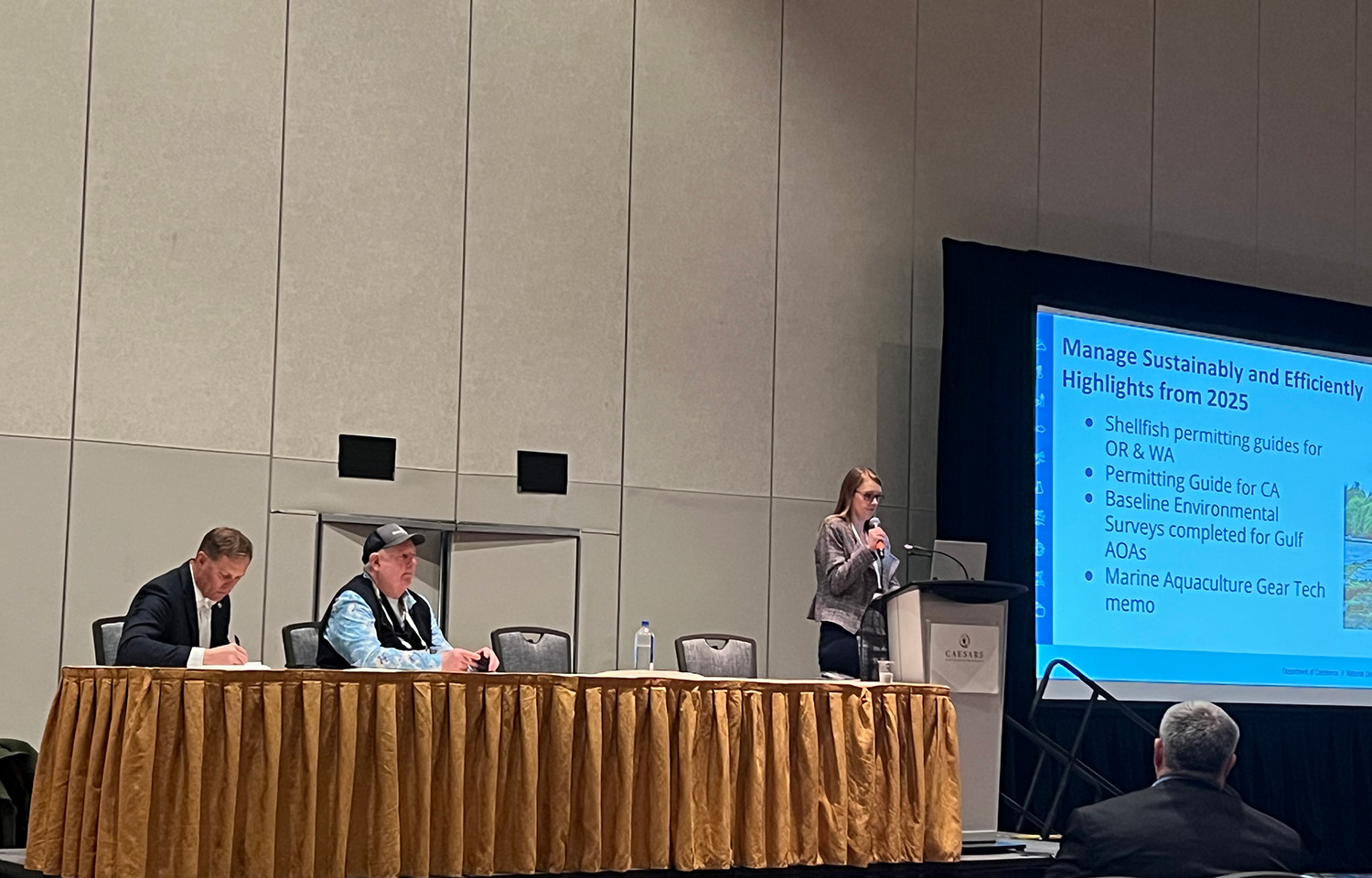
Following directives from the administration of U.S. President Donald Trump, NOAA’s Aquaculture Program said it made steady progress in 2025 on exploring new aquaculture projects in the U.S., inching closer to helping the country close its farmed seafood import gap.
“Currently, the U.S. imports USD 15 billion [EUR 12.7 billion] worth of farmed seafood. That’s billion with a ‘b.’ It is by far more than we produce here at home, which is less than USD 2 billion [EUR 1.7 billion], and that has the eyes of a lot of people across the government, not just people who focus on aquaculture,” NOAA Office of Aquaculture Director Danielle Blacklock said on 17 February during the 2026 Aquaculture America conference in Las Vegas, Nevada, U.S.A.
As more people in the government begin to realize the importance of closing that gap and other government initiatives like the new 2025–2030 Dietary Guidelines for Americans push for more seafood consumption, Blacklock said NOAA’s Aquaculture Program has been aiming to keep up with the gaining momentum.
NOAA’s Aquaculture Program, which operates under NOAA Fisheries, recently released its “Aquaculture Highlights 2025” report, emphasizing that last year it published permitting guides for shellfish aquaculture in Oregon, Washington, and California; hosted the first ever aquaculture summer camp for kids; published more than 20 peer-reviewed articles, reports, and technical memos on various aquaculture issues; completed baseline environmental surveys in the Gulf of Mexico – currently referred to as the Gulf of America by the U.S. government – to lessen the barriers of entry for possible future aquaculture sites; and, most importantly, identified 13 aquaculture opportunity areas (AOAs) potentially suitable for future finfish, shellfish, and seaweed farming.
The 13 AOAs comprise 10 areas off of Southern California and three in the Gulf, mainly off of the coast of Texas, according to Blacklock.
“We looked for areas appropriate for aquaculture to grow. By appropriate, that means areas that are appropriate socially – so staying out of traditional fishing routes and shipping lanes. You’re not going to put a farm on top of an oil rig,” she said. “In addition, we looked at areas appropriate environmentally and technologically so not in essential fish habitat or where endangered species are breeding. And then also appropriate economically.”
Besides the 13 identified areas, Blacklock confirmed NOAA is also still looking at opportunities in Alaskan state waters.
“This is a planning process, not a permitting process, so applicants in these areas will need to go through the traditional permitting process, but it will be a robustly informed one where we are hopeful that all of the analysis that has gone into this will stop the two steps forward, one step back approach we have seen so often as folks try to put farms in marine waters in the U.S.,” she said.
Though Blacklock highlighted the progress made with AOAs, the number of potential AOAs has actually shrunk over the years. In 2021, NOAA Fisheries identified 19 potential AOAs in Southern California and the Gulf; in 2024, that number shrunk to 14 in a draft version.
Nevertheless, she said that momentum for aquaculture projects in the U.S. is moving in the right direction and now has more government backing than it has had before.
“I got approval to say this on a stage in public. Aquaculture is a priority at NOAA within this administration. That has been felt for a long time internally, but we have not been saying that publicly as the administration analyzes what it wants us to do,” Blacklock said. “We are now, without a doubt, a priority within the Fisheries Service. We’re looking forward to making the process a bit easier for everyone.”
