



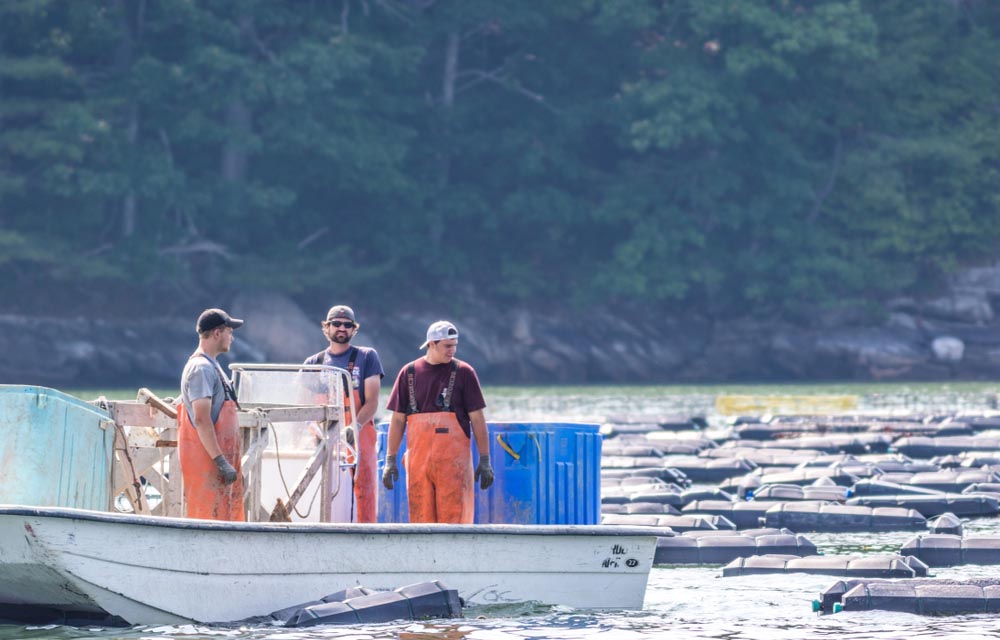
NOAA has launched a new initiative to improve the United States’ seafood competitiveness, the Cooperative Institute Fostering Aquaculture Research and Markets (CIFARM)
“By investing in aquaculture research and markets, NOAA Fisheries continues its commitment to improving sustainable American fisheries through science-based management,” NOAA Fisheries Assistant Administrator Eugenio Piñeiro Soler, said in a release. “We are proud to empower the industry to produce more seafood for American plates.”
The government said CIFARM will be hosted by the University of New Hampshire and will partner with other universities and researchers “to advance American marine aquaculture.”
“We are excited to partner with NOAA on this first-of-its kind cooperative institute to advance American aquaculture,” University of New Hampshire President Elizabeth Chilton said in a release. “By leveraging our coalition’s scientific excellence and regional expertise, we are poised to make great strides for the aquaculture industry.”
CIFARM partners at launch include New Hampshire Sea Grant, the University of Miami Rosenstiel School of Marine, Atmospheric, and Earth Science, Florida Sea Grant, University of Southern Mississippi, Mississippi-Alabama Sea Grant Consortium, Hubbs-Sea World Research Institute, California Sea Grant, University of Hawaii, and Hawaii Sea Grant.
“The Rosenstiel School's expertise in aquaculture, ocean observing, environmental forecasting, marine ecosystems, and coastal resilience will help provide the scientific foundation needed to support responsible growth of U.S. aquaculture,” Rosenstiel School Dean Ben Kirtman said in a release. “Through CIFARM, we look forward to collaborating with partners across the country to develop science-based solutions that strengthen domestic seafood production while supporting healthy ocean ecosystems and coastal communities.”
“The United States is finally recognizing aquaculture as a vital complement to our world-class fisheries,” NOAA Administrator Neil Jacobs said in a release. “We look forward to collaborating with these exemplary partners to continue to unlock the potential of this industry in the United States.”
CIFARM is set to carry on the work over the next five years, with roughly USD 13.5 million (EUR 11.7 million) in funding available for projects this year. Potential areas of interest for the new institute include:
- Marine aquaculture demonstration projects;
- Engineering and technology development;
- Artificial intelligence for aquaculture;
- Environmental observations and forecasting;
- Risk management and vulnerability analysis; and
- Seafood markets research.
CIFARM was established in accordance with the demands of Congress, which directed NOAA to create the institute in fiscal year 2024 appropriations legislation.
Earlier this year, NOAA’s Aquaculture Program said it was making steady progress in improving domestic aquaculture, although the sector still faces a major gap with aquaculture imports.
“Currently, the U.S. imports USD 15 billion [EUR 12.7 billion] worth of farmed seafood. That’s billion with a ‘b.’ It is by far more than we produce here at home, which is less than USD 2 billion [EUR 1.7 billion], and that has the eyes of a lot of people across the government, not just people who focus on aquaculture,” NOAA Office of Aquaculture Director Danielle Blacklock said on 17 February during the 2026 Aquaculture America conference in Las Vegas, Nevada, U.S.A.
Now, Blacklock said, the U.S. government had made aquaculture a priority.
“I got approval to say this on a stage in public. Aquaculture is a priority at NOAA within this administration. That has been felt for a long time internally, but we have not been saying that publicly as the administration analyzes what it wants us to do,” Blacklock said. “We are now, without a doubt, a priority within the Fisheries Service. We’re looking forward to making the process a bit easier for everyone.”
