






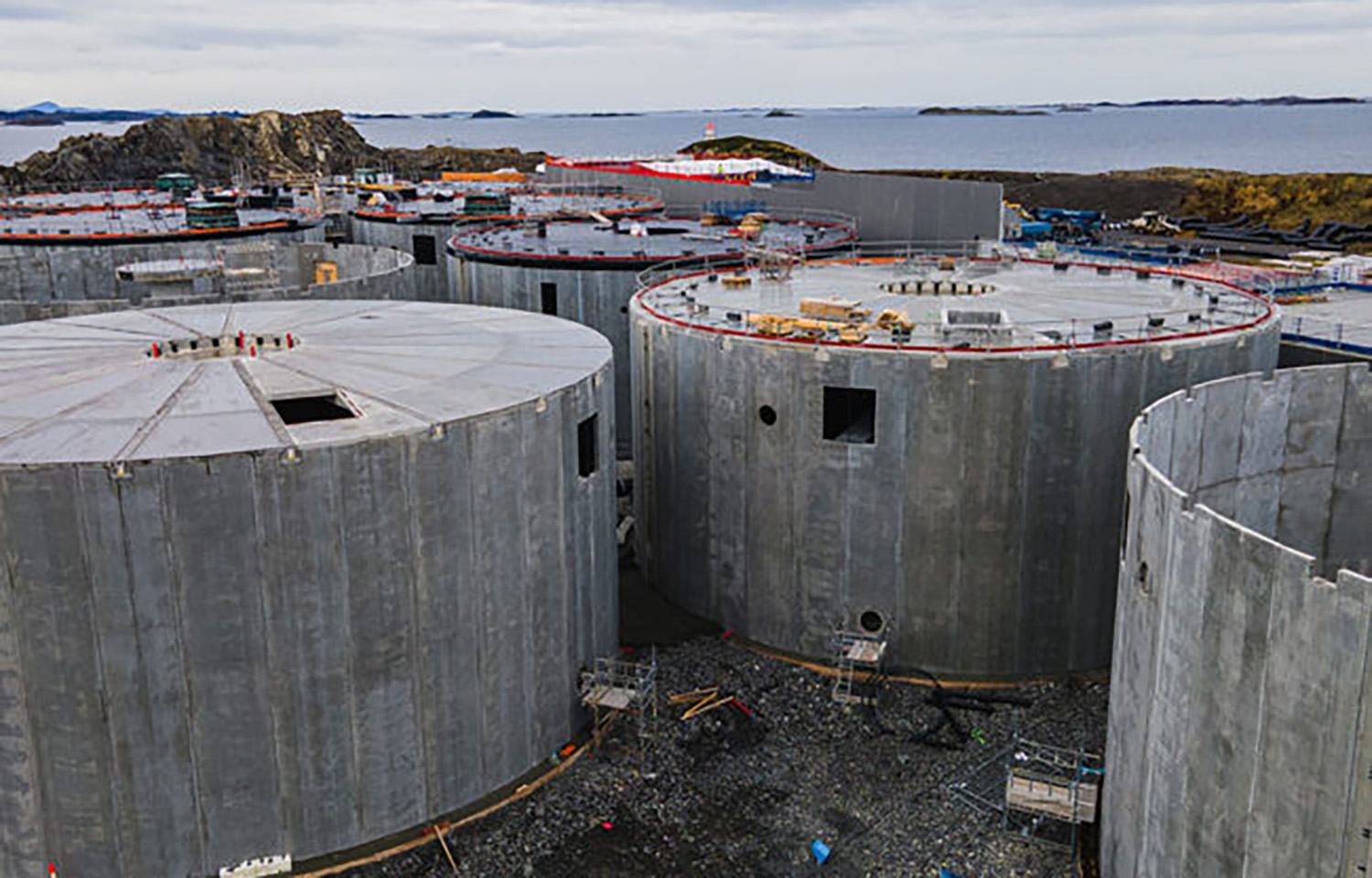
According to a new report from Dutch banking and financial services firm Rabobank, hybrid flow-through systems (HFS) may be the answer to increasing volume and quality across the global fish-farming industry, particularly in the salmon sector.
Highlighting that traditional marine cage-based farming is not only struggling to grow global salmon supply but that mortalities associated with this form of farming have increased both this year and last, the study, “Going with the flow: The rise of hybrid flow-through systems in aquaculture,” suggests HFS technology could be a profitable and sustainable way to produce more market-ready salmon and meet demand.
Even though the technology shows a lot of promise, the study’s author, RaboResearch Senior Analyst for Seafood Gorjan Nikolik, told SeafoodSource that much more backing is needed to drive wider adoption of the technology into regions like Chile, the U.S., and Canada.
Rabobank estimates that HFS projects currently operating and under construction will need between EUR 2 billion and EUR 3 billion (USD 2.1 billion and USD 3.1 billion) of capital between 2024 and 2030 for their existing plans, and that a much larger amount will be needed if conceptual and permitted projects are to become reality.
“We need [strategic investors] to get involved because they bring more than capital. These companies – processors, feed and technology companies, and specialized investors in the seafood industry – bring differentiation to the market,” Nikolik said. “They also help attract financial investors, who find it comforting to see some strategic investment. We probably didn’t see enough of that with recirculating aquaculture systems [RAS], but with HFS, we are seeing it more, which is really good.”
Investors may be interested in HFS technology, according to Nikolik, because these contained basins on the shore make it possible for operations to exclude most pathogens, such as lice, bacteria, algae, and jellyfish, therefore minimizing the need for medication, resulting in faster growth rates and better feed-conversion ratios (FCRs) than other forms of farming.
HFS farms, Nikolik said, have reported FCRs of around 1.1 on average, compared to an industry average of 1.3, alongside a survival rate of 97 percent, compared to 83 percent for the net pen industry.
Better yet for investors, the realized price of HFS salmon is “considerably higher” than that of cage-farmed salmon because it produces a higher percentage of superior-grade fish, which has been an “unexpected benefit” from the technology, Nikolik said.
Nikolik said he doesn’t see HFS technology fully replacing other forms of farming, like RAS, but can provide a viable option for regions where RAS is not compatible.
“It has become evident that operating RAS at the scale needed for Atlantic salmon is more challenging than originally assumed,” Nikolik said. “Full grow-out RAS is a very different industry. It’s essentially a new salmon industry that changes the business model, while HFS is more of an extension of the existing industry. It’s much more interlinked and connected to what’s already there in terms of location, being next to the incumbent players, and using the same infrastructure, such as feed mills and processors, and local expertise.”
One of the downsides of HFS systems is increased energy consumption, according to the report, but its high price achievements and lower biological costs more than offset those increased energy costs, according to Nikolik.
HFS technology might also face fewer environmental protests, Nikolik said, as these systems don’t release pathogens into the surrounding environment or run the risk of fish escapes.
However, he added that it’s important that the industry ensures it communicates the technology’s environmental benefits and gets its messaging right.
“I think at the end of the day, if [the industry] shows how good it is for the economy, that there is a very limited impact on the environment, that it produces a healthy food, and that it employs people in rural areas, that should counterbalance any negative arguments,” Nikolik said. “The question is where it will end up and how much of an impact it will have. Will it add 100,000 metric tons [to global production] and be an important small supplier by 2030? I think that’s quite likely.”
