



Elevated economic and political upheaval and the looming threat of tariffs have started hindering investments in the blue food economy, with backers of start-ups finding later-stage funders are edging away from the aquaculture innovation space.
Speaking at the Blue Food Innovation Summit, held in London from 8 to 9 April 2025, Aqua-Spark Chief Portfolio Officer Maria Velkova said there’s a tremendous amount of uncertainty in the aquaculture industry at present – particularly among investors. Such a backdrop tends to make things more difficult, with people becoming increasingly risk-averse and more prone to freezing up.
“But this makes our role even more important, because we should continue fostering innovations and working together to make sure that whatever is going on around the world is not stopping us in what we want to achieve,” she said.
While it’s too soon to know what the full impact of the tariffs first introduced and then later paused by U.S. President Donald Trump will be, there’s likely to be significant changes in investment deal flows and the types of innovations that are invested in, The Yield Lab Asia-Pacific Managing Director and Co-founder Claire Pribula said.
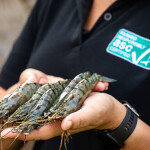
With her investment company “squarely-focused on aquaculture” in the Asian Pacific, Pribula is expecting the U.S. tariffs to have a significant effect on the region, highlighting that the investment dynamics are sure to change dramatically in sectors such as India’s shrimp industry, which is the top supplier to the United States, with 40 percent of its shrimp exports going directly to the market.
Indonesia and other producing countries are in a very similar boat, and companies that are already in the space are going to have to re-adjust, she said.
“Tariffs are rarely a good thing in international trade, especially with the U.S. being a net importer of seafood – those trade flows are already being disrupted,” Rabo Ventures Executive Director Jeroen van der Staay remarked.
Rabo Ventures predominantly invests in companies at the early-stage. These are typically sourcing and selling locally, and are therefore unlikely to be greatly affected by the changes. However, the longer-term outlook for these ventures is a lot more uncertain, and the likelihood is that once they reach a certain level of maturity, they will be impacted, van der Staay said.
“That’s already incorporated in valuations today, and there’s a pressure on valuations because of it. It also limits the ability for us to then sell these companies to next stage investors, because investors are already less interested in the space because of this, and generalist [investors] are already retracting a little bit,” he said.
As a company, dealing with these lower valuations in a market situation that can quickly change is difficult, and the suggestion from van der Staay is for such enterprises to ensure they “have enough runway” and to remember that they are not being valued on a daily basis. On the investor side, he said, there has to be the ability and willingness to support the companies in their portfolio.
A lot also depends on the type of investor and its investment horizon, Velkova added.
“If you have a longer investment horizon, and if you have a bigger idea in your head around creating synergies and a balanced portfolio, then maybe short-term fluctuations are a little less scary. Yes, it’s disrupting, it's not pleasant, it creates stress, and people become more risk-averse, but I think the structure that you have as an investor, and the horizon you have, plays a big role in [managing] short-term shocks,” she said. “That’s why I think for innovation, investors have to have it in their head that you can't be a two- or three-years flipper, because then it's just not going to work.”
As for whether the U.S. tariffs are likely to be a long-term fixture, van der Staay has his doubts.
"Personally, I'm not yet convinced that Trump has the stamina to continue this for a long period of time,” he said. “I would say the current trade environment and tariffs will likely slow down the growth outlook of the global economy in the next few years, but in the meantime, it also highlights the importance of focusing on efficiency, resiliency, and also the sustainability of the investment. I think this is also generally in line with the overall trend in the aquaculture industry, where the thesis has shifted from simply creating scales to enhancing efficiency, resiliency, and sustainability.”
Alongside making early-stage investment more complicated, the new trade situation and tariff threat have raised the bar that potential investments need to meet in order to convince investors that it will be a good move, Novo Holdings Vice President Alan Liu told the conference.
As such, Denmark-based Novo is “still very excited” about opportunities that can improve efficiency, as well as solutions to improve biosecurity, breeding, and environmental footprints, Liu said.
Adding that investors are taking a longer-term view when assessing the investment opportunities, he explained that Novo is now also focusing more on the core value drivers, rather than being distracted by short-term volatilities.
“I feel that for the next few years, given all these volatilities, [investments] won't be just about growth, there will also be some rebalancing between growth and production efficiency and resiliency, and that’s what is solving our concerns regarding this current uncertainty,” Liu said.
What this situation does change is the type of companies that The Yield Lab invests in, Pribula said.
“It raises up those companies that allow for or can help to manage the disruptions … companies that can adapt. That's the whole premise – to be able to adapt quickly,” she said.
Nevertheless, a lot of the bigger, later stage investors “have moved their chairs back” from the table, “which doesn’t help,” she said.
“I understand why it's happening. But I also think we have to not be so fickle when disruption happens. We can't just drop what we're doing and alter our strategy in a way that's going to poorly impact the innovation. That's what it's about: if you don't have innovation coming in on the front end, you ain't going to have something to invest in on the back end,” Pribula said.
Acknowledging that while it’s been very encouraging to see a good number of companies raising funds, Liu said a noticeable gap has emerged with regards to later-stage, more mature capital.
These are those entities with the mandate and also the risk appetite to fund businesses to scale and help them reach the stage where they can be sold to an industrial company, he said, adding that the aquaculture industry also needs more entrepreneurs who can develop business models that deliver stable cash flow generation and “enough upside” for the next phase of ownership.
“Shifting to those mindsets will also fit the later stage investors better when they look at opportunities in the aquaculture industry,” Liu said. “I think in the long-term, you will see more sovereign funds investors, or longer-term investors, either coming from a foundation background or from a private equity background, coming into the sector as they would see those later stage opportunities as being very attractive.”
Van der Staay also called for more investors in the space, and said outside factors can also influence investor willingness.
“I think regulators can play an important role in that. I think strategic players can also play a very important role in that. I think in every value chain, it's clear where the money's being made, those players also have a responsibility. And together, we can weather this storm and make this a more prosperous industry,” he said. “But we all need to play our part.”
As the industry continues to grapple with the impacts of tariffs and trade instability, the shockwaves that followed the recent eFishery collapse – and the investigation into allegations of misconduct by the Indonesian aquaculture start-up’s founders – have already changed some of the dynamics with regards to venture capital and the types of rounds that are being raised, Pribula said, telling the summit that some of the investor valuations made since have halved or quartered.
However, she also pointed out that the interest generated in eFishery and its USD 200 million (EUR 176 million) funding round “that investors fought to get in on” generated positive momentum in other deals.
Aqua-Spark was the largest shareholder in eFishery, and Velkova said that while its collapse has become such a big focus, it should be remembered such things also happen in every other industry.
“I don't ever want to say it’s normal, because I don't think it is. But at the same time, I think we are much more resilient [and shouldn’t be] thinking that one company that failed is going to have a massive impact,” she said. “I can imagine how this can be used by skeptics: to say, ‘I told you so.’ I completely disagree with this. I think we have a lot of amazing examples that show there’s much more there. It's very, very unfortunate. It's very emotional as well, because I think we, we were all looking to a success [with eFishery]. At the same time, in the pipeline, we have so many other companies that are getting there. So, I would say it’s bad luck, but also that’s not the end of aquaculture. I think we should all stop making it bigger than it is.”
While it has “created a pause for reflection,” the eFishery episode certainly isn’t unique to the blue economy, insisted Liu.
“It happens in finance, in tech, in energy, and all of those sectors continue to thrive,” Liu said. “I still think the fundamentals of the blue economy are intact, driven by innovation, climate, and resiliency. So, we shouldn’t mix up this one case with the many more opportunities that we have in this sector.”
