






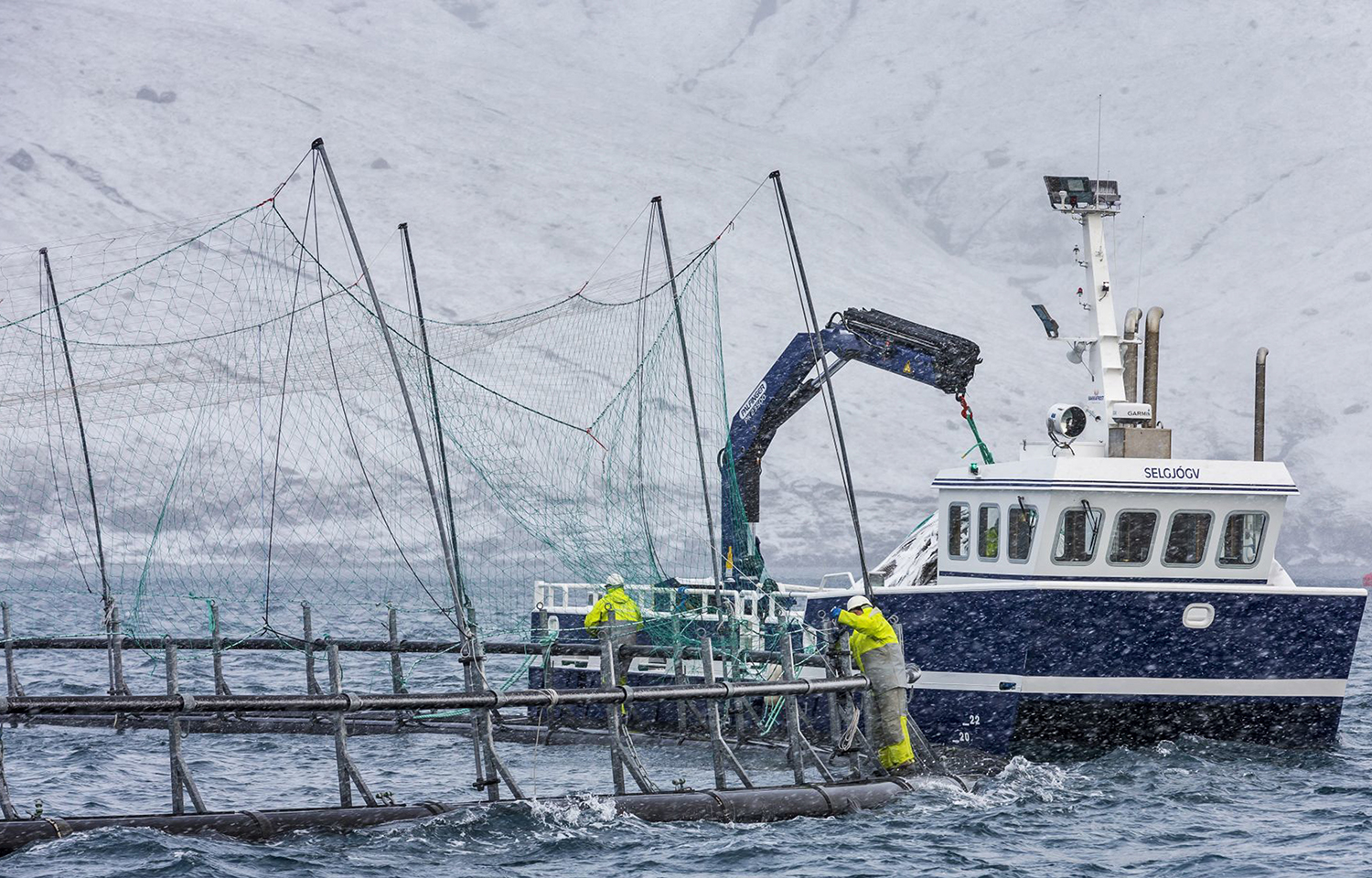
Strong biological performance and a 67 percent increase in Faroese harvest volumes drove sharp improvement in salmon-farming firm Bakkafrost’s results for the second quarter of this year.
Bakkafrost reported operational EBIT of DKK 273 million (USD 42.3 million, EUR 36.5 million) in Q2 2026, which was more than four times the DKK 65 million (USD 10.1 million, EUR 8.7 million) recorded in the same period last year.
According to its latest Q2 report, this improvement was overwhelmingly led by the group’s Faroese operations, which harvested a record 26,749 gutted weight tons (GWT) in the quarter, compared to 16,020 GWT a year earlier.
That higher harvest volume, combined with stronger biological performance and lower farming costs, helped the segment’s operational EBIT almost double to DKK 411 million (USD 63.8 million, EUR 55 million) from DKK 211 million (USD 32.7 million, EUR 28.2 million) in Q2 2025.
By contrast, Bakkafrost’s Scottish operations harvested just 3,145 GWT in Q2, compared to 7,034 GWT in Q2 2025.
Due to this lower harvest volume and biological challenges affecting one batch of externally sourced smolt, the firm’s Scottish segment recorded an operational EBIT of DKK -139 million (USD -21.6 million, EUR -18.6 million), compared to DKK -146 million (USD -22.6 million, EUR -19.5 million) a year previously.
Bakkafrost CEO Regin Jacobsen explained the lower Scottish harvest volumes were largely intentional as the firm continues to carry out its derisking strategy in the region. At the same time, the firm’s Scottish operations are also continuing to ramp up freshwater production at the Applecross hatchery facility, where smolt stocking developed well during Q2, keeping Bakkafrost on track to deliver its full-year transfer target.
For 2026 as a whole, Bakkafrost expects to transfer approximately 20 million smolts in the Faroe Islands at an average weight of around 440 grams. Scottish transfers are expected to reach around 10 million at an average weight of 179 grams.
Advising that “survivability is good at the moment,” Jacobsen said the benefits of its transition toward larger smolt will become increasingly visible from 2027 onward.
Aiding in that goal, the firm reached a new milestone at its Faroese Skálavík hatchery, where the first eggs were introduced in June. The facility is being brought into production gradually, with the first smolt output expected toward the end of 2027. Once completed, the hatchery is expected to increase Bakkafrost's Faroese smolt production capacity to approximately 24.4 million smolts at 500 grams, compared to current capacity of around 18 million.
Bakkafrost also announced in its Q2 report that it is maintaining its 2026 harvest guidance of approximately 117,000 GWT, comprising around 97,000 GWT in the Faroe Islands and 20,000 GWT in Scotland, despite the fact the firm is dealing with a sharp increase in feed raw material costs.
Jacobsen explained that Bakkafrost’s integrated value chain and strong inventory position give it flexibility to manage these conditions, with the ability to secure supply, adapt formulations, and mitigate the impact, but doesn’t totally eliminate its exposure to raw material inflation.
“We believe Bakkafrost has one of the most integrated value chains in the salmon industry. This gives us in-house expertise and the ability to coordinate decisions across the business. I think this is especially valuable now with the current feed market, where prices have risen sharply and some raw materials are less available,” he said.
Though raw materials are tight and costly, Bakkafrost has increased its expected 2026 feed production from 165,000 MT to around 175,000 MT, with almost all of that output expected to be used internally by its Faroese and Scottish farming operations. Jacobsen added that Bakkafrost’s current fishmeal inventory is sufficient to support feed production into Q2 2027.
Elsewhere, the group is also continuing to pursue its DKK 5 billion (USD 775.7 million, EUR 668.9 million) investment program for 2026 through 2030, which was first announced at its 2025 Capital Markets Day. The program focuses on reducing biological risk, improving operational efficiency, and supporting growth in both the Faroe Islands and Scotland.
In the Faroe Islands, investments aim to increase annual smolt production capacity and enhance feed production, farming sites, harvesting capacity, and farming technology. For Scotland, planned investment includes site expansion and optimization, together with a new harvest and processing facility intended to accommodate higher future production.
The program also includes new dual-freshwater treatment vessels and DKK 245 million (USD 38 million, EUR 32.8 million) earmarked for energy transition initiatives across the firm’s value chain.
Bakkafrost expects the investments to support sustainable growth, leading to expected annual harvest volumes of 162,000 GWT by 2030.
