

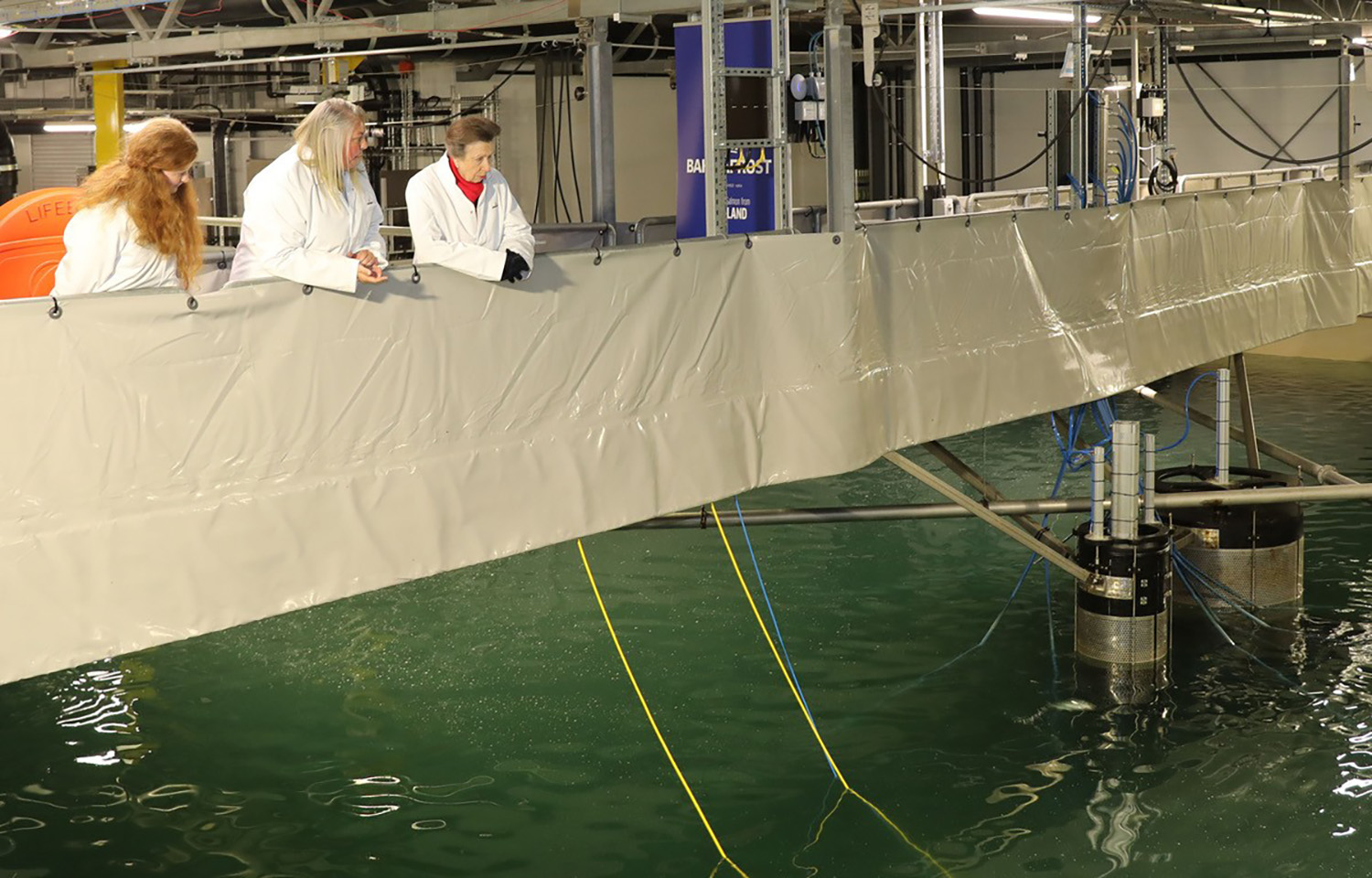
Bakkafrost Scotland has officially opened its modernized and expanded Applecross land-based hatchery and smolt facility in the Scottish Highlands.
Opened by The Princess Royal during a ceremony on 13 May, the facility is now the largest freshwater recirculating aquaculture system (RAS) in the U.K. and underpins the Faroe Islands-headquartered company’s “one summer at sea” production model.
The model aims to allow salmon to remain in controlled freshwater conditions for longer before transfer to sea as larger smolt, reducing marine grow-out time and exposure to biological and environmental challenges.
Bakkafrost Scotland Managing Director Ian Laister said the facility represented “a significant long-term investment in the future of sustainable salmon farming in Scotland.”
“It reflects our determination to become the most sustainable Scottish salmon producer,” Laister said. “The ‘one summer at sea’ model has the potential to be a real gamechanger for the sector, improving survival, reducing biological challenges, and making better use of natural resources.”
Biological challenges in particular have plagued Bakkafrost’s Scottish operations, so much so that the firm has spent multiple years implementing a “de-risking” strategy in the region aimed at turning around poor biological performance that hampered financial results.
The high-quality smolt expected to come from the expanded Applecross facility is a major component of the strategy, according to the firm.
Operating around the clock, the Applecross site supports about 40 permanent skilled jobs spanning biology, veterinary services, engineering, energy, and technical operations. The company said staff worked alongside local and international specialists during the design, construction, and commissioning phases, developing expertise in RAS management, renewable energy integration, and fish health monitoring.
Bakkafrost said the project also generated wider economic benefits across the region through the use of local suppliers, contractors, and haulage firms during construction.
The RAS facility uses advanced water recirculation technology to tightly control water quality, temperature, and flow while reducing overall water consumption compared with conventional hatcheries. Water is continuously filtered, oxygenated, disinfected, and treated through biofilter systems to support fish welfare and smolt performance.
A key feature of the development is a waste-to-fertilizer conversion system using pyrolysis technology to convert sludge from the RAS process into biochar. According to the company, this is a first for global aquaculture, and the resulting carbon-rich material can be used locally to improve forestry soils, supporting circular economy goals and reducing waste output.
The site is powered directly by renewable energy sources, including on-site solar and hydropower generation. As part of the development, Bakkafrost installed a private wire network across the Bealach na Bà mountain pass to connect the facility to renewable hydropower supplies.
The company also invested in local infrastructure improvements, including new passing places and road signage aimed at improving safety and accessibility in the area.
