



Roughly 120 years ago, Harry Brownstein went from smokehouse to smokehouse with a horse-drawn wagon, distributing their products to stores.
“He was a wagon jobber, with a horse-drawn wagon buying smoked fish from different smokehouses around Brooklyn and Queens, and he had himself a sales route,” Adam Caslow, Managing Partner and Co-Owner of Acme Smoked Fish, told SeafoodSource. “His dream was to open his own smokehouse, which he achieved close to the end of his career.”
Brownstein started the business with his sons Joe and Morty, later on adding the help of his son-in-law Rubin Caslow to the mix as a small team trying to break into a well-established industry.
“They were among a bunch of different smokers in the city; it was a very week-in, week-out business just grinding it out, trying to buy fish, front the money to buy fish, and they were always lucky if at the end of the week there was money left in the till,” Adam said. “It was a very tough business, one that had no growth strategy. The plan was to survive.”
Now, 120 years on from Brownstein’s dreams, Acme Smoked Fish is the largest producer of smoked fish in the U.S., and the family is still running the business.
“Through different attrition, my grandfather, Rubin Caslow, and his brother-in-law, Joe Brownstein, ended up being generation two. Joe’s kids ended up not really going into the business, and Rubin had two sons – Robert and Eric,” Adam said.
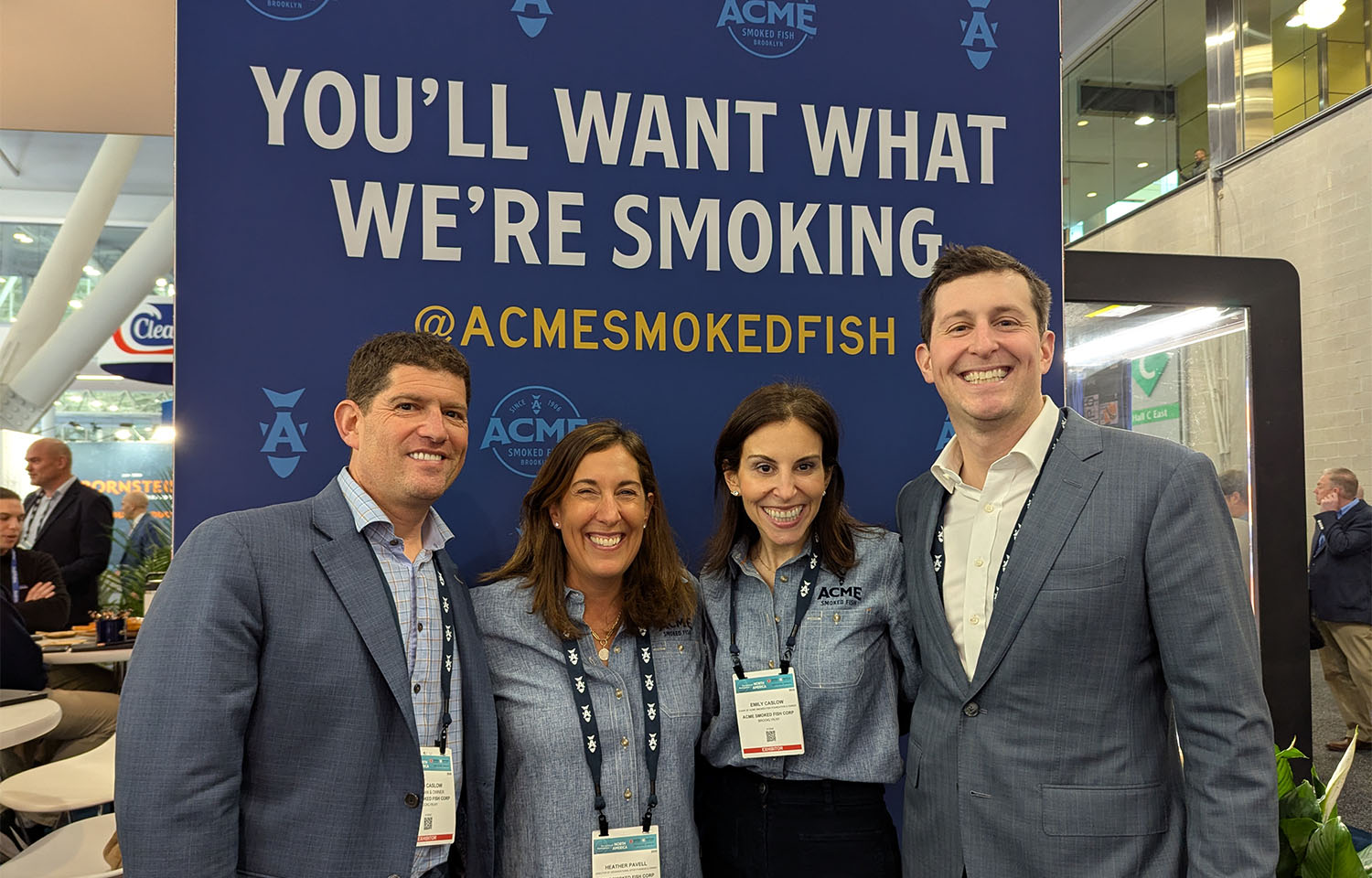
Robert and Eric would both go on to have children of their own, and today, Adam, Emily Caslow, David Caslow, and Heather Pavell are all still in the business – though they all took a different route to get back to Acme.
“We’ve all taken different routes to get here, and what’s been cool is we’ve discovered how enriching the business is by having different perspectives from our different lived experiences,” Adam said.
Adam said he remembers growing up as a kid and heading to work with his dad on days off of school.
“When you had a day off school, you go up super early at 4 in the morning, got in the car, fell asleep, and arrived at Acme. To keep us there, he got pancakes from the local Three Decker Diner – which is still there,” Adam said. “Then, you kind of wandered around this dark, smelly, wet place trying to figure out ‘What’s happening here?’”
Adam, along with Emily, the chair of Acme Smoked Fish Foundation, and Pavell, the director of organizational effectiveness, said they all recall making boxes, putting stickers on packaging, and riding on forklifts.
“I remember being so curious about what this is all about – a lot of people have parents who are business people or doctors or lawyers or other jobs, but there are very few smoked seafood professionals,” Adam said.
From that initial start with the business, the family all branched out. Adam said he first left and went to hospitality school and went on to work in hotels. Emily, David, and Heather all had their own round-about journeys, but in 2025, the whole family was back at the company – marking the first year they were all together under the same banner.
Acme has come a long way from the early days when the only plan was trying to keep the lights on in the business.
It currently employs 1,100 people in three different countries. It purchased a new facility in Florida in 2022 and fellow salmon smoker Banner Smoked Fish in 2024. Those purchases built on the existing 100,000-square-foot facility it opened in North Carolina in 2015, which it said is the largest smoked salmon plant in the U.S., capable of producing 10 million pounds of product a year.
While Acme has become synonymous with smoked fish, Adam said there are more opportunities for the company outside the medium as well.
“How do we bring consumers into the seafood space – whether that’s through ready-to-eat, almost ready-to-eat, ready-to-cook?” Adam said.
He said there’s an intimidation factor to cooking seafood, and the company’s growth efforts are focused on making those occasions where someone is considering seafood as frictionless as possible.
“Our innovation and growth efforts have been rooted around, ‘How do we make those usage occasions more accessible?’ whether it’s through snacks, or lox in a box, or poke bowls,” Adam said. “Our growth ambitions are rooted around not just smoked but ready-to-eat occasions for the consumer.”
Adam said the company is considering ways to introduce other species to the mix as well, as seafood consumption is still dominated by salmon, tuna, and shrimp.
“Smokers have a history of taking underappreciated, under-loved species and getting some love back into them and making them tasty and delicious,” he said. “That really is about consumer trends.”
As it continues to build on its past success, Adam said making Acme a more household name is also on the agenda for the company in the coming years.
“There’s not a lot of brand awareness. A lot of industry folks know who we are, but I think it’d be great for the consumer to be able to trust our brand,” Adam said.
Throughout that growth journey, having four generations of family business behind it forms a strong foundation to build on, Adam said.
“We’re rooted in our history and in it for the long haul,” Adam said. “We have a long-term view. We’re not compromising for quarterly performance over our long-term growth and values.”
