






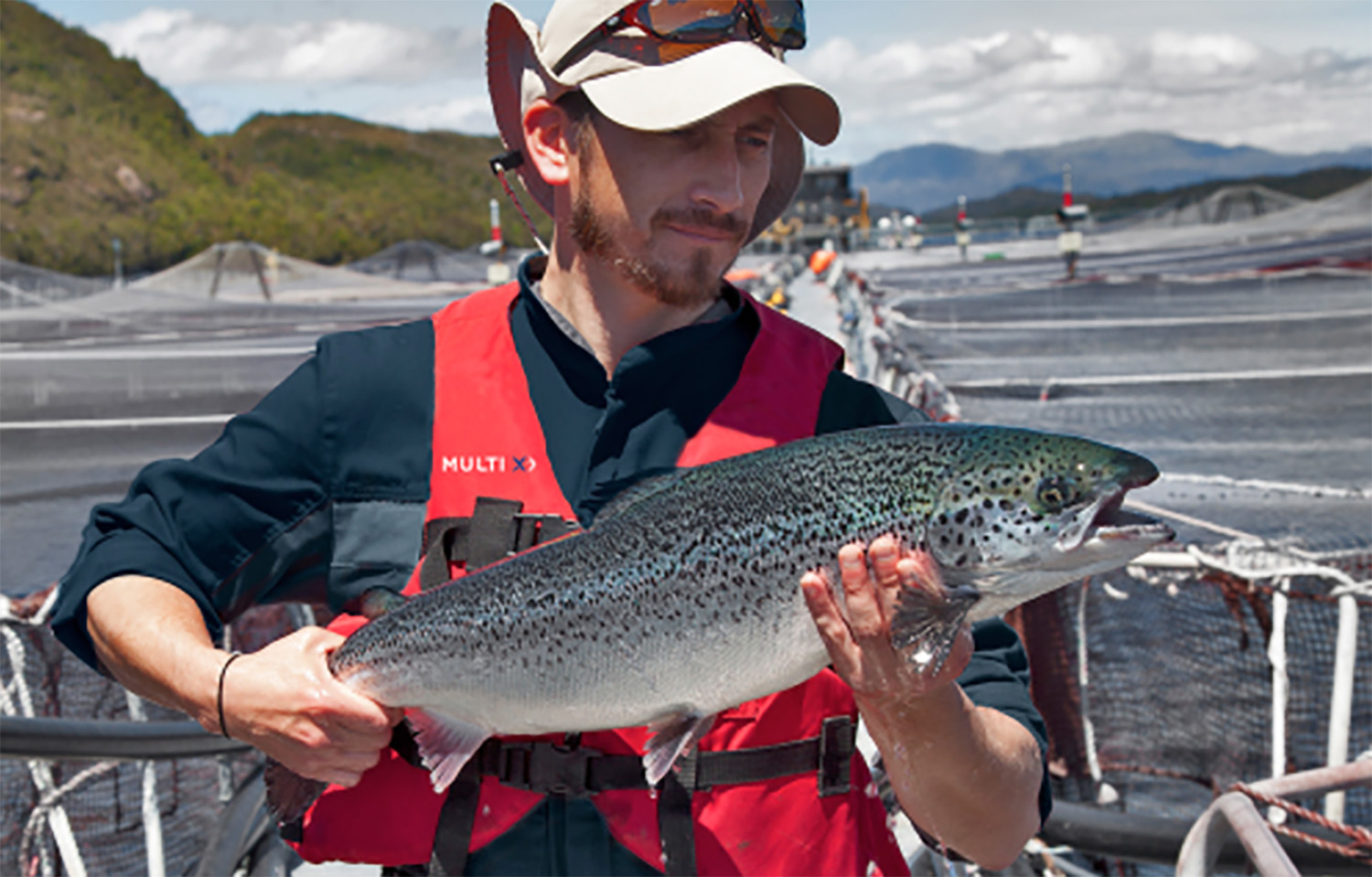
Chilean salmon-farming firm Multi X closed the third quarter of 2024 with a significant drop in revenue, which the company said was due to low average harvest weights and weak market prices.
The firm’s average harvest weight of Atlantic salmon reached 4.94 kilograms during the third quarter of 2024, compared to 5.28 kilograms in the same quarter last year.
In the U.S., which is the company’s main market, Multi X said average sales prices dropped from USD 5.73 (EUR 5.44) per pound in Q3 2023 to USD 5.49 (EUR 5.21) per pound in the same quarter of 2024 due to weak demand as consumers opted for cheaper protein options.
The firm’s Q3 harvest volume totaled 25,509 metric tons (MT) whole fish equivalent (WFE) – down 19 percent when compared to the same quarter last year – while volume sold was down 27 percent to 25,781 MT WFE.
Correspondingly, Multi X’s Q3 revenues fell 27 percent to USD 189 million (EUR 179 million), compared to USD 258 million (EUR 245 million) posted in Q3 2023. Operational EBIT reached USD 5.4 million (EUR 5.1 million), which was 59 percent lower than the USD 13.3 million (EUR 12.6 million) in the same quarter of the previous year. The firm attributed this heavy drop mainly to higher production costs, as well as the aforementioned lower sales volumes and prices.
Those higher production costs included total Atlantic salmon costs for the quarter which reached USD 6.24 (EUR 5.93) per kilogram WFE, which was higher compared to USD 6.10 (EUR 5.79) from the third quarter of 2023.
Multi X did, however, bring ex-farm costs down to USD 4.84 (EUR 4.60) per kilogram WFE, decreasing 3.1 percent compared to the previous quarter despite lower harvest weight and higher mortality rates during the quarter.
Multi X sold 12,590 MT WFE of fillets in Q3, representing 49 percent of total sales, followed by 9,354 MT WFE of head-on, gutted (HON) fish, making up 36 percent of the total, and then 3,973 MT WFE of custom processed (CP) products, making up 15 percent of total sales. During the quarter, 97.1 percent of its sold products were considered premium, it said.
Due to all of these factors, the firm reported a consolidated loss for the period before fair value adjustments of USD 3.5 million (EUR 3.3 million), compared to profits of USD 5.8 million (EUR 5.5 million) posted for the third quarter of 2023. After fair value adjustments, Multi X posted a Q3 profit of USD 5.9 million (EUR 5.6 million), compared to profits of USD 3.3 million (EUR 3.1 million) from the same period of 2023.
To elicit better financial results, the company has been focusing on lowering costs.
“On average, our costs have increased 30 percent since the Covid-19 pandemic,” Multi X CFO José Ramón Gutiérrez said on the “Zoom Empresas” podcast. “This is not due to just one factor, but it is mainly due to increases in oil prices, inflation in goods and services, higher values in fish feed – which rose around 60 percent compared to pre-pandemic costs, and feed represents around 30 percent to 40 percent of the total cost – as well as low volumes and lower average weights.”
As a result, the firm has instituted the Humboldt Project – developed with a third-party consultancy – that involves negotiating and tendering services with a focus on efficiency following significant growth in 2023, when Multi X expanded about 30 percent in volume over 2022, Gutiérrez said.
The project has identified 112 cost-saving initiatives and Multi X is projecting total savings of around USD 49.5 million (EUR 47 million) compared to the cost base of 2023, he said.
“We have implemented half of the initiatives, contributing to the target savings, where in the second quarter we reached USD 4 million (EUR 3.8 million), and by 2024, this will reach USD 20 million to USD 24 million (EUR 19 million to EUR 22.8 million) in terms of cash flow and USD 14 million (EUR 13.3 million) in results,” Gutiérrez said.
As it works to increase efficiencies, the company is also facing some regulatory headwinds.
On 22 November, Chile’s National Fisheries and Aquaculture Service (Sernapesca) reported that Multi X was sentenced to pay a fine for failing to extract daily mortalities, and for not using exclusive containers to prevent possible spills or cross-contamination into the environment or other farming operations at its Puyuhuapi 2 farming center.
The fine, equivalent to CLP 20 million (USD 20,500, EUR 19,500), was levied after Sernapesca determined the actions were an infringement on the nation’s aquaculture regulations.
“Sernapesca confirmed the poor management of mortality by the center, given that the protection measures provided for in the sanitary programs were not adopted. This is in addition to the fact that the owner was convicted as a repeat offender, which aggravates the conduct,” Sernapesca Aysén Regional Director Daniela Leiva said in a release. “We are satisfied with the court’s decision since it shows how important it is for companies to comply with current regulations and protection measures. We at Sernapesca will continue to monitor aquaculture activity in person, flying over the area and also remotely and in document review. We expect an improvement in conduct and regulatory compliance by salmon companies, avoiding repeat offenses.”
