






Harsh winter conditions and biological challenges negatively impacted Frøya, Norway-headquartered SalMar’s salmon production in the first half of 2024, though the firm reported improved biological performance as the period progressed.
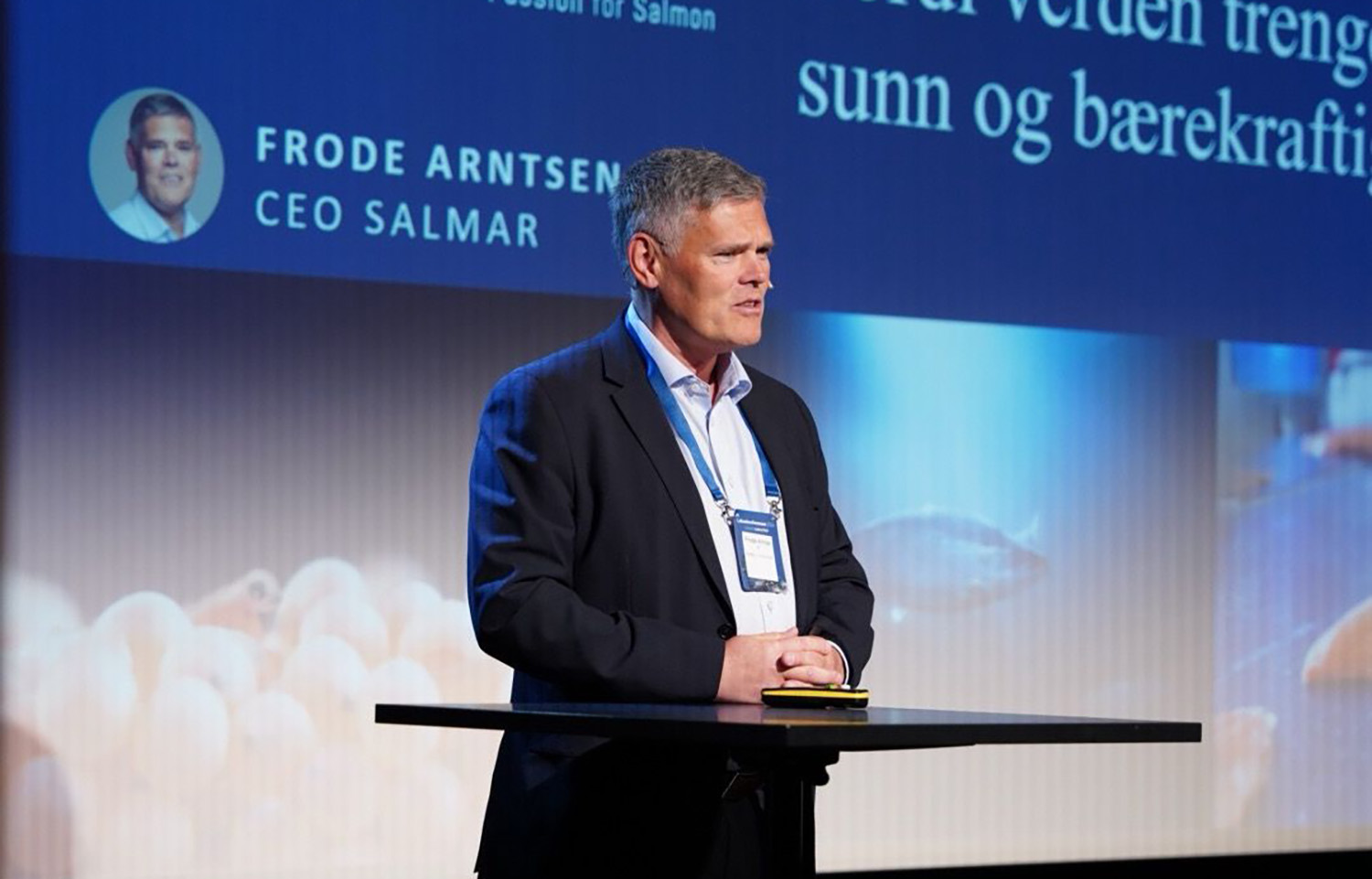
In the company’s Q2 2024 report, SalMar CEO Frode Arntsen said string jellyfish and related winter sore challenges that began toward the end of 2023 continued to affect Norway throughout the winter and spring of 2024, but that conditions improved as summer neared.
This improvement, according to Arntsen, was accompanied by reduced costs and effective operational management at its harvesting and processing facilities.
Nevertheless, the company was only “moderately satisfied” with its Q2 2024 results, Arntsen said.
SalMar’s Q2 2024 operational EBIT for its Norwegian operations ended at NOK 1.47 billion (USD 139.4 million, EUR 125.8 million). Its nationwide harvest volume was 44,100 metric tons (MT), and its operational EBIT per kilogram was NOK 33.20 (USD 3.15, EUR 2.84).
Through Norway’s “traffic-light system,” which aims to regulate aquaculture growth, SalMar purchased a share of allowed growth at a fixed price of NOK 170,000 (USD 16,117, EUR 14,544) per MT in the quarter, totaling 753 MT. At the auction for remaining available volume held in June, SalMar acquired 2,274 MT at a price of NOK 633 million (USD 60 million, EUR 54.2 million).
“At SalMar, growth is at the core of our strategy. We are not pursuing growth for its own sake but because the world needs more sustainable food and we see significant, unrealized potential in our value chain and in the salmon market. This is why we participated in the traffic-light auction,” Arntsen said. “In total, we acquired 3,027 MT of increased maximum allowable biomass … representing a growth of approximately 2 percent in our total MAB capacity.”
SalMar recently increased its ownership stake in two Norwegian salmon-farming subsidiaries: It acquired the remaining 45 percent of Refsnes Laks, operating in Central Norway, and increased its stake in Øylaks MTB by 2 percent, bringing its total stake to 51 percent. Øylaks operates in a different production area in Central Norway.
In Iceland, SalMar owns 52 percent of Icelandic Salmon, which owns 100 percent of Arnarlax. Arnarlax faced high costs on its harvested volume due to biological challenges faced in the second quarter, including heart and skeletal muscle inflammation (HSMI) disease and lice issues. The segment harvested just 700 MT of fish in the period.
Icelandic Salmon is the country’s largest producer and processor of farmed salmon. In July, it received additional licenses granting it 10,000 MT of MAB sterile salmon and three new farming sites in Ísafjarðardjúp, which is a little farther north than where it currently operates.
Icelandic Salmon's operating income increased to NOK 113 million (USD 10.7 million, EUR 9.7 million) in Q2 2024, and its operational EBIT fell NOK 8 million (USD 759,259, EUR 685,184) to NOK -43 million (USD -4.1 million, EUR -3.7 million). Its operational EBIT per kilogram was NOK -61.60 (USD -5.85, EUR -5.28) due to the low harvest volume and biological challenges.
“Sadly, this is a weak result – influenced by the low harvest volume and the biological challenges we have faced at sea,” Arntsen said. The company's high costs are expected to persist in the coming quarters as harvesting from those sites continues, he said.
For the wider group, SalMar’s Q2 2024 operational EBIT was NOK 1.39 billion (USD 131.8 million, EUR 119 million), compared to NOK 1.75 billion (USD 166 million, EUR 149.8 million) in Q2 2023. Its operating revenues reached almost NOK 5.8 billion (USD 550 million, EUR 496.6 million), down from NOK 5.9 billion (USD 559.5 million, EUR 505.1 million) in the same period a year previously.
SalMar's overall harvest volumes totaled 44,800 MT, marking an increase of 500 MT year over year, and the operational EBIT per kilogram was NOK 31.10 (USD 2.95, EUR 2.66). In Q1 2023, these measures totaled 44,300 MT and NOK 39.40 (USD 3.74, EUR 3.37), respectively, with the EBIT decrease attributed to higher prices.
Norway's recently implemented production tax and Iceland's resource tax cost SalMar NOK 44 million (USD 4.2 million, EUR 3.8 million) in Q2 2024.
SalMar’s Sales and Industry segment, which sells all the fish the group harvests in Norway, generated Q2 gross operating income of NOK 5.86 billion (USD 556.1 million, EUR 501.9 million), down from NOK 6 billion (USD 569.4 million, EUR 513.9 million) in the same period a year ago. Its operational EBIT decreased by NOK 23 million (USD 2.2 million, EUR 2 million) to NOK -90 million (USD -8.5 million, EUR -7.7 million).
For H1 2024, SalMar generated a gross operating income of almost NOK 12.4 billion (USD 1.2 billion, EUR 1.1 billion), down from NOK 12.7 billion (USD 1.2 billion, EUR 1.1 billion) in H1 2023. The group harvested 97,700 MT in the period, an increase of 5 percent year over year.
SalMar's average price of salmon for H1 2024 reached NOK 110.50 (USD 10.48, EUR 9.46) per kilogram, compared with NOK 106 (USD 10.06, EUR 9.08) in the same period last year.
SalMar’s operational EBIT for the first six months of this year dropped to NOK 2.9 billion (USD 275.2 million, EUR 248.4 million) from NOK 3.6 billion (USD 341.6 million, EUR 308.3 million) in H1 2023. This gave the firm an operational EBIT per kilo of NOK 29.70 (USD 2.82, EUR 2.54), compared with NOK 39.10 (USD 3.71, EUR 3.35) in H1 2023.
SalMar’s harvest guidance for 2024 has remained the same in Norway, which is expected to produce 237,000 MT of salmon, its Scottish operations are expected to remain at 37,000 MT, and its SalMar Aker Ocean operations are expected to remain at 7,000 MT. Its guidance for its operations in Iceland was reduced by 2,000 MT to 13,000 MT.
Looking ahead, SalMar’s Q2 report estimates current volume potential in Norway at 300,000 MT, annually 13,000 MT for SalMar Aker, 26,000 MT for Iceland, and 45,000 MT for Scottish Sea Farms. Overall, this implies a total volume projection for the group of 362,000 MT, including its share from Scottish Sea Farms.
“The actions that we have taken in this quarter demonstrate our confidence in the industry. They strengthen our position in some of the best regions in the world for farming and provide us with a better foundation for efficient operations, allowing us to offer more salmon to our customers worldwide,” Arntsen said.
Kristine Hartmann, formerly the development director at SalMar Aker Ocean, has been appointed to lead SalMar's Salmon Living Lab, an initiative launched this year aimed at understanding the drivers of biological performance. Initial investments in Salmon Living Lab are estimated at NOK 500 million (USD 47.5 million, EUR 42.8 million).
And in June, SalMar was named by Time magazine as one of the world's 500 most sustainable companies.
“We know that we produce one of the most sustainable proteins that you can put on your plate, and as long as we manage this responsibly, we are an industry with eternal potential,” he said.
