


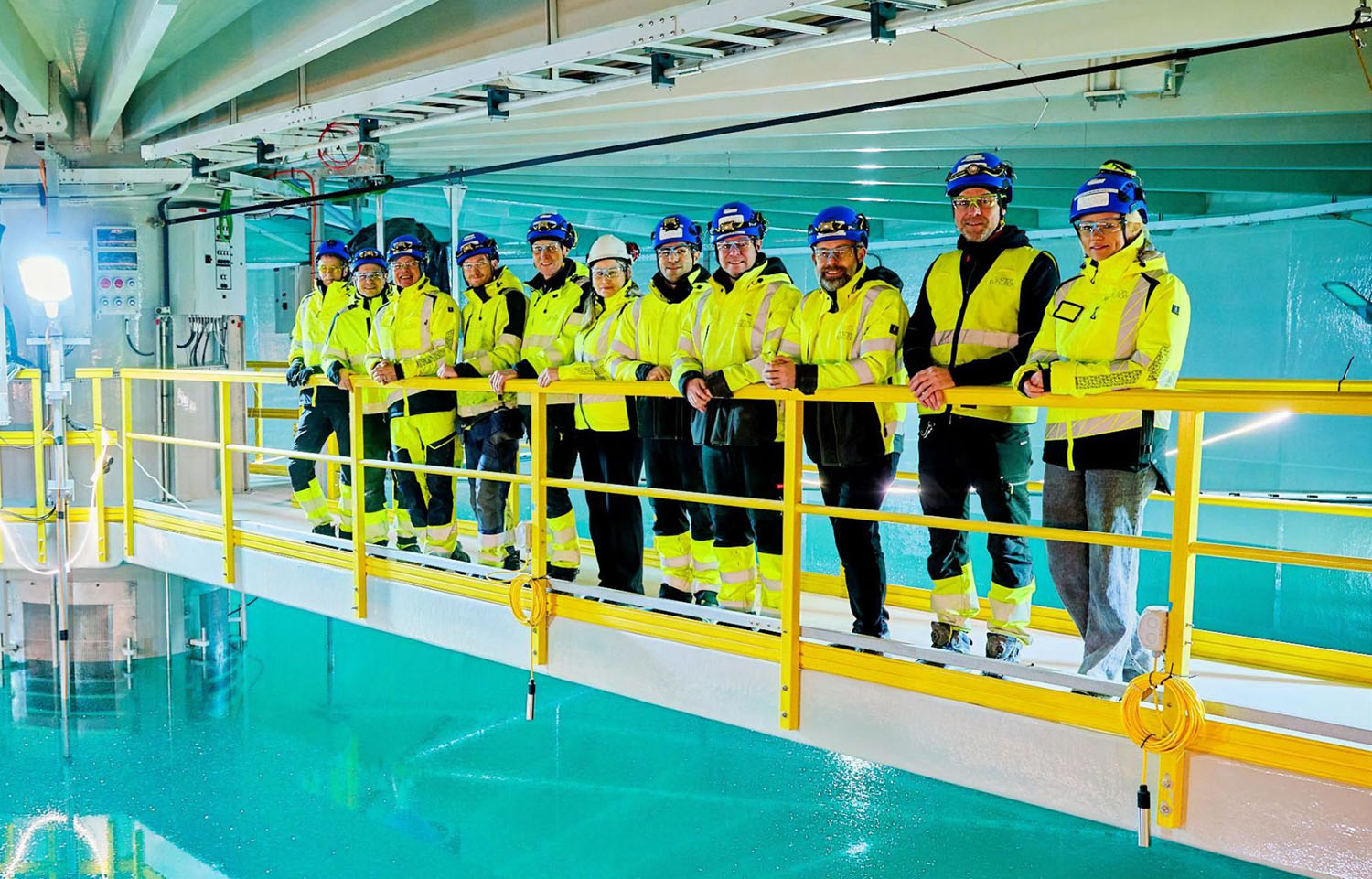
Norwegian land-based aquaculture company Salmon Evolution is steadily progressing through an important new chapter for the firm and is eyeing a significant ramp-up in production, according to CEO Trond Håkon Schaug-Pettersen.
Delivering Salmon Evolution’s Q1 2026 results in Oslo, Norway, Schaug-Pettersen said that “everything is progressing according to plan,” and with Phase 2 of its Indre Harøy hybrid flow-through salmon farm now in operation, the company “is truly at an inflection point where we are now transitioning from a period dominated by construction and investment toward scale up and cash flow generation.”
“Phase 2 will be a real gamechanger for the company. It will give us an unprecedented platform in this industry, both in terms of scaling earnings and also future growth capacity,” he said. “We are very confident that this will set a new benchmark for land-based salmon farming. Things are looking very good. We've only been operating it for a couple of weeks, but it has been very good so far, and we strongly believe that that will continue.”
Furthermore, following the introduction of both a new feed strategy and updated operational protocols during Q1, there has been a “step change” in growth compared to what the firm experienced during Phase 1 of Indre Harøy, giving Salmon Evolution increased confidence in reaching its stated targets, Schaug-Pettersen said.
This “strong and sound operational platform” led to solid Q1 financial metrics.
Salmon Evolution reported revenues of NOK 152.2 million (USD 16.4 million, EUR 14 million) in the three-month period, compared to NOK 59.2 million (USD 6.4 million, EUR 5.4 million) in Q1 2025. On the farming side, its operational EBITDA increased from NOK 5.7 million (USD 615,124, EUR 522,650) to NOK 17.6 million (USD 1.9 million, EUR 1.6 million), while the group’s EBITDA as a whole improved from NOK -4.1 million (USD -442,318, EUR -375,815) to NOK 9.4 million (USD 1 million, EUR 861,480).
These numbers were achieved despite some “softer than expected” salmon prices in the period and the temporary impacts on biomass of changing feed and operating protocols, Schaug-Pettersen said.
In line with earlier guidance, the producer harvested a record 1,765 metric tons (MT) of head-on-gutted (HOG) salmon in the period. These fish had an average weight of 3.2 kilograms, realizing a price of around NOK 84 (USD 9.05, EUR 7.69) per kilogram. The firm also achieved a 94 percent superior grade share, which was on par with previous quarters.
Harvest weights are expected to improve throughout 2026 on the back of biomass growth acceleration, while a simultaneous projected slowdown in salmon production in both Norway and Chile is likely to create a more favorable price backdrop going forward, Schaug-Pettersen said.
He also highlighted that the first smolt released in Phase 2 has adapted well, with feeding starting quickly after release.
“This is exactly what we want to see at this stage: predictable startup, good biology, and also tight operational control,” he said. “I have to say, although it's still early, things are looking very good, and we very much look forward to seeing the development here going forward.”
The second smolt release into Phase 2 will take place in mid to late May, and for 2026 as a whole, the plan is to stock around 2.8 million smolts, which would represent a year-over-year increase of approximately 60 percent.
“This underpins a stepwise ramp-up in biomass and production over the coming quarters,” Schaug-Pettersen said.
Through phases 1 and 2, Salmon Evolution is targeting the production of 18,000 MT HOG by the end of 2027, after which Phase 3 aims to double the capacity to 36,000 MT HOG.
There is also a “potential Phase 4” with a further 18,000 MT HOG capacity, Schaug-Pettersen added.
“While this is still conceptual, it provides an upside that can be unlocked over time,” he said.
Meanwhile, following an equity raise in April, with strong support from existing shareholders and the addition of some new investors, Salmon Evolution has completed a refinancing round that will give it the capital structure to complete Phase 2, Salmon Evolution CFO Trond Vadset Veibust confirmed.
This has given the company a “solid financial platform” to move forward, he said.
“The bottom line is the business has been de-risked, the foundation has been built, and now we are positioned to harvest the returns,” Veibust said.
