

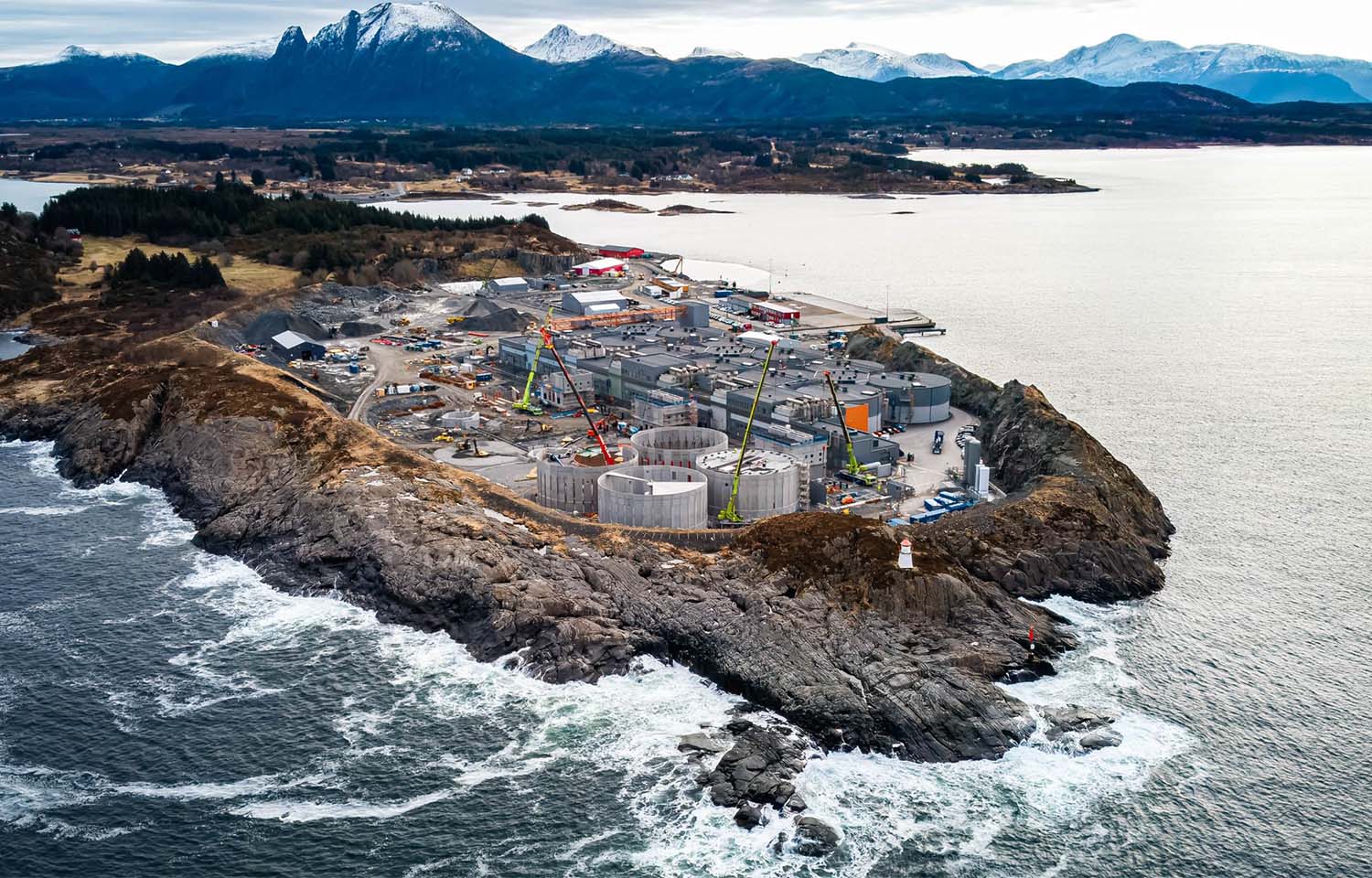
Norwegian land-based aquaculture company Salmon Evolution is expecting the Phase 2 expansion of its Indre Harøy facility to be a gamechanger for the company.
Delivering the firm’s Q1 2025 financial results, Salmon Evolution CEO Trond Håkon Schaug-Pettersen said that the groundbreaking expansion is progressing on time and on budget, with 10 months left until the first stocking of the facility is expected to take place.
If the project continues to progress as expected, the facility will produce its first harvest in the fourth quarter of 2026, Schaug-Pettersen confirmed, with Phase 2 expected to eventually add 10,100 metric tons (MT) of head-on-gutted (HOG) capacity, thereby increasing Indre Harøy’s production capacity from 7,900 MT to approximately 18,000 MT HOG.
“We're very confident that Phase 2 will be even better than Phase 1 in the same way that Phase 3 will eventually be even better than Phase 2,” he said. “That's one of the beauties in this industry; there's always room for improvement.”
By the end of Phase 3, Salmon Evolution will have a production capacity of 36,000 MT HOG at Indre Harøy.
Though the company is looking toward the future, it also just concluded a successful Q1 2025 in terms of production, setting a new record by increasing its standing biomass 45 percent from the preceding quarter to 2,939 MT of live weight. It also achieved a new best in terms of net biomass growth, with its 1,624 MT up 7 percent from Q4 2024.
The company’s revenue and harvest were down, however, compared to the same quarter in 2024. Salmon Evolution recorded Q1 revenues of NOK 49.7 million (USD 4.8 million, EUR 4.3 million) and a harvest of 581 MT HOG, including post smolt. Those numbers totaled NOK 97.5 million (USD 9.4 million, EUR 8.4 million) and 901 MT in Q1 2024.
The firm’s group EBITDA in Q1 2025 totaled NOK -4.1 million (USD -393,294, EUR -354,053), while its farming EBITDA amounted to NOK 5.7 million (USD 546,675, EUR 492,220). In the corresponding period of 2024, these totals were NOK 24.1 million (USD 2.3 million, EUR 2.1 million), and NOK 36.2 million (USD 3.5 million, EUR 3.1 million), respectively.
Part of the reason why those numbers were down year over year was that the firm harvested 300 MT that were originally intended for March in April this year.
At the same time, the salmon market has been much weaker than most people expected to start 2025, Schaug-Pettersen said, adding that he believes it’s temporary.
“For us, it's all about continuing positive operational development, which in turn will bring our production costs further down. We have seen our production increasing steadily over many quarters, and this continued in Q1 with production up 7 percent from Q4 [2024],” he said. “We also reached our target run rate levels of between 2,900 and 3,000 [MT] of standing biomass after growing the biomass 45 percent from the fourth-quarter. We know we have a fully stocked farm, both in terms of the number of individuals and also in terms of volume, and going forward, it's all about maintaining this biomass level so that we can continue to increase production.”
One thing that helped Salmon Evolution set production levels was a lack of biological challenges.
“What's really satisfying about this is that we’ve also never had so much fish in the facility as we have today. Mortality has been steadily decreasing over the last months and is now at the lowest levels we have ever seen; we have a target of 3 percent to 5 percent annually, and we are already operating well within this range,” Schaug-Pettersen said. “In fact, in March, we ended at an annualized mortality of 2.4 percent, and if you go to April, the figure was actually 1.7 percent.”
Salmon Evolution’s 2025 harvest guidance has been updated from an estimated 6,000 to 6,500 MT HOG to 5,800 to 6,200 MT HOG.
“What's important here is that we are able to maintain full biomass going forward so that we can maximize production. That's what it's all about – to get the cost to where we want it,” Schaug-Pettersen said. “The biological situation is very good at the moment, and I think this is the result of a very systematic approach over the last three years. We really see that things are improving every day, and I would say that especially in the last six to nine months, we have taken huge steps. We have been able to maintain strong operational stability over time while at the same time increasing production.”
Besides Indre Harøy expansion plans, Salmon Evolution has also been eyeing further production opportunities in Norway, North America, and South Korea.
“Our close link to some existing salmon value chains in Norway gives us a substantial competitive advantage [there]. When it comes to North America, we have a very good overview of potential opportunities suitable for our concept, but in the current geopolitical environment, we will take a more of a wait-and-see approach. [For] Korea, the work we are doing with authorities with respect to financial support is continuing, and we expect to have clarification around this during this year,” Schaug-Pettersen said.
