


Land-based salmon-farming company Salmon Evolution posted steep drops in revenue and an EBITDA loss in Q2 2025 due to a combination of weak salmon pricing and higher farming costs.
Salmon Evolution posted NOK 90.2 million (USD 8.7 million, EUR 7.5 million) in revenue in Q2 2025, down from the NOK 170.5 million (USD 16.6 million, EUR 14.2 million) it posted in Q2 2024. That lower revenue was a symptom of both lower pricing for salmon and lower harvest volumes; the company harvested 1,232 metric tons (MT) of head-on gutted salmon in the quarter, down from 1,581 MT.
The lower revenue and higher costs meant a steep drop in earnings as its operational EBITDA dropped to a loss of NOK 13.2 million (USD 1.3 million, EUR 1.1 million) in Q2 2025, down from a positive EBITDA of NOK 58.6 million (USD 5.7 million, EUR 4.9 million) in the same period of 2024. Operational EBIT also dropped to a loss of NOK 33.9 million (USD 3.3 million, EUR 2.8 million), down from a positive operational EBIT of NOK 40 million (USD 3.9 million, EUR 3.3 million).
The lower earnings came as the company’s operational EBITDA per kilogram of salmon dropped to a loss of NOK 10.80 (USD 1.05, EUR 0.90) per kilogram, down from earnings of NOK 37.10 (USD 3.61, EUR 3.09) per kilogram in Q2 2024. The cost per kilogram of salmon, meanwhile, jumped to NOK 81.20 (USD 7.90, EUR 6.78) in Q2 2025, up from NOK 67.20 (USD 6.53, EUR 5.61) the same period last year.
Despite the poor financial results, Salmon Evolution predicted better times ahead thanks to its operational performance. The company recently hit a production record at its Indre Harøy, Norway-based salmon facility, and it reported continued biomass improvements in Q2 2025.
“With a strong operational platform at the core, we will continue to scale production, harvest, and harvest weights,” Salmon Evolution CEO Trond Håkon Schaug-Pettersen said. “We are well-positioned to capitalize on an expected salmon price recovery in 2026.”
The company said it continues to have stable operations and a fully stocked farm with minimal mortality. The standing biomass at the end of Q2 2025 reached 3,043 MT, and the company said its standing biomass has been on target for the last two quarters. It also said underperforming groups of salmon caused by smolt issues have all been harvested from the facility.
Salmon Evolution said it is currently prioritizing harvests in 2026 and that its 2025 harvest volumes have been “somewhat reduced” due to the prevailing market conditions and weaker salmon prices.
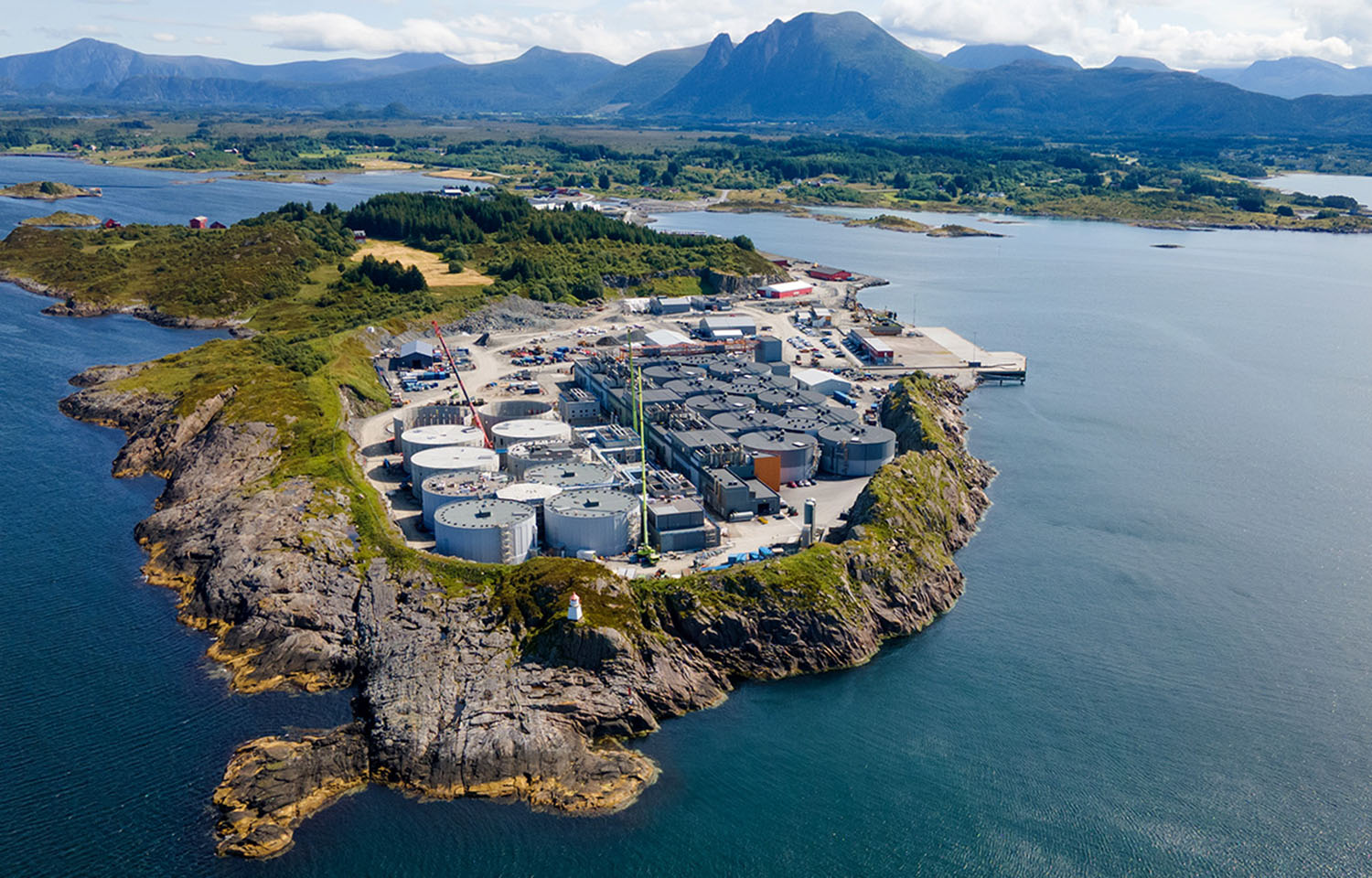
As its current operations continue to set new bests in term of biomass and production, the company is also making strong progress on its next facility at Indre Harøy, Schaug-Pettersen said.
“Momentum at the construction site remained strong throughout the quarter with installation of both intake pipes being a highlight,” he said.
According to Salmon Evolution, the next phase of its construction continues to be on schedule. At the current rate of construction, the next phase will begin housing smolt in 2026. When completed, Phase 2 will add 10,100 MT of head-on gutted salmon, which according to the company will bring the total capacity of the facility to 18,000 MT a year bringing with it significant economies of scale.
“With Phase 2, we are creating a unique operational platform and the first smolt release is only about seven months away,” Schaug-Pettersen said.
