





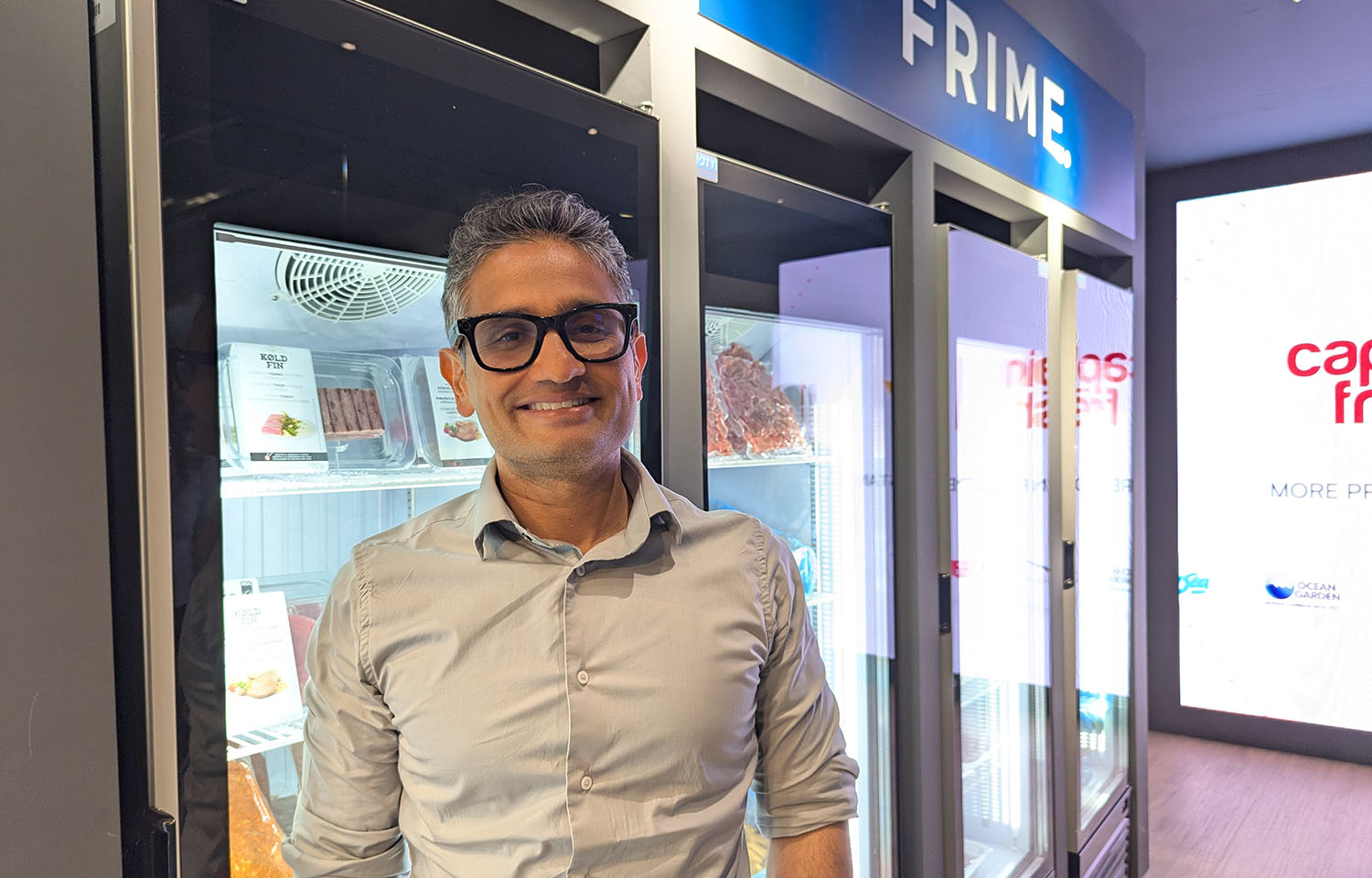
Captain Fresh CEO and Founder Utham Gowda is a self-professed outsider to the seafood industry who now holds the reins of a major player on multiple continents.
Incorporated in June 2020, the supply chain platform has raised billions of dollars and purchased major seafood companies like CenSea in 2024 and Spanish tuna giant Frime in March of this year. The company’s stated mission is to connect the dots across the seafood supply chain from procurement to retail consumers using its online platform.
Gowda, speaking with SeafoodSource during the 2026 Seafood Expo Global – which ran from 21 to 23 April in Barcelona, Spain – said one of his personal missions is a makeover of seafood’s image, which can benefit from his outsider perspective, as a means of unlocking growth for both Captain Fresh and the industry as a whole.
“I come as an outsider into this industry, so when I looked at it as an outsider, what I saw was a product that is excellent. I see the product as almost like nature’s gift, but it’s presented in a very messy manner to the end consumer,” Gowda said. “I saw an opportunity, in that it doesn’t have a rightful place in the consumer stack, simply because as incumbents we haven’t done a good job of presenting it.”
That vision has been the driving force behind Captain Fresh and its many acquisitions, including its recent acquisition of Frime. Gowda said the company’s strategy has hinged on its eventual goal of targeting the end consumer, and it has been working to build a company to do just that.
“In terms of investments, for us, it made a lot of sense to invest in the downstream, and that’s what we’ve done in the last three years,” he said. “We have bought more than 10 brands in strategic pockets of consumers, whether it’s white-cloth restaurants, whether it’s prepared meals, across both sides of the Atlantic.”
Building a distribution engine to supply those simple, high-quality, sustainable protein products has been the first step, and Captain Fresh has deliberately targeted the main consumed species of shrimp, salmon, and tuna. Gowda said it is still looking at more acquisitions in the future, and the company is currently evaluating “something in cephalopods” as the potential next step, along with whitefish, crab, and lobster.
“From a coverage standpoint, we have 60 to 70 percent of the seafood basket and the high-frequency species that are growing,” Gowda said.
With that distribution engine in place comes the next goal of Captain Fresh: simplify seafood for the consumer and capitalize on the product’s inherent quality.
“We want to look at seafood as a superior protein product, rather than playing for a salmon, playing for a shrimp, playing for a tuna, playing for X, Y, Z,” he said. “When you look at the end consumer, they are actually not that bothered about all the details that we lure them in with.”
Gowda said the seafood industry makes origin details or complicated facts a major part of its advertising, which doesn’t help.
“Whether it’s Alaska coho or Norwegian versus Chilean, versus Australian, and that’s just the salmon,” Gowda said.
Other species have even longer lists of jargon and what the end consumer is really looking for is a “simple, high-quality, sustainable protein,” Gowda said.
“When we started this business, we had one of the top consulting outfits do market research for us,” Gowda said. “They came back saying that an average consumer looks at this category as ‘There’s some fish which is white in color, there’s some fish which is pink in color, there’s some fish that smells, there’s some fish that doesn’t smell, there’s some fish that looks like an insect.’ The consumer is at that level.”
Gowda said the industry has frequently overcomplicated things when marketing, not taking into account the realistic level of consumer engagement
“I think this overcomplication has essentially added a lot more details which were not necessary in the first place,” he said.
As a result, Gowda said seafood has become a “laggard” compared to other categories as it relates to innovation due to targeting the wrong ideas when trying to build a market for its products.
“Innovation is like a deficit that has been built over the last 10, 20, 30 years,” Gowda said. “We want to bridge that, and to be able to bridge that, we first needed the foundation that is distribution. This is what we are building now. This is the first floor of the building which we want to build, and on top of this, there is going to be a lot of investments and innovation.”
Building that first floor has involved acquisitions which haven’t played out like many in the industry. Gowda said Captain Fresh has deliberately avoided fully taking over the management of companies as the strategy involves tapping into what made those companies successful in the first place.
“This is a relationship-heavy industry because there is so much of a lack of trust, which manifests itself in terms of relationship densities,” he said. “So, we in the last three years have essentially gone about buying these relationships, buying their reputations. These are reputations which have been around for the last 10 [to] 60 years in some cases.”
Captain Fresh purchases those well-established companies and leaves them alone, he said, while also making sure that those companies have a vested interest in ensuring the success of the wider portfolio.
“All these companies that we are buying, we ensure that there is skin in the game,” Gowda said.
He said Captain Fresh has been successfully acquiring companies in part due to its ability to tap into pools of capital that were previously difficult for seafood companies to get access to, which he called the “hallmark” of its success.
“That equity has truly given us the firepower to be able to execute at the rate we have been executing and continue to execute hopefully at a faster rate,” he said.
Those seafood companies form a management team that can capitalize on the vision in a way that Captain Fresh could not alone, Gowda said.
“At some point, you know that your vision is beyond your execution quality. Once you know that, it’s about putting together different competencies,” he said.
Gowda said the ultimate goal Captain Fresh is hoping to achieve is to become a USD 4 billion to USD 5 billion (EUR 3.4 billion to EUR 4.2 billion) company, which would be roughly 1 percent of the total seafood industry.
“Given all the constraints, that’s a decent point for us to start,” Gowda said.
He acknowledges it’s an ambitious goal, but the underlying fundamentals of the seafood industry are capable of making it happen.
“You’re all so damn lucky to be selling this product. Let’s focus on that,” Gowda said.
