


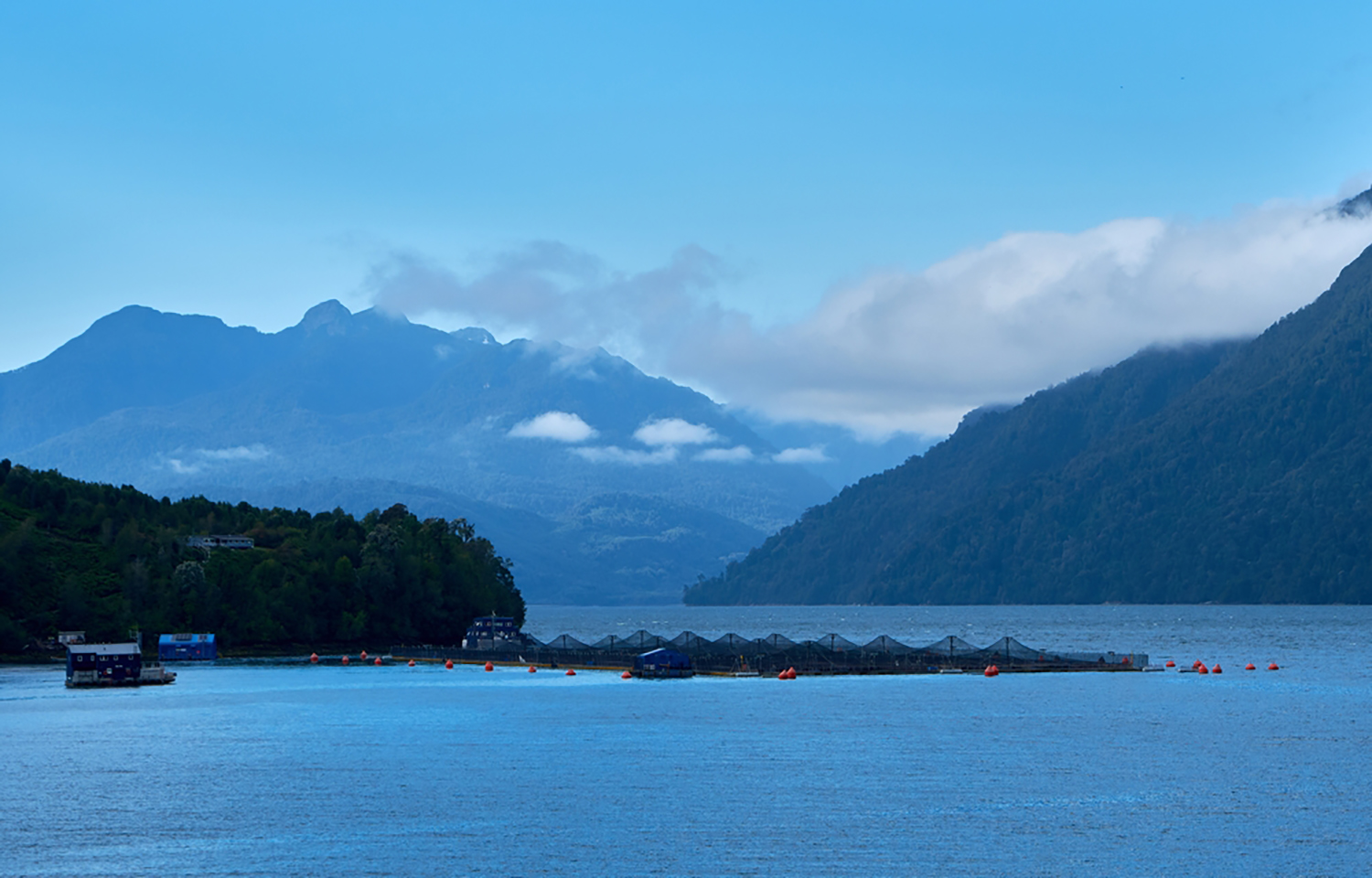
Chile’s Lafkenche Law is holding up an estimated USD 200 million (EUR 181 million) in new salmon-farming investments, according to a study from public advocacy center Pivotes, which warned that the regulation’s application process is causing widespread uncertainty for businesses in Southern Chile.
The Lafkenche Law, formally known as Law 20,249, was enacted in 2008 to recognize and protect the use of coastal marine areas for Indigenous communities, allowing them to obtain administration rights over designated spaces to preserve traditional practices and access to natural resources. Indigenous Peoples’ Coastal Marine Spaces (ECMPOs) are the marine areas designated under the law and are administered by Indigenous communities or associations based on their demonstrated customary use. As soon as an ECMPO is declared admissible, projects originating from outside an Indigenous community are automatically suspended in the area.
According to the Pivotes study, titled “Lafkenche Law: Impacts on Investment and Territorial Development,” shortcomings in the law's implementation have allowed claims covering disproportionately large areas to suspend economic activities for years, even before the customary use underlying the requests has been verified. That bureaucracy, coupled with lengthy processing times, has created a regulatory bottleneck affecting hundreds of investment opportunities, Pivotes said.
As of June 2026, 216,928 hectares of marine space has been defined as an ECMPO, while pending applications cover an additional 2.34 million hectares. The area requested is more than 500 times the combined surface area of Chile's salmon-farming centers, which occupy approximately 4,681 hectares.
The study explained that the legislation does not establish a maximum area for an application or require any relationship between the size of the requested territory and the number of members in the Indigenous community submitting it. Regulations state only that the boundaries should include the area necessary to guarantee customary use.
For instance, based on membership figures provided by Chile’s National Corporation for Indigenous Development (CONADI), the national average is 82 hectares requested per individual. However, of 107 applications analyzed by Pivotes, 52 surpass 100 hectares per person, 23 exceed 500 hectares, and nine top 1,000 hectares per person.
In the latter category, one application in the Chiloé archipelago, submitted by a community of 57 people, covers 248,189 hectares, equivalent to 4,354 hectares per member. Another application submitted by a community of 10 people covers approximately 30,000 hectares.
The study also questioned the criteria for demonstrating customary use as outlined in the law; applicants need to demonstrate only two instances of use within a 10-year period, Pivotes noted.
Additionally, Pivotes emphasized that most of the Southern Chilean coastline is covered by applications that have not yet been verified. It conducted a spatial analysis, overlaying ECMPO application areas with the official coastline mapped by Chile's Military Geographic Institute, and found that 56 percent of the coastline throughout the southern regions of La Araucanía, Los Ríos, and Los Lagos is subject to pending applications. When considering already approved ECMPOs, this increases to approximately 60 percent.
The USD 200 million estimated impact on salmon farming corresponds to 33 applications for aquaculture concessions that have been suspended owing to ECMPO disputes.
However, Pivotes warned that this figure represents only part of the economic impact. Across the nation’s south, 791 applications for projects involving aquaculture, maritime concessions, and management areas remain frozen. The consultancy did not quantify the total investment associated with these applications, but it said it believes the broader economic damage could be significantly greater.
The Pivotes report comes as a reform of the Lafkenche Law is being discussed in Chile's Senate. Though Pivotes said the proposed changes are a step in the right direction, it said they do not go far enough, particularly considering that CRUBC – the authoritative body responsible for approving or rejecting ECMPO applications – would remain largely unchanged.
Los Lagos Senator Fidel Espinoza recognized that whenever an ECMPO application is submitted, it paralyzes economic activities. Therefore, he called for communities to be required to submit management plans when filing applications, rather than waiting until the space has been granted, potentially holding up development for years.
"As it is, this becomes an obstacle to the productive development of our region and to job creation," he said.
Los Lagos Congresswoman Claudia Reyes also called for changes, arguing that the law's legitimate objective of protecting Indigenous communities has been undermined by poor implementation. She called for clear deadlines, proportionate applications, greater institutional capacity at CONADI, and rules that protect Indigenous rights while also safeguarding employment and economic opportunities in Southern Chile.
The salmon-farming industry also backed efforts to modify the legislation.
Outgoing Salmon Council Executive President Loreto Seguel said the study demonstrates how deficiencies in the law's design have turned it into a source of uncertainty and paralysis for Southern Chile, despite its original objective of protecting Indigenous traditions and customary uses.
“When an ECMPO application keeps projects and investments halted for years, not only an industry is affected: Communities, workers, suppliers, and regional economies also lose,” she said, requesting a regulatory framework that reconciles the protection of Indigenous rights and traditions with legal certainty, investment, and regional development.
SalmonChile General Manager Tomás Monge noted that his organization welcomes studies and proposals contributing to the debate over improving the law. He underlined the need for clearer rules, more agile procedures, and stronger legal certainty to allow aquaculture, artisanal fishing, and maritime and port activities to coexist sustainably.
