




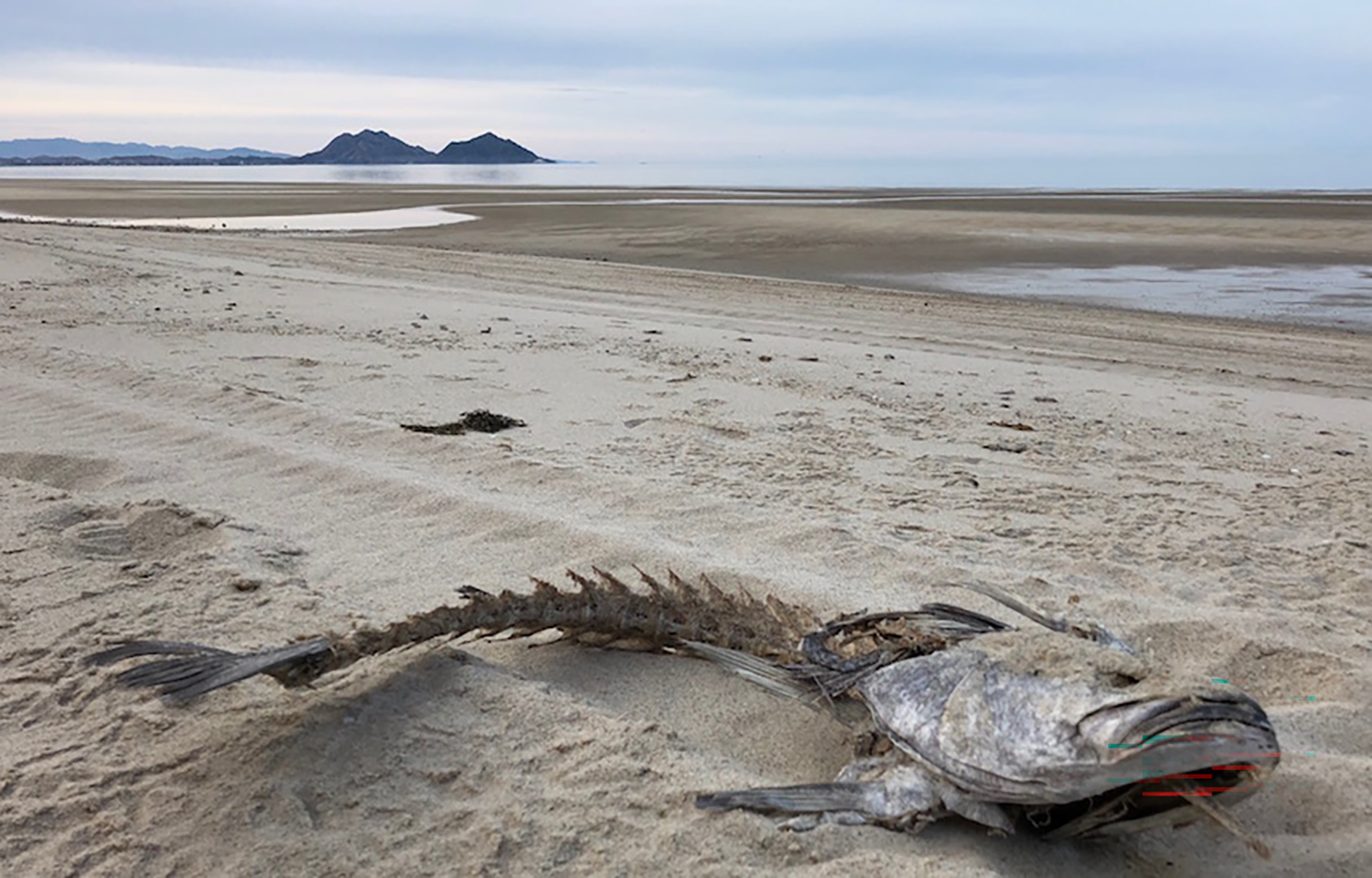
Illegal trade of totoaba – a highly endangered fish endemic to the Gulf of California in Mexico – is intertwined with human smuggling and money laundering, with trafficking networks operating across Mexico, the United States, and China, according to an investigation conducted by Earth League International (ELI), an investigative NGO focusing on environmental crime.
ELI Founder and Executive Director Andrea Crosta said that as part of that investigation, undercover operatives gained close access to a trafficker who sold totoaba swim bladders, which are highly valued illegal marine products traditionally sold to the Chinese market where they are used for traditional medicine, luxury consumption, and as a status symbol. In addition to totoaba trade, the individual also claimed to facilitate human smuggling and large-scale money laundering.
The findings illustrate what Crosta calls “crime convergence,” in which wildlife trafficking operates alongside other forms of organized crime. They also, according to Crosta, point to the growing importance of the U.S. market for totoaba swim bladders.
“What they reveal, again and again, is crime convergence: environmental crime and wildlife trafficking intertwined with drugs, money laundering, and corruption,” Crosta said recently on LinkedIn while introducing his series of case studies based on undercover recordings.
The investigation references Operation FAKE GOLD, an intelligence-gathering initiative launched by ELI in 2017 to investigate totoaba trafficking and its impact on the vaquita, a critically endangered porpoise native to Mexico’s upper Gulf of California. The gillnets used by poachers to catch totoaba can also entangle vaquita; scientists estimate that there are fewer than 10 individual vaquita left in the wild.
Crosta’s case study centers on a person of interest identified as “Mx56,” a Chinese individual fluent in Spanish with connections in both Mexico and the United States. According to ELI, such intermediaries can operate across Chinese diaspora communities, Latin American criminal groups, and U.S. markets, making them valuable connections for transnational trafficking networks.
In recorded conversations with ELI undercover operatives, Mx56 described selling totoaba swim bladders weighing 500 grams for USD 7,500 (EUR 6,700). He said buyers could resell them for USD 9,000 (EUR 8,000), adding that some of his agents had recently sold the product to Chinese buyers in New York for USD 9,500 (EUR 8,500) per bladder.
The trafficker also described dealing in other marine wildlife products, including sea cucumbers from Mexico and Venezuela, abalone from South Africa, and black coral, for which he said he could get a CITES permit, referring to documentation from the Convention on International Trade in Endangered Species of Wild Fauna and Flora that seeks to ensure international trade in wild animals and plants does not threaten their survival. The apparent availability of permits for products such as black coral raises concerns about fraudulent documentation or documentation obtained through corruption being used to make illegally sourced wildlife appear legitimate.
For Crosta, Mx56 showcases how major intermediaries can control several illegal supply chains simultaneously rather than specialize in a single species.
“Brokers like him are the most important players in the entire chain,” Crosta wrote in his analysis, explaining that they control logistics, capture much of the profit, and connect the places where animals are harvested illegally with the customers who ultimately buy them.
Poachers and couriers can be replaced relatively easily, he added, while brokers are more difficult to substitute, making them particularly important targets for law enforcement seeking to dismantle trafficking networks, rather than simply seizing individual shipments or gillnets.
The recorded conversation with Mx56 also suggests that the U.S. is becoming more than a transit point for illegally traded totoaba products.
“For years, the conventional picture had Mexican totoaba crossing into the U.S. on its way to Hong Kong and mainland China. Mx56 describes a different reality: an established, wealthy clientele inside the United States in cities like New York, paying up to USD 9,500 for a single swim bladder,” Crosta said. “The implication for enforcement is significant: U.S. agencies cannot treat this only as a border and export problem. There is a domestic demand market to investigate and a network of wholesalers serving it.”
Mx56 told the undercover operatives that the market had shifted as economic conditions in Hong Kong made it more difficult to sell expensive products there.
“Before, we sent our stuff to Hong Kong, but now expensive stuff like totoaba is hard to sell there because of the bad economy, so we sell it in the U.S.,” he said.
He described shipping products to the U.S. by air cargo and declaring them as different goods.
ELI said other persons of interest in separate investigations had described similar patterns, suggesting that the U.S. has an established customer base for totoaba swim bladders.
At the same time, wildlife trafficking was only one part of Mx56’s reported activities.
In the recorded conversation, he claimed that his network could smuggle hundreds of Chinese nationals into Mexico annually and then move them onward to the U.S. He also offered to obtain genuine Mexican permanent residency within two months for USD 15,000 (EUR 13,300) per person.
While the claims were made by the trafficker and are not independently verified, Crosta said the offer raised concerns about potential corruption within institutions responsible for issuing official documents.
The trafficker also described money laundering as a larger business than human smuggling, claiming that an associate had processed USD 1 billion (EUR 890 million) in a single year.
Crosta identified informal Chinese financial networks, including via systems known as “flying money,” as a mechanism used to settle value across borders without transferring funds through conventional banking channels. He said such networks have become service providers for organized crime, including drug cartels.
For investigators, the implication is that wildlife trafficking can provide a visible entry point into a much larger criminal economy. Seizing illegal marine products is necessary, Crosta said, but stopping investigations there may risk missing the larger picture: financial infrastructure connecting wildlife trafficking, human smuggling, and drug-related crime.
Since launching Operation FAKE GOLD in 2017, ELI has investigated the totoaba supply chain from Mexico’s Baja California peninsula through the U.S. to the Chinese province of Guangdong. The NGO said that under this operation, it has identified 23 transnational totoaba and wildlife trafficking networks operating between Mexico, the U.S., and China, as well as more than 260 persons of interest. Those identified include international traffickers, intermediaries, local politicians, and members of Mexican cartels.
According to ELI, the illegal supply chain begins in coastal communities such as San Felipe and Santa Clara along the Gulf of California. The product then moves through trafficking hubs including Tijuana, Mexicali, and Mexico City and U.S. cities such as San Diego and Los Angeles in California.
ELI said Mexican criminal groups and Chinese trafficking networks collaborate in what the organization calls “totoaba cartels.” Its investigation found that criminal groups finance fishers and fishing cooperatives, sometimes with the complicity of local public officials, before the swim bladders are sold to Chinese traders and moved toward the Chinese market. According to ELI, the profitability of totoaba trafficking, combined with the fact it is considered lower risk than drug trafficking, has helped drive the formation of these networks.
Thanks to Operation FAKE GOLD’s investigation, ELI is able to provide confidential intelligence briefs and updates to U.S. and Mexican authorities to support investigations and efforts to arrest key participants.
The operation has already contributed to high-profile prosecutions.
In May 2023, U.S. authorities arrested international totoaba traffickers near San Diego following a lengthy investigation supported by ELI’s intelligence and technical work. The defendants faced charges related to totoaba swim bladder trade and other protected marine wildlife. In October 2025, both traffickers pled guilty in U.S. court and were cooperating with authorities, ELI reported.
ELI continues to argue that dismantling the middlemen supplying the Chinese market is an essential step, along with efforts to reduce demand for totoaba swim bladders.
Crosta called on law enforcement to follow the criminal networks and the money behind the trade, understanding who connects suppliers to buyers, moves products across borders, and handles the proceeds in an attempt to ultimately disrupt the business sustaining the illegal totoaba market.
